
KNOW THAT THIS chapter is very extensive and there is no lengthier chapter in this book. Allah  willing, I shall mention some concise sentences. If anyone is granted the ability and guidance to act on all of them it will be because of the favour and bounty that Allah has bestowed upon him. Congratulations to him! Anyone who is unable to act on all of them should limit themselves to what is concise, even if it be only one dhikr.
willing, I shall mention some concise sentences. If anyone is granted the ability and guidance to act on all of them it will be because of the favour and bounty that Allah has bestowed upon him. Congratulations to him! Anyone who is unable to act on all of them should limit themselves to what is concise, even if it be only one dhikr.The foundation of this chapter is from the Noble Qur’ān. Allah says: “And celebrate the praise of your Lord before the sun rises and before it sets.” [1].
says: “And celebrate the praise of your Lord before the sun rises and before it sets.” [1].
Allah also says: “And celebrate the praise of your Lord in the evening and in the morning.” [2].
also says: “And celebrate the praise of your Lord in the evening and in the morning.” [2].
Allah says: “And remember your Lord in your soul with fear and humility, and speaking quietly, in the mornings and evenings.” [3].Linguists say that evenings (āṣāl) is the plural of aṣīl, and means the time between ‘Aṣr and Maghrib.
says: “And remember your Lord in your soul with fear and humility, and speaking quietly, in the mornings and evenings.” [3].Linguists say that evenings (āṣāl) is the plural of aṣīl, and means the time between ‘Aṣr and Maghrib.
Allah says: “Do not send away those who call on their Lord morning and evening, seeking His Face.” [4].Linguists say that evening (‘ashī) is the time between the sun’s declination from the meridian up until sunset.
says: “Do not send away those who call on their Lord morning and evening, seeking His Face.” [4].Linguists say that evening (‘ashī) is the time between the sun’s declination from the meridian up until sunset.
Allah says: “In houses which Allah has allowed to be raised, in order that in them His name may be celebrated. In them is He glorified in the morning and in the evening, by men whom neither trading nor selling can distract from the remembrance of Allah.” [5].
says: “In houses which Allah has allowed to be raised, in order that in them His name may be celebrated. In them is He glorified in the morning and in the evening, by men whom neither trading nor selling can distract from the remembrance of Allah.” [5].
Allah also says: “We made the hills extol (Us), in unison with him, at evening and at break of day.” [6].
also says: “We made the hills extol (Us), in unison with him, at evening and at break of day.” [6].
We relate in the Ṣaḥīḥ of al-Bukhārī from Shaddād ibn Aws  , from the Prophet
  who said: “The chief formula for seeking forgiveness is: O Allah, You are my Lord; there is no god but You. You created me and I am Your slave; and I am under Your covenant and pledge [to fulfil it] to the best of my ability. I seek Your protection from the evil that I have done, acknowledging Your favour on me and admitting my sin. So forgive me, for none forgives sins but You. Whoever says it during the day and then passes away before the evening will be one of the people of Paradise. And whoever says it during the night and then passes away before the morning will be one of the people of Paradise.” [7].The meaning of ‘I return’ (abū’u) is ‘I affirm or ‘I acknowledge’.
, from the Prophet who said: “The chief formula for seeking forgiveness is: O Allah, You are my Lord; there is no god but You. You created me and I am Your slave; and I am under Your covenant and pledge [to fulfil it] to the best of my ability. I seek Your protection from the evil that I have done, acknowledging Your favour on me and admitting my sin. So forgive me, for none forgives sins but You. Whoever says it during the day and then passes away before the evening will be one of the people of Paradise. And whoever says it during the night and then passes away before the morning will be one of the people of Paradise.” [7].The meaning of ‘I return’ (abū’u) is ‘I affirm or ‘I acknowledge’.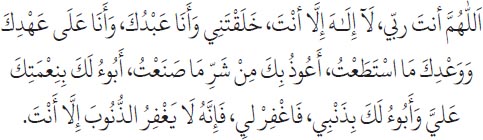
Allāhumma Anta Rabbī, lā ilāha illā Ant, khalaqtanī wa anā ‘abduk, wa anā ‘alā ‘ahdika wa wa‘dika mā’staṭa‘t, a‘ūdhu bika min sharri mā ṣana‘t, abū’u laka bi-ni‘matika ‘alayya wa abū’u laka bi-dhambī, fa-ghfir lī, fa-innahu lā yaghfiru-dh-dhunūba illā Ant.
We relate in the Ṣaḥīḥ of Muslim, from Abū Hurayrah , that the Messenger of Allah said: “If anyone says one hundred times in the morning and in the evening: Glory be to Allah and with His praise, no-one will come up with anything better than what he has produced except for someone who has said the same as he said or added more to it.” [8].In the narration of Abū Dāwūd, it reads: Glory be to Allah the Tremendous and with His praise.
, that the Messenger of Allah said: “If anyone says one hundred times in the morning and in the evening: Glory be to Allah and with His praise, no-one will come up with anything better than what he has produced except for someone who has said the same as he said or added more to it.” [8].In the narration of Abū Dāwūd, it reads: Glory be to Allah the Tremendous and with His praise.
Subḥāna-llāhi-l-‘Aẓīmi wa bi-ḥamdih.
We relate in the Sunans of Abū Dāwūd, at-Tirmidhī, an-Nasā’ī, as well as others, with ṣaḥīḥ isnāds, from ‘Abdullāh ibn Khubayb who narrated: “We went out on a dark and rainy night looking for the Prophet to lead us in ṣalāh. We found him and he said: ‘Speak’ but I did not say anything. Then he said: ‘Speak’ but I did not say anything. Then he said: ‘Speak.’ I asked: ‘O Messenger of Allah , what should I say?’ He replied: ‘Say, “Say: He is Allah, One” and the Mu‘awwidhatayn (Sūrahs 112–114) thrice in the morning and in the evening, and they will suffice for you in everything.’” [9].According to at-Tirmidhī, this hadith is ḥasan ṣaḥīḥ.
who narrated: “We went out on a dark and rainy night looking for the Prophet to lead us in ṣalāh. We found him and he said: ‘Speak’ but I did not say anything. Then he said: ‘Speak’ but I did not say anything. Then he said: ‘Speak.’ I asked: ‘O Messenger of Allah , what should I say?’ He replied: ‘Say, “Say: He is Allah, One” and the Mu‘awwidhatayn (Sūrahs 112–114) thrice in the morning and in the evening, and they will suffice for you in everything.’” [9].According to at-Tirmidhī, this hadith is ḥasan ṣaḥīḥ.And we relate from the Sunans of Abū Dāwūd, at-Tirmidhī, Ibn Mājah and others, with ṣaḥīḥ isnāds, from Abū Hurayrah who reported that when the Messenger of Allah woke up he used to say: “O Allah, by You we have woken up in the morning and by You we have met the evening, by You we live and by You we die, and to You is the Resurrection”; and in the evening he said, “O Allah, by You we have seen evening come, by You we live and by You we die; and to You is the Resurrection.” [10].According to at-Tirmidhī, this is a ḥasan hadith.
who reported that when the Messenger of Allah woke up he used to say: “O Allah, by You we have woken up in the morning and by You we have met the evening, by You we live and by You we die, and to You is the Resurrection”; and in the evening he said, “O Allah, by You we have seen evening come, by You we live and by You we die; and to You is the Resurrection.” [10].According to at-Tirmidhī, this is a ḥasan hadith.
Allāhumma bika aṣbaḥnā, wa bika amsaynā, wa bika naḥyā, wa bika namūt, wa ilayka-n-nushūr. Allāhumma bika amsaynā, wa bika naḥyā, wa bika namūt, wa ilayka-n-nushūr.
We relate in the Ṣaḥīḥ of Muslim from Abū Hurayrah who reported that when the Messenger of Allah was on a journey he used to say in the last part of the night: “May a listener hear the praise of Allah and hear about His good favour towards us. O Lord, accompany us and confer Your bounty upon us. We seek the protection of Allah from Hell-Fire.” [11].
who reported that when the Messenger of Allah was on a journey he used to say in the last part of the night: “May a listener hear the praise of Allah and hear about His good favour towards us. O Lord, accompany us and confer Your bounty upon us. We seek the protection of Allah from Hell-Fire.” [11].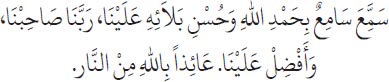
Samma‘a sāmi‘un bi-ḥamdi-llāhi wa ḥusni balā’ihi ‘alaynā, Rabbanā ṣāḥibnā, wa afḍil ‘alaynā, ‘ā‘idhan bi-llāhi min an-Nār.
Al-Qādī ‘Iyāḍ, and the author of al-Maṭāli‘, and others say that samma‘a with an a on a doubled mīm means: “May whoever hears convey my words to others”, exhorting them to do dhikr before dawn and to make du‘ā’.
According to al-Khaṭṭābī and some others, the verb sami‘a has an i on the un-doubled letter mīm. Imam Abū Sulaymān al-Khaṭṭābī said that ‘sami‘a sāmi‘un’ (‘a listener hears’) means ‘shahida shāhidun’ (‘a witness witnesses’) and its real meaning is: “Let the listener listen and the onlooker witness our praise of Allah Most High for His blessing and His good favour.”
And we relate from the Ṣaḥīḥ of Muslim from ‘Abdullāh ibn Mas‘ūd who reported that when it became evening the Messenger of Allah used to say: “We have seen evening come and the Kingdom belongs to Allah this evening. Praise be to Allah. There is no god but Allah alone without partner.” The narrator said: I believe he said: “His is the kingdom and His is the praise, and He has power over all things. O my Lord, I ask You for the good that is in this night and the good that comes after it. O my Lord, I ask Your protection from the evil that is in this night and the evil that comes after it. I seek Your protection from laziness, senility and the harm of old age. [Lord] I seek Your protection from punishment in Hell-Fire and punishment in the grave.” When he got up in the morning he also said: “We have seen morning come, and the Kingdom belongs to Allah this morning.” [12].
who reported that when it became evening the Messenger of Allah used to say: “We have seen evening come and the Kingdom belongs to Allah this evening. Praise be to Allah. There is no god but Allah alone without partner.” The narrator said: I believe he said: “His is the kingdom and His is the praise, and He has power over all things. O my Lord, I ask You for the good that is in this night and the good that comes after it. O my Lord, I ask Your protection from the evil that is in this night and the evil that comes after it. I seek Your protection from laziness, senility and the harm of old age. [Lord] I seek Your protection from punishment in Hell-Fire and punishment in the grave.” When he got up in the morning he also said: “We have seen morning come, and the Kingdom belongs to Allah this morning.” [12].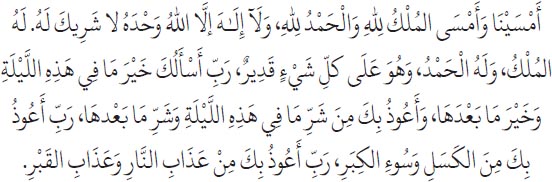
Amsaynā wa amsā-l-mulku li-llāhi wa-l-ḥamdu li-llāh, wa lā ilāha illa-llāhu waḥdahu lā sharīka lah, lahu-l-mulk, wa lahu-l-ḥamd, wa Huwa ‘alā kulli shay’in Qadīr. As’aluka khayra mā fī hādhihi-l-laylati wa khayra mā ba‘dahā, wa a‘ūdhu bika min sharri mā fī hādhihi-l-laylati wa sharri mā ba‘dahā. Rabbi a‘ūdhu bika min al-kasali wa sū’i-l-kibar. Rabbi a‘ūdhu bika min ‘adhābi-n-Nāri wa ‘adhābi-l-qabr.
Aṣbaḥnā wa aṣbaḥa-l-mulku li-llāhi. . .
We relate from Ṣaḥīḥ Muslim from Abū Hurayrah who narrated that a man came to the Messenger of Allah and said: “Messenger of Allah , what I have endured from the scorpion that stung me yesterday!” He replied: “If you had said in the evening: I seek protection in the perfect words of Allah from the evil that He created, it would not have harmed you.” Muslim narrated this with a continuous chain from a hadith reported by Khawlah bint Ḥakīm. And we relate from the book of Ibn as-Sunnī, who said in it: “Say three times ‘I seek refuge in the perfect words of Allah from the evil He has created’ and you will not be harmed.” [13].
who narrated that a man came to the Messenger of Allah and said: “Messenger of Allah , what I have endured from the scorpion that stung me yesterday!” He replied: “If you had said in the evening: I seek protection in the perfect words of Allah from the evil that He created, it would not have harmed you.” Muslim narrated this with a continuous chain from a hadith reported by Khawlah bint Ḥakīm. And we relate from the book of Ibn as-Sunnī, who said in it: “Say three times ‘I seek refuge in the perfect words of Allah from the evil He has created’ and you will not be harmed.” [13].
A‘ūdhu bi-kalimāti-llāhi-t-tāmmāti min sharri mā khalaq.
We relate with a ṣaḥīḥ isnād in the Sunans of Abū Dāwūd and at-Tirmidhī that Abū Hurayrah reported that Abū Bakr aṣ-Ṣiddīq once said: “Messenger of Allah, instruct me with some words to say in the morning and in the evening.” He replied: “Say: O Allah, Creator of the heavens and the earth, Knower of the Unseen and the Seen, Lord and Sovereign of all things, I bear witness that there is no god but You. I seek refuge with You from the evil of my soul and the evil and polytheism of Shayṭān.” He continued: “Say this when you get up in the morning and in the evening and when you go to bed.” [14].At-Tirmidhī described this as a ḥasan ṣaḥīḥ hadith.
reported that Abū Bakr aṣ-Ṣiddīq once said: “Messenger of Allah, instruct me with some words to say in the morning and in the evening.” He replied: “Say: O Allah, Creator of the heavens and the earth, Knower of the Unseen and the Seen, Lord and Sovereign of all things, I bear witness that there is no god but You. I seek refuge with You from the evil of my soul and the evil and polytheism of Shayṭān.” He continued: “Say this when you get up in the morning and in the evening and when you go to bed.” [14].At-Tirmidhī described this as a ḥasan ṣaḥīḥ hadith.
Allāhumma Fāṭira-s-samāwāti wa-l-arḍ, ‘Ālima-l-ghaybi wa-sh-shahāda, Rabba kulli shay’in wa Malīkah, ashhadu an lā ilāha illā Ant, a‘ūdhu bika min sharri nafsī wa min sharri-sh-Shayṭāni wa shirkih.
We also relate something similar from the Sunan of Abū Dāwūd, in the narration of Abū Mālik al-Ash‘arī who related that people said: “Messenger of Allah , teach us some words to say in the morning and in the evening when we go to bed. . ..” He mentioned [what was said in the previous] hadith and added, after “his polytheism”: “Or that we should inflict evil upon ourselves or bring evil upon a Muslim.” [15].
who related that people said: “Messenger of Allah , teach us some words to say in the morning and in the evening when we go to bed. . ..” He mentioned [what was said in the previous] hadith and added, after “his polytheism”: “Or that we should inflict evil upon ourselves or bring evil upon a Muslim.” [15].
Wa an naqtarifa sū’an ‘alā anfusinā aw najurrahu ilā muslim.
His words “And his polytheism” (wa shirkihi) are related in two ways. The clearer and more obvious of the two is with kasrah on the letter shīn and a silent vowel on the letter rā’ in the sense of ‘ishrāk’ (association); this means the associating others with Allah Most High which he calls one to or insinuates. The second is ‘sharakihi’ with fatḥah on the letters shīn and rā’, which means ‘his snares and traps’ (ḥabā’ilihi wa maṣā’idihi). The singular form is sharakah with fatḥah on the letters shīn and rā’ and hā’ as the last letter.
“And his polytheism” (wa shirkihi) are related in two ways. The clearer and more obvious of the two is with kasrah on the letter shīn and a silent vowel on the letter rā’ in the sense of ‘ishrāk’ (association); this means the associating others with Allah Most High which he calls one to or insinuates. The second is ‘sharakihi’ with fatḥah on the letters shīn and rā’, which means ‘his snares and traps’ (ḥabā’ilihi wa maṣā’idihi). The singular form is sharakah with fatḥah on the letters shīn and rā’ and hā’ as the last letter.And we relate from the Sunans of Abū Dāwūd and at-Tirmidhī from ‘Uthmān ibn ‘Affān who reported that the Messenger of Allah said: “If one says thrice every morning and every evening: In the name of Allah, against Whose name nothing on the earth or in the heavens can do harm; and He is the All-Hearing, the All-Knowing, nothing will harm him.” [16].According to at-Tirmidhī, this hadith is ḥasan ṣaḥīḥ. The above hadith is in at-Tirmidhī’s wording. Abū Dāwūd’s narration reads ‘and he will not be afflicted by sudden tribulation’.
who reported that the Messenger of Allah said: “If one says thrice every morning and every evening: In the name of Allah, against Whose name nothing on the earth or in the heavens can do harm; and He is the All-Hearing, the All-Knowing, nothing will harm him.” [16].According to at-Tirmidhī, this hadith is ḥasan ṣaḥīḥ. The above hadith is in at-Tirmidhī’s wording. Abū Dāwūd’s narration reads ‘and he will not be afflicted by sudden tribulation’.
Bismi-llāhi-lladhī lā yaḍurru ma‘ ismihih shay’un fī-l-arḍi wa lā fī-s-samā’i, wa Huwa-s-Samī‘u-l-‘Alīm.
We relate in the book of at-Tirmidhī that Thawbān reported that the Messenger of Allah said: “If a person says in the evening: I am pleased with Allah as Lord, with Islam as religion and with Muḥammad as Prophet, it will be an obligation for Allah to make him happy and pleased.” [17].Its isnād includes Sa‘īd ibn al-Marzubān Abū Sa‘d al-Baqqāl—with bā’—of Kūfa, who was the freed slave of Ḥudhayfah ibn al-Yamān and who is considered a weak narrator by all the major memorisers and authorities. At-Tirmidhī, however, considered this to be a ḥasan ṣaḥīḥ hadith which is unusual in this narration; so perhaps it was ṣaḥīḥ in his view from another narration.
reported that the Messenger of Allah said: “If a person says in the evening: I am pleased with Allah as Lord, with Islam as religion and with Muḥammad as Prophet, it will be an obligation for Allah to make him happy and pleased.” [17].Its isnād includes Sa‘īd ibn al-Marzubān Abū Sa‘d al-Baqqāl—with bā’—of Kūfa, who was the freed slave of Ḥudhayfah ibn al-Yamān and who is considered a weak narrator by all the major memorisers and authorities. At-Tirmidhī, however, considered this to be a ḥasan ṣaḥīḥ hadith which is unusual in this narration; so perhaps it was ṣaḥīḥ in his view from another narration.
Raḍītu bi-llāhi Rabbā, wa bi-l-Islāmi dīnā, wa bi-Muḥammadin—ṣalla-llāhu ‘alayhi wa-sallam—Nabiyyā.
Abū Dāwūd and an-Nasā’ī narrated the same hadith with a good isnād from a man who served the Prophet , from the Prophet with the same wording. The sound basis of the hadith is thus assured, praise be to Allah.
, from the Prophet with the same wording. The sound basis of the hadith is thus assured, praise be to Allah.Al-Ḥākim Abū ‘Abdullāh states in al-Mustadrak ‘ala-ṣ-Ṣaḥīḥayn that the isnād of this hadith is ṣaḥīḥ.
A different version of Abū Dāwūd and others has the wording: “And with Muḥammad as Messenger”; and at-Tirmidhī’s version has “As Prophet”. It is preferable to combine the two narrations and so to say: “As Prophet and Messenger”. If one does restrict himself to only one of the narrations, he will have acted according to the hadith.
We relate in the Sunan of Abū Dāwūd, with a good isnād which he did not consider weak, that Anas reported that the Messenger of Allah said: “Whenever a person says in the morning or the evening: O Allah, I have arisen calling on You to witness and calling on the bearers of Your Throne and Your angels and all of Your Creation to witness that You are Allah, there is no god but You, and Muḥammad is Your slave and Messenger, Allah will liberate one quarter of him from Hell-Fire. If he says it twice, Allah will liberate half of him from Hell-Fire. If he says it thrice, Allah will free three quarters of him from Hell-Fire. It he says it four times Allah will liberate all of him from Hell-Fire.” [18].
reported that the Messenger of Allah said: “Whenever a person says in the morning or the evening: O Allah, I have arisen calling on You to witness and calling on the bearers of Your Throne and Your angels and all of Your Creation to witness that You are Allah, there is no god but You, and Muḥammad is Your slave and Messenger, Allah will liberate one quarter of him from Hell-Fire. If he says it twice, Allah will liberate half of him from Hell-Fire. If he says it thrice, Allah will free three quarters of him from Hell-Fire. It he says it four times Allah will liberate all of him from Hell-Fire.” [18].
Allāhumma innī aṣbaḥtu ushhiduka wa ushhidu ḥamalata ‘arshika wa malā’ikataka wa jamī‘a khalqika annaka Anta-llāhu lā ilāha illā Ant, wa anna Muḥammadan ‘abduka wa Rasūluk.
We relate in the Sunan of Abū Dāwūd with a good isnād which he did not consider weak from ‘Abdallāh ibn Ghannām—with ghayn and a doubled nūn—al-Bayāḍī , a Companion, who reported that the Messenger of Allah said: “If one says in the morning: ‘O Allah, all the favours that I have received in the morning are from You Alone; You have no partner. To You belong all praise and all thanks,’ then he has fulfilled the thanks [that are due] for that day. If he says it in the evening, then he has fulfilled the thanks [that are due] that night.” [19].
, a Companion, who reported that the Messenger of Allah said: “If one says in the morning: ‘O Allah, all the favours that I have received in the morning are from You Alone; You have no partner. To You belong all praise and all thanks,’ then he has fulfilled the thanks [that are due] for that day. If he says it in the evening, then he has fulfilled the thanks [that are due] that night.” [19].
Allāhumma mā aṣbaḥa bī min ni‘matin fa-minka waḥdaka lā sharīka lak, fa-laka-l-ḥamd, wa laka-sh-shukr.
And we relate with ṣaḥīḥ isnāds from the Sunans of Abū Dāwūd, an-Nasā’ī and Ibn Mājah from Ibn ‘Umar , who said that the Prophet never failed to say these words when he got up in the morning or in the evening: “O Allah, I ask You for well-being in this world and in the Hereafter. O Allah, I ask You for forgiveness and well-being in my religion, my worldly life, and my family and wealth. O Allah, hide my faults and grant me security from my fears. O Allah, protect me from what is in front of me and from what is behind me, and from what is to my right and my left and above me. I seek Your protection in Your Vastness from being misled from below me.” [20].According to al-Wakī‘, this last phrase refers to ‘shame’ (al-khasf). According to al-Ḥākim Abū ‘Abdullāh, this is a hadith with a ṣaḥīḥ isnād.
, who said that the Prophet never failed to say these words when he got up in the morning or in the evening: “O Allah, I ask You for well-being in this world and in the Hereafter. O Allah, I ask You for forgiveness and well-being in my religion, my worldly life, and my family and wealth. O Allah, hide my faults and grant me security from my fears. O Allah, protect me from what is in front of me and from what is behind me, and from what is to my right and my left and above me. I seek Your protection in Your Vastness from being misled from below me.” [20].According to al-Wakī‘, this last phrase refers to ‘shame’ (al-khasf). According to al-Ḥākim Abū ‘Abdullāh, this is a hadith with a ṣaḥīḥ isnād.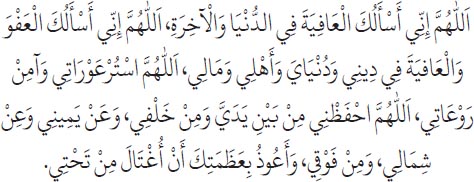
Allāhumma innī as’aluka-l-‘āfiyata fi-d-dunyā wa-l-ākhirah, Allāhumma innī as’aluka-l-‘afwa-l-‘āfiyata fī dīnī wa dunyāya wa ahlī wa mālī, Allāhumma-stur ‘awrātī wa āmin raw‘ātī, Allāhumma-ḥfaẓnī min bayni yadayya wa min khalfī, wa ‘an yamīnī wa ‘an shimālī, wa min fawqī, wa a‘ūdhu bi-‘aẓamatika an ughtāla min taḥtī.
We relate in the Sunans of Abū Dāwūd, an-Nasā’ī and others, with a ṣaḥīḥ isnād from ‘Alī , that the Messenger of Allah said, when it was time to go to bed: “O Allah, I seek protection by Your Noble Countenance and by Your Perfect Words from the evil of all those whom You hold by the forelock. O Allah, You Alone remove debt and sin. O Allah, Your army is not defeated and Your promise is never broken. The power of the mighty does not avail him against You. Glory be to You, Allah, and to You belongs all praise.” [21].
, that the Messenger of Allah said, when it was time to go to bed: “O Allah, I seek protection by Your Noble Countenance and by Your Perfect Words from the evil of all those whom You hold by the forelock. O Allah, You Alone remove debt and sin. O Allah, Your army is not defeated and Your promise is never broken. The power of the mighty does not avail him against You. Glory be to You, Allah, and to You belongs all praise.” [21].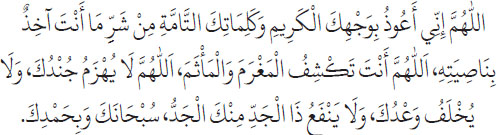
Allāhumma innī a‘ūdhu bi-wajhika-l-karīmi wa kalimātika-t-tāmmati min sharri mā Anta ākhidhun bi-nāṣiyatih, Allāhumma Anta takshifu-l-maghrama wa-l-ma’tham, Allāhumma lā yuhzamu junduk, wa lā yukhlafu wa‘duka, wa lā yanfa‘u dha-l-jaddi minka-l-jadd. Subḥānaka wa bi-ḥamdik.
And we relate from the Sunans of Abū Dāwūd and Ibn Mājah with excellent isnāds from Abū ‘Ayyāsh—with a shīn—, who reported that the Messenger of Allah said: “Whoever says in the morning: There is no god but Allah. He is One and has no partner. To Him belongs sovereignty and to Him belongs all praise, and He has power over all things will receive a reward like that given for freeing a slave who is of the progeny of Ismā‘īl, ten good deeds will be written for him, ten of his sins will be expunged, ten stages will be raised for him and it will be a protection for him from Shayṭān until the evening. If he says it in the evening, he will have the same until the morning.” [22].
, who reported that the Messenger of Allah said: “Whoever says in the morning: There is no god but Allah. He is One and has no partner. To Him belongs sovereignty and to Him belongs all praise, and He has power over all things will receive a reward like that given for freeing a slave who is of the progeny of Ismā‘īl, ten good deeds will be written for him, ten of his sins will be expunged, ten stages will be raised for him and it will be a protection for him from Shayṭān until the evening. If he says it in the evening, he will have the same until the morning.” [22].
Lā ilāha illa-llāh, Waḥdahu lā sharīka lah, lahu-l-mulk, wa lahu-l-ḥamd, wa Huwa ‘alā kulli shay’in qadīr.
And we relate from the Sunan of Abū Dāwūd, with an isnād that he did not consider weak, from Abū Mālik al-Ash‘arī who reported that the Messenger of Allah said: “When any of you get up in the morning, let him say: We have risen in the morning and the Kingdom this morning belongs to Allah, Lord of the Worlds. O Allah, I ask You for the good of this day, its victory, its assistance, its light, its blessings and its guidance. And I seek Your protection from the evil that is in it and the evil that is after it.” [23].Then in the evening he should say the same.
who reported that the Messenger of Allah said: “When any of you get up in the morning, let him say: We have risen in the morning and the Kingdom this morning belongs to Allah, Lord of the Worlds. O Allah, I ask You for the good of this day, its victory, its assistance, its light, its blessings and its guidance. And I seek Your protection from the evil that is in it and the evil that is after it.” [23].Then in the evening he should say the same.
Aṣbaḥnā wa aṣbaḥa-l-mulku li-llāhi Rabbi-l-‘ālamīn, Allāhumma innī as’aluka khayra hādha-l-yawmi fatḥahu wa naṣrahu wa nūrahu wa barakatahu wa hudāh, wa a‘ūdhu bika min sharri mā fīhi wa sharri mā ba‘dah.
And we relate from the Sunan of Abū Dāwūd from ‘Abd ar-Raḥmān ibn Abī Bakrah , who said to his father: “Dear father, I hear you supplicating every morning: ‘O Allah, give me health in my body, O Allah, give me health in my hearing, Allah, give me health in my sight. O Allah, I seek protection in You from disbelief and poverty. O Allah, I seek protection in You from punishment in the grave. There is no god but You.’ You repeat it thrice in the morning and thrice in the evening.” He said: “I heard the Messenger of Allah making these supplications and I love to follow his Sunnah.” [24].
, who said to his father: “Dear father, I hear you supplicating every morning: ‘O Allah, give me health in my body, O Allah, give me health in my hearing, Allah, give me health in my sight. O Allah, I seek protection in You from disbelief and poverty. O Allah, I seek protection in You from punishment in the grave. There is no god but You.’ You repeat it thrice in the morning and thrice in the evening.” He said: “I heard the Messenger of Allah making these supplications and I love to follow his Sunnah.” [24].
Allāhumma ‘āfinī fī badanī, Allāhumma ‘āfinī fī sam‘ī, Allāhumma ‘āfinī fī baṣarī, Allāhumma innī a‘ūdhu bika min al-kufri wa-l-faqr, Allāhumma innī a‘ūdhu bika min ‘adhābi-l-qabr, lā ilāha illā Ant.
And we relate from the Sunan of Abū Dāwūd from Ibn ‘Abbās from the Messenger of Allah who said: “Whoever says in the morning: ‘So glory be to Allah when you reach evening and when you rise in the morning; and to Him be praise, in the heavens and on Earth, and at eventide and at noontide. He brings out the living from the dead, and brings out the dead from the living. And He gives life to the earth after it is dead; and thus shall you be brought back out [from the dead]’ [25].will attain what he may have lost in that day. Whoever says it in the evening will attain all that he may have missed that night.” [26].Abū Dāwūd did not consider the narration weak but al-Bukhārī did so in his Tārīkh as well as in his book Kitāb aḍ-ḍu‘afā’.
from the Messenger of Allah who said: “Whoever says in the morning: ‘So glory be to Allah when you reach evening and when you rise in the morning; and to Him be praise, in the heavens and on Earth, and at eventide and at noontide. He brings out the living from the dead, and brings out the dead from the living. And He gives life to the earth after it is dead; and thus shall you be brought back out [from the dead]’ [25].will attain what he may have lost in that day. Whoever says it in the evening will attain all that he may have missed that night.” [26].Abū Dāwūd did not consider the narration weak but al-Bukhārī did so in his Tārīkh as well as in his book Kitāb aḍ-ḍu‘afā’.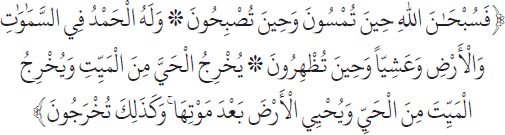
Fa-Subḥāna-llāhi ḥīna tumsūna wa ḥīna tuṣbiḥūn, wa lahu-l-ḥamdu fi-s-samāwāti wa-l-arḍi wa ‘ashiyyan wa ḥīna tuẓhirūn, yukhriju-l-ḥayya min al-mayyiti wa yukhriju-l-mayyita mina-l-ḥayyi wa yuḥyi-l-arḍa ba‘da mawtihā, wa kadhālika tukhrajūn.
We relate in the Sunan of Abū Dāwūd who reported that one of the daughters  of the Messenger of Allah said that the Prophet taught them: “Say when you get up in the morning: Glory be to Allah and with His praise. There is no power and no strength except with Allah. What Allah wills shall be and what He does not will shall not be. I know that Allah has power over all things and that Allah encompasses everything in His knowledge. [27].Whoever says this in the morning will be protected until the evening, and whoever says it in the evening will be protected until the morning.”
of the Messenger of Allah said that the Prophet taught them: “Say when you get up in the morning: Glory be to Allah and with His praise. There is no power and no strength except with Allah. What Allah wills shall be and what He does not will shall not be. I know that Allah has power over all things and that Allah encompasses everything in His knowledge. [27].Whoever says this in the morning will be protected until the evening, and whoever says it in the evening will be protected until the morning.”
Subḥāna-llāhi wa bi-ḥamdihi, lā ḥawla wa lā quwwata illā bi-llāhi, Mā shā’a-llahu kāna wa mā lam yashā’ lam yakun, a‘lamu anna-llāha ‘alā kulli shay’in qadīr, wa anna-llāha qad aḥāṭa bi-kulli shay’in ‘ilmā.
We relate again from the Sunan of Abū Dāwūd, that Abū Sa‘īd al-Khudrī reported that the Messenger of Allah entered the mosque one day and found there Abū Umāmah, one of the Anṣār. He asked: “Abū Umāmah, why do I see you sitting in the mosque when it is not time for ṣalāh?” He replied: “Worries that cling to me and debts, Messenger of Allah.” He said: “Should I not teach a expression which, if you say it, will cause Allah to take away your worries and remove your debt?” He answered: “Yes, Messenger of Allah.” He said: “Say morning and evening: O Allah, I seek Your protection from worries and grief. I seek Your protection from feebleness and laziness; I seek Your protection from cowardice and avarice; and I seek Your protection from the oppression of debts and the tyranny of men.” Abū Umāmah said: “I did so, and Allah removed my worries and concerns and settled my debts.” [28].
reported that the Messenger of Allah entered the mosque one day and found there Abū Umāmah, one of the Anṣār. He asked: “Abū Umāmah, why do I see you sitting in the mosque when it is not time for ṣalāh?” He replied: “Worries that cling to me and debts, Messenger of Allah.” He said: “Should I not teach a expression which, if you say it, will cause Allah to take away your worries and remove your debt?” He answered: “Yes, Messenger of Allah.” He said: “Say morning and evening: O Allah, I seek Your protection from worries and grief. I seek Your protection from feebleness and laziness; I seek Your protection from cowardice and avarice; and I seek Your protection from the oppression of debts and the tyranny of men.” Abū Umāmah said: “I did so, and Allah removed my worries and concerns and settled my debts.” [28].
Allāhumma innī a‘ūdhu bika min al-hammi wa-l-ḥazan, wa a‘ūdhu bika min al-‘ajzi wa-l-kasal, wa a‘ūdhu bika min al-jubni wa-l-bukhl, wa a‘ūdhu bika min ghalabati-d-dayni wa qahri-r-rijāl.
And we relate from the book of Ibn as-Sunnī with a ṣaḥīḥ isnād from ‘Abdullāh ibn Abzī , who reported that the Messenger of Allah said in the morning: “We have woken up in the natural disposition of Islam, and following words of sincerity, and in the religion of our Prophet Muḥammad and following the way of our father Ibrāhīm  , a man by nature upright and a Muslim; and who was not one of the idolaters.” [29].
, who reported that the Messenger of Allah said in the morning: “We have woken up in the natural disposition of Islam, and following words of sincerity, and in the religion of our Prophet Muḥammad and following the way of our father Ibrāhīm , a man by nature upright and a Muslim; and who was not one of the idolaters.” [29].I say: Thus it is in [Ibn as-Sunnī’s] book “And the religion of our Prophet Muhammad ” and this is not impossible. Perhaps he said it aloud so that someone else could hear it and learn it. But Allah knows best.
” and this is not impossible. Perhaps he said it aloud so that someone else could hear it and learn it. But Allah knows best.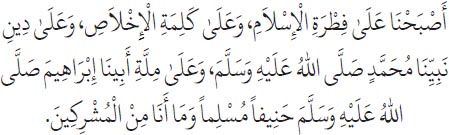
Aṣbaḥnā ‘alā fiṭrati-l-Islām, wa ‘alā kalimati-l-ikhlāṣ, wa ‘alā dīnī Nabiyyinā Muḥammadin ṣalla-llāhu ‘alayhi wa sallam, wa ‘alā millati abīnā Ibrāhīma ṣalla-llāhu ‘alayhi wa sallama ḥanīfan, Musliman, wa mā kāna min al-mushrikīn.
And we relate from the book of Ibn as-Sunnī from ‘Abdullāh ibn Abī Awfā  who narrated that the Messenger of Allah used to say in the morning: “We have woken up this morning and the Kingdom belongs to Allah this morning. Praise be to Allah. Grandeur and Majesty belong to Allah. The Creation and the Command, night and day and all that lives in them belong to Allah, Most High. O Allah, make the first part of this day righteousness, the middle of it success and the end of it prosperity, O Most Merciful of those who show mercy.” [30].
who narrated that the Messenger of Allah used to say in the morning: “We have woken up this morning and the Kingdom belongs to Allah this morning. Praise be to Allah. Grandeur and Majesty belong to Allah. The Creation and the Command, night and day and all that lives in them belong to Allah, Most High. O Allah, make the first part of this day righteousness, the middle of it success and the end of it prosperity, O Most Merciful of those who show mercy.” [30].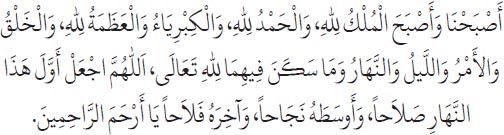
Aṣbaḥnā wa aṣbaḥa-l-mulku li-llāh, wa-l-ḥamdu li-llāh, wa-l-kibriyā’u wa-l-‘aẓamatu li-llāh, wa-l-khalqu wa-l-amru wa-l-laylu wa-n-nahāru wa mā sakana fīhimā li-llāhi ta‘ālā. Allāhumma-j‘al awwala hādhā-n-nahāri ṣalāḥā, wa awsaṭahu najāḥā, wa ākhirahu falāḥan yā Arḥama-r-rāḥimīn.
We relate in the books of at-Tirmidhī and Ibn as-Sunnī with an isnād that has weakness in it, from Maqāl ibn Yasār who reported that the Messenger of Allah said: “If anyone says thrice when he wakes up: I seek protection in Allah, the All-Hearing, the All-Knowing from Shayṭān the rejected, and then recites three verses from Sūrat al-Ḥashr, Allah will appoint seventy thousand angels to pray for him until the evening. If he dies that day, he will die as a shahīd [31].. Whoever says it in the evening will also have that status [should he die].”
said: “If anyone says thrice when he wakes up: I seek protection in Allah, the All-Hearing, the All-Knowing from Shayṭān the rejected, and then recites three verses from Sūrat al-Ḥashr, Allah will appoint seventy thousand angels to pray for him until the evening. If he dies that day, he will die as a shahīd [31].. Whoever says it in the evening will also have that status [should he die].”
A‘ūdhu bi-llāhi-s-Samī‘i-l-‘Alīmi mina-sh-Shayṭāni-r-rajīm.
And we relate from the book of Ibn as-Sunnī from Muḥammad ibn Ibrāhīm from his father who said: “The Messenger of Allah sent us out on an expedition and instructed us to recite in the morning and evening: ‘Did you suppose, then, that We had created you in jest?’ [32].We recited it, and we won booty and were safe.” [33].
who said: “The Messenger of Allah sent us out on an expedition and instructed us to recite in the morning and evening: ‘Did you suppose, then, that We had created you in jest?’ [32].We recited it, and we won booty and were safe.” [33].
A-faḥasibtum annamā khalaqnākum ‘abathan. . .
And we relate from Anas that the Messenger of Allah would say these supplications in the morning and the evening: “O Allah, I ask You for unexpected good and I seek Your protection from unexpected evil.” [34].
that the Messenger of Allah would say these supplications in the morning and the evening: “O Allah, I ask You for unexpected good and I seek Your protection from unexpected evil.” [34].
Allāhumma as’aluka min fujā’ati-l-khayr, wa a‘ūdhu bika min fujā’ati-sh-sharr.
We also relate from (the book of Ibn as-Sunnī) from Anas that the Messenger of Allah asked Fāṭimah : “What prevents you from hearing what I advise you to do? Say in the morning and in the evening: ‘O Living and Everlasting, from You I seek help. Set right all my affairs and do not entrust me to myself for the blink of an eye.’” [35].
that the Messenger of Allah asked Fāṭimah : “What prevents you from hearing what I advise you to do? Say in the morning and in the evening: ‘O Living and Everlasting, from You I seek help. Set right all my affairs and do not entrust me to myself for the blink of an eye.’” [35].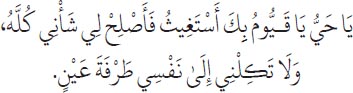
Yā Ḥayyu yā Qayyūmu bika astaghīthu fa-aṣliḥ lī sha’nī kullah, wa lā takilnī ilā nafsī ṭarfata ‘ayn.
We also relate from (the book of Ibn as-Sunnī), with an isnād that has some weakness, from Ibn ‘Abbās , who reported that a man complained to the Messenger of Allah that afflictions were befalling him. The Messenger of Allah then told him: “Say in the morning: In the name of Allah over my soul, family and wealth, and nothing will be lost to you.” The man said that, and his afflictions went away. [36].
, who reported that a man complained to the Messenger of Allah that afflictions were befalling him. The Messenger of Allah then told him: “Say in the morning: In the name of Allah over my soul, family and wealth, and nothing will be lost to you.” The man said that, and his afflictions went away. [36].
Bismi-llāhi ‘alā nafsī wa ahlī wa mālī.
And we relate from the Sunan of Ibn Mājah, as well as from the book of Ibn as-Sunnī from Umm Salamah , who narrated that the Messenger of Allah said in the morning: “O Allah, I ask You for beneficial knowledge, good sustenance, and good deeds that are acceptable [to You].” [37].
, who narrated that the Messenger of Allah said in the morning: “O Allah, I ask You for beneficial knowledge, good sustenance, and good deeds that are acceptable [to You].” [37].
Allāhumma innī as’aluka ‘ilman nāfi‘ā, wa rizqan ṭayyibā, wa ‘amalan mutaqqabalā.
And we relate from the book of Ibn as-Sunnī that Ibn ‘Abbās reported that the Messenger of Allah said: “If one says thrice in the morning and evening: O Allah, I have awoken having from You abundance, good health and protection; so complete that abundance, good health and protection in this world and the Hereafter, it is obligatory for Allah to complete it for him.” [38].
reported that the Messenger of Allah said: “If one says thrice in the morning and evening: O Allah, I have awoken having from You abundance, good health and protection; so complete that abundance, good health and protection in this world and the Hereafter, it is obligatory for Allah to complete it for him.” [38].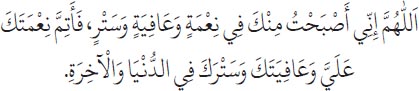
Allāhumma innī aṣbaḥtu minka fī ni‘matin wa ‘āfiyatin wa sitr fa-atimma ni‘mataka ‘alayya wa ‘āfiyataka wa sitraka fi-d-dunyā wa-l-ākhirah.
We relate in the books of at-Tirmidhī and Ibn as-Sunnī from az-Zubayr ibn al-‘Awwām , who reported that the Messenger of Allah said: “There is no morning on which [Allah’s] servants wake up without a caller calling out ‘Glory to the All-Holy King.’” According to another report from Ibn as-Sunnī it is said: “without an announcer announcing: ‘Glory to the All-Holy King.’” [39].
, who reported that the Messenger of Allah said: “There is no morning on which [Allah’s] servants wake up without a caller calling out ‘Glory to the All-Holy King.’” According to another report from Ibn as-Sunnī it is said: “without an announcer announcing: ‘Glory to the All-Holy King.’” [39].
Subḥāna-l-Maliki-l-Quddūs.
And we relate from the book of Ibn as-Sunnī from Buraydah , who reported that the Messenger of Allah said: “Whoever says morning and evening: My Lord is Allah; I rely on Him. There is no god but Him; on Him I rely, and He is the Lord of the Mighty Throne. There is no god but Allah, the Most High, the Mighty. What Allah wills shall be and whatever He does not will shall not. I know that Allah has power over all things and that Allah encompasses everything with His knowledge, and then passes away will enter Paradise.” [40].
, who reported that the Messenger of Allah said: “Whoever says morning and evening: My Lord is Allah; I rely on Him. There is no god but Him; on Him I rely, and He is the Lord of the Mighty Throne. There is no god but Allah, the Most High, the Mighty. What Allah wills shall be and whatever He does not will shall not. I know that Allah has power over all things and that Allah encompasses everything with His knowledge, and then passes away will enter Paradise.” [40].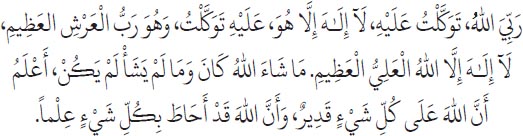
Rabbiyya-llāhu, tawakkaltu ‘alayh, lā ilāha illā Hū, ‘alayhi tawakkalt, wa Huwa Rabbu-l-‘Arshi-l-‘aẓīm, lā ilāha illa-llāhu-l-‘Aliyyu-l-‘Aẓīm. Mā shā’a-llāhu kāna wa mā lam yasha’ lam yakun, a‘lamu anna-llāha ‘alā kulli shay’in qadīr, wa anna-llāha qad aḥāṭa bi-kulli shay’in ‘ilmā.
We relate from the book of Ibn as-Sunnī that Anas reported that the Messenger of Allah asked: “Are any of you unable to be like Abū Ḍamḍam?” They asked: “Who is Abū Ḍamḍam, Messenger of Allah?” He replied: “He used to say in the morning: ‘O Allah, I have given myself and my honour to You.’ So he did not curse those who cursed him; he did not wrong those who wronged him; and he did not beat those who beat him.” [41].
reported that the Messenger of Allah asked: “Are any of you unable to be like Abū Ḍamḍam?” They asked: “Who is Abū Ḍamḍam, Messenger of Allah?” He replied: “He used to say in the morning: ‘O Allah, I have given myself and my honour to You.’ So he did not curse those who cursed him; he did not wrong those who wronged him; and he did not beat those who beat him.” [41].
Allāhumma innī qad wahabtu nafsī wa ‘irḍī lak.
And we relate from it (the book of Ibn as-Sunnī) from Abū ad-Dardā’, who reported that the Messenger of Allah said: “Whoever says seven times in the morning and the evening: Allah is sufficient for me, there is no god besides Him, in Him have I put my trust, and He is the Lord of the Mighty Throne, Allah will remove from him all that worries him about his affairs in this world and the Hereafter.” [42].
said: “Whoever says seven times in the morning and the evening: Allah is sufficient for me, there is no god besides Him, in Him have I put my trust, and He is the Lord of the Mighty Throne, Allah will remove from him all that worries him about his affairs in this world and the Hereafter.” [42].
Ḥasbiya-llāhu lā ilāha illā Hū, ‘alayhi tawakkaltu wa Huwa Rabbu-l-‘Arshi-l-‘aẓīm.
And we relate from the books of at-Tirmidhī and of Ibn as-Sunnī with a weak isnād, from Abū Hurayrah who reported that the Messenger of Allah said: “Whoever recites [Sūrah] Ḥā Mīm al-Mu’min up to He is the final destination and the Verse of the Throne in the morning will be protected by them until the evening. Whoever recites them in the evening will be protected by them until morning.” [43].
who reported that the Messenger of Allah said: “Whoever recites [Sūrah] Ḥā Mīm al-Mu’min up to He is the final destination and the Verse of the Throne in the morning will be protected by them until the evening. Whoever recites them in the evening will be protected by them until morning.” [43].“Ḥā Mīm. The revelation of the Book is from Allah, the Powerful, the All-Knowing, the Forgiver of Sin, Accepter of Repentance, Severe in Punishment, and All-Bountiful. There is no god but He; to Him is the final return.” [44].

Ḥā Mīm. Tanzīlu-l-Kitābi mina-llāhi-l-‘Azīzi-l-‘Alīm, Ghāfiri-dh-dhanbi wa Qābili-t-tawb, Shadīdi-l-‘iqābi Dhi-ṭ-ṭawl, lā ilāha illā Hū, ilayhi-l-maṣīr.
“Allah! There is no god but He, the Ever-Living, the Self-Subsisting. No slumber can seize Him, nor sleep. His are all things in the heavens and on Earth. Who can intercede in His presence except as He permits? He knows what is before or behind them; nor shall they compass any of His knowledge except as He wills. His Throne extends over the heavens and the earth, and He feels no fatigue in guarding and preserving them, for He is the Most High, the Supreme.” [45].
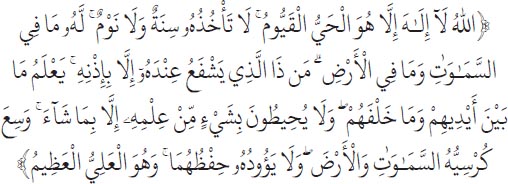
Allāhu lā ilāha illā Huwa-l-Ḥayyu-l-Qayyūm, lā ta’khudhuhu sinatun wa lā nawm, lahū mā fī-s-samāwāti wa mā fī-l-arḍ, man dhā’lladhī yashfa‘u ‘indahū illā bi-idhnih, ya‘lamu mā bayna aydīhim wa mā khalfahum, wa lā yuḥīṭūna bi-shay’im-min ‘ilmihī illā bi-mā shā’, wasi‘a kursiyyuhu-s-samāwāti wa-l-arḍ, wa lā ya’ūduhu ḥifẓuhumā, wa Huwa-l-‘Aliyyu-l-‘Aẓīm.
That is the sum of the hadiths which we intended to mention. It is sufficient for anyone to whom Allah gives the capacity. We ask Allah the Exalted for the ability to practice it and all the ways of goodness.
gives the capacity. We ask Allah the Exalted for the ability to practice it and all the ways of goodness.We relate in the book of Ibn as-Sunnī, from Talq ibn Ḥabīb who narrated that a man came to Abū ad-Dardā’ and said: “Abū ad-Dardā’, your house has burnt down.” He replied: “It has not burnt down. Allah will not do that, because of the words that I heard from the Messenger of Allah . Whoever says them in the morning will be safe from calamity until the evening, and whoever says them in the evening will be safe from calamity until the morning: Allah, You are my Lord. There is no god but You. In You I do trust and You are the Lord of the Mighty Throne. What Allah wills shall be, and what He does not will shall not. There is no power or strength but by Allah, the Most High, the Mighty. I know that Allah has power over all things and that He encompasses everything with His knowledge. O Allah, I seek protection with You from the evil of my soul and from the evil of every beast that You hold by the forelock. Verily my Lord is on a straight path.” [46].
who narrated that a man came to Abū ad-Dardā’ and said: “Abū ad-Dardā’, your house has burnt down.” He replied: “It has not burnt down. Allah will not do that, because of the words that I heard from the Messenger of Allah . Whoever says them in the morning will be safe from calamity until the evening, and whoever says them in the evening will be safe from calamity until the morning: Allah, You are my Lord. There is no god but You. In You I do trust and You are the Lord of the Mighty Throne. What Allah wills shall be, and what He does not will shall not. There is no power or strength but by Allah, the Most High, the Mighty. I know that Allah has power over all things and that He encompasses everything with His knowledge. O Allah, I seek protection with You from the evil of my soul and from the evil of every beast that You hold by the forelock. Verily my Lord is on a straight path.” [46].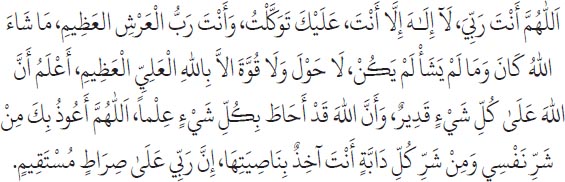
Allāhumma Anta Rabbī, lā ilāha illā Ant, ‘alayka tawakkalt, wa Anta Rabbu-l-‘Arshi-l-‘aẓīm, mā shā’a-llāhu kāna wa mā lam yasha’ lam yakun, wa lā ḥawla wa lā quwwata illā bi-llāhi-l-‘Aliyyi-l-‘Aẓīm. A‘lamu anna-llāha ‘alā kulli shay’in Qadīr, wa anna-llāha qad aḥāṭa bi-kulli shay’in ‘ilmā. Allāhumma a‘ūdhu bika min nafsī wa min sharri kulli dabbatin Anta ākhidhun bi-nāṣiyātihā, inna Rabbī ‘alā ṣirāṭim-mustaqīm.
This has also been reported concerning one of the Companions of the Messenger of Allah besides Abū ad-Dardā’ . A person came to him repeatedly and said: “Go to your house, for it has burnt down.” He repeated: “It has not burnt down, because I heard the Messenger say: “Nothing will happen to anyone who says in the morning (and he mentioned the above words), or to his family or his wealth that will displease him.’ I have said that today.” Then he said: “Come with us.” He stood up and they stood up with him. They went to his house, and everything around it had burned down but nothing had happened to it.
besides Abū ad-Dardā’ . A person came to him repeatedly and said: “Go to your house, for it has burnt down.” He repeated: “It has not burnt down, because I heard the Messenger say: “Nothing will happen to anyone who says in the morning (and he mentioned the above words), or to his family or his wealth that will displease him.’ I have said that today.” Then he said: “Come with us.” He stood up and they stood up with him. They went to his house, and everything around it had burned down but nothing had happened to it.References
[1] Qur’ān 20:130.
[2] Qur’ān 40:55.
[3] Qur’ān 7:205.
[4] Qur’ān 6:52.
[5] Qur’ān 24:36–37.
[6] Qur’ān 38:18.
[7] Al-Bukhārī (6306), at-Tirmidhī (3390), and an-Nasā’ī (8/279).
[8] Muslim (2691) and Abū Dāwūd (5091).
[9] At-Tirmidhī (3570) and Abū Dāwūd (5082).
[10] Abū Dāwūd (5068), Ibn Mājah (3868), and at-Tirmidhī (3388). Ibn Ḥajar considers this hadith to be ṣaḥīḥ gharīb.
[11] Muslim (2718), Abū Dāwūd (5086), and an-Nasā’ī (536) in ‘Amal al-yawm wa al-laylah.
[12] Muslim (2723), Abū Dāwūd (5071), at-Tirmidhī (3387), and an-Nasā’ī (23) in ‘Amal al-yawm wa al-laylah.
[13] Muslim (2709).
[14] At-Tirmidhī (3389) in ad-Da‘awāt, grading it as ṣaḥīḥ, Abū Dāwūd (5067), Ibn as-Sunnī (45), an-Nasā’ī (11), both in ‘Amal al-yawm wa al-laylah, and al-Ḥākim (1/513), who grades it as ṣaḥīḥ and adh-Dhahabī agrees. Ibn Ḥajar indicated that this hadith is ṣaḥīḥ. It is also reported by Aḥmad (1/9), ad-Dārimī (2292), Ibn Ḥibbān in Mawārid az-zamān (3349), al-Bukhārī in al-Adab al-mufrad (1202), al-Futūḥāt (3/96), and others.
[15] Abū Dāwūd (5083). Ibn Ḥajar states that this is a gharīb hadith reported by Abū Dāwūd, whose narrators are all trustworthy except for Muḥammad ibn Ismā‘īl ibn ‘Ayyāsh, who was deemed a weak narrator by Abū Dāwūd. Abū Ḥātim ar-Rāzī states that he did not hear anything from his father; however, this hadith has a shāhid narration (i.e. from a witness) reported by at-Tirmidhī (3526) from Abū Rashīd al-Ḥibrānī.
[16] Abū Dāwūd (5088, 5089) and at-Tirmidhī (3385), who states that this hadith is ḥasan ṣaḥīḥ, Ibn Mājah (3869), and an-Nasā’ī in ‘Amal al-yawm wa al-laylah (15). Its chain is ḥasan ṣaḥīḥ, as mentioned in al-Futūḥāt (3/99).
[17] Abū Dāwūd (5083) Ibn Ḥajar considered this a gharīb hadith reported by Abū Dāwūd, its narrators being trustworthy except for Muḥammad ibn Ismā‘īl ibn ‘Ayyāsh, whom Abū Dāwūd considered weak. Abū Ḥātim ar-Rāzī said: He did not hear anything from his father; but it has a witnessed narration (shāhid) reported by at-Tirmidhī (3526) from Abū Rashīd al-Ḥibrānī.
[18] Abū Dāwūd (5078), at-Tirmidhī (3501), an-Nasā’ī in ‘Amal al-yawm wa al-laylah (9), Aḥmad in al-Musnad (2/354, 522), and al-Futūḥāt (3/105). Ibn Ḥajar states that the description of this chain as good (jayyid) needs to be reassessed. Abū Dāwūd does not mention it, perhaps because it was reported via another route from Anas. For this reason I describe it as ḥasan.
[19] Abū Dāwūd (5073), and an-Nasā’ī in ‘Amal al-yawm wa al-laylah (7).
[20] Abū Dāwūd (5074), Ibn Mājah (3871), al-Futūḥāt (3/109), and al-Ḥākim in al-Mustadrak (1/517), who grades it as ṣaḥīḥ, and adh-Dhahabī agrees. Ibn Ḥajar states that this is ḥasan gharīb hadith which we only know from the hadith of ‘Ubādah ibn Muslim. He also says that the statement of an-Nawawī that it was reported with a number of ṣaḥīḥ chains, gives the impression that it has a number of routes of transmission (ṭuruq) from Ibn ‘Umar , which is not the case.
, which is not the case.[21] Abū Dāwūd (5052), al-Futūḥāt (3/112), and an-Nasā’ī in as-Sunan al-kubrā. Ibn Ḥajar states that this hadith is ḥasan ; its chain contains two defects, which bring it below the level of ṣaḥīḥ.
[22] Abū Dāwūd (5077), Ibn Mājah (3867), an-Nasā’ī in ‘Amal al-yawm wa al-laylah (27) and in al-Musnad (4/59), and al-Futūḥāt (3/114). Ibn Ḥajar states that this hadith is ṣaḥīḥ. An-Nawawī’s statement that it was reported with a number of chains needs to be reassessed, since Abū Dāwūd and Ibn Mājah both describe the chain as consisting of the same narrators from Ḥammād to the end of the chain.
[23] Abū Dāwūd (5084) and al-Futūḥāt (3/115). Ibn Ḥajar states that this is a gharīb hadith. An-Nawawī states that Abū Dāwūd declares it to be weak.
[24] Abū Dāwūd (5090), an-Nasā’ī in ‘Amal al-yawm wa al-laylah (22), and Ibn as-Sunnī (79). Ibn Ḥajar grades it as ḥasan.
[25] Qur’ān 30:17–19.
[26] Abū Dāwūd (5076) and Natā ’ ij al-afkār (174). Ibn Ḥajar states that this is a gharīb hadith whose narration was deemed weak by al-Bukhārī in at-Tārīkh and aḍ-Ḍu‘afā.
[27] Abū Dāwūd (5075), an-Nasā’ī in ‘Amal al-yawm wa al-laylah (12), Ibn as-Sunnī (46), and al-Futūḥāt (3/122). Al-Ḥāfiẓ states that this hadith is gharīb : ‘Abd al-Ḥamīd, who is one of the narrators in the chain, is unknown, as is Umm ‘Abd al-Ḥamīd. Ibn Ḥajar adds: “I do not know her name or circumstances, but she was probably a female Companion, as all the daughters of the Prophet died during his lifetime, except for Fāṭimah , who outlived him by six months or less. It is related that she (Umm ‘Abd al-Ḥamīd) served those that she reported from, but did not name them. If the narrator were other than Fāṭimah then the probability of her (being a female Companion) grows stronger; if not, then it is possible that she lived after the passing away of the Prophet . But Allah knows best”. I say: “This hadith has supporting narrations (shawāhid) with the same meaning, some of which will be mentioned in this chapter.”
died during his lifetime, except for Fāṭimah , who outlived him by six months or less. It is related that she (Umm ‘Abd al-Ḥamīd) served those that she reported from, but did not name them. If the narrator were other than Fāṭimah then the probability of her (being a female Companion) grows stronger; if not, then it is possible that she lived after the passing away of the Prophet . But Allah knows best”. I say: “This hadith has supporting narrations (shawāhid) with the same meaning, some of which will be mentioned in this chapter.”[28] Abū Dāwūd (1555) and al-Futūḥāt (3/123). Ibn Ḥajar states that this hadith is gharīb ; Ghassān ibn ‘Awf is mentioned by as-Sājī and al-‘Uqaylī in aḍ-Ḍu‘afā’. The du‘ā is also narrated by witnesses, but without the story.
[29] Ibn as-Sunnī (33), an-Nasā’ī in ‘Amal al-yawm wa-l-laylah (1), and Aḥmad (3/406). It is graded as ḥasan by Ibn Ḥajar and as-Suyūṭī, and as ṣaḥīḥ by al-‘Irāqī in Takhrīj aḥādīth al-Iḥyā ’ .
[30] Ibn as-Sunnī (38).
[31] At-Tirmidhī (2923) states that this hadith is gharīb ; we only know of it by this route (wajh), Ibn as-Sunnī (79), ad-Dārimī (2/458), and Aḥmad (5/26). The chain of this hadith contains Khālid ibn Tahmān, whom al-Mundhirī describes as a truthful Shī‘ī; his transmission was declared to be weak by Ibn Ma‘īn, but is regarded as trustworthy by Abū Ḥātim. Ibn Ḥajar states that this hadith is gharīb (177).
[32] Qur’ān 23:115.
[33] Ibn as-Sunnī (76) and Natā ’ ij al-afkār (177). Ibn Ḥajar states that this hadith is gharīb.
[34] Ibn as-Sunnī (39). The author of Majma‘ az-zawā ’ id (10/115) said that this hadith was reported by Abū Ya‘lā. Its chain includes Yūsuf ibn ‘Aṭiyyah, who is a disregarded (matrūk) narrator. Shaykh Yaḥyā al-Mullā, in his notes on the abridgement of al-Adhkār, says that as-Suyūṭī described it in al-Jāmi‘ aṣ-ṣaghīr as ḥasan.
[35] Ibn as-Sunnī (48) and Natā ’ ij al-afkār (178). Al-Mundhirī states that this hadith was reported by an-Nasā’ī and al-Bazzār with a ṣaḥīḥ chain, as well as by al-Ḥākim, who states that it is ṣaḥīḥ according to the criteria of al-Bukhārī and Muslim. It was also graded as ḥasan by Ibn Ḥajar.
[36] Ibn as-Sunnī (50).
[37] Ibn Mājah (925) and Ibn as-Sunnī from the client (mawlā) of Umm Salamah. In az-Zawā ’ id it is mentioned that all the narrators of the chain are trustworthy except for the mawlā of Umm Salamah, who did not hear the hadith herself. I have not seen anyone who has written regarding unknown narrators mention him, so his trustworthiness is not known.
[38] Ibn as-Sunnī (54), Aḥmad (3/406), and ad-Dārimī (2/262).
[39] Ibn as-Sunnī (62) and at-Tirmidhī (3564), who states that this hadith is gharīb.
[40] Ibn as-Sunnī (42) and Natā ’ ij al-afkār (179). Ibn Ḥajar states that all of the narrators of this hadith are trustworthy except for ‘Alī ibn Qadīm and Ja‘far al-Aḥmar, whose transmissions are weak because they are Shī‘ī.
[41] Ibn as-Sunnī (64) from Anas and Natā ’ ij al-afkār (176). Ibn Ḥajar states that this hadith is gharīb.
[42] Ibn as-Sunnī (70) and Abū Dāwūd (5081) in a mawqūf form to Abū ad-Dardā’. The text contains some gharābah (rarity).
[43] At-Tirmidhī (2882) and Ibn as-Sunnī (75). At-Tirmidhī states that this hadith is gharīb.
[44] Qur’ān 40:1–3.
[45] Qur’ān 2:255.
[46] Ibn as-Sunnī (56) from Abū ad-Dardā’ and (57) from a male Companion of the Messenger of Allah . Al-‘Irāqī states in his Takhrīj aḥādīth al-Iḥyā’ that this hadith is recorded by aṭ-Ṭabarānī with a weak chain.
. Al-‘Irāqī states in his Takhrīj aḥādīth al-Iḥyā’ that this hadith is recorded by aṭ-Ṭabarānī with a weak chain.