
KNOW THAT THE most momentous time for dhikr during the day is after the ṣalāh of Ṣubḥ.
We relate in Anas  in the book of at-Tirmidhī and elsewhere that the Messenger of Allah
  said: “Whoever performs [the ṣalāh of] Fajr in congregation, then sits and remembers Allah
  until the sun rises and then performs two rak‘ahs of ṣalāh, will get the reward of a Ḥajj and an ‘Umrah which are complete, which are complete, which are complete.” [1].At-Tirmidhī described this as a ḥasan hadith.
in the book of at-Tirmidhī and elsewhere that the Messenger of Allah said: “Whoever performs [the ṣalāh of] Fajr in congregation, then sits and remembers Allah until the sun rises and then performs two rak‘ahs of ṣalāh, will get the reward of a Ḥajj and an ‘Umrah which are complete, which are complete, which are complete.” [1].At-Tirmidhī described this as a ḥasan hadith.We relate in the book of at-Tirmidhī and others that Abū Dharr reported that the Messenger of Allah said: “Whoever says ten times, after the ṣalāh of Ṣubḥ, whilst sitting in the position of tashahhud and before speaking: There is no god but Allah. He is One and has no partner. To Him belongs sovereignty and to Him belongs all praise, He gives life and He gives death, and He has power over all things will have ten good deeds written for him, ten of his sins will be forgiven and ten stages will be raised for him. It will be a shield for him against all repulsive things, he will be guarded from Shayṭān, and no sin will be allowed to reach him that day unless it be from assigning partners to Allah .” [2].At-Tirmidhī declared this to be a ḥasan hadith and in some texts ḥasan ṣaḥīḥ.
said: “Whoever says ten times, after the ṣalāh of Ṣubḥ, whilst sitting in the position of tashahhud and before speaking: There is no god but Allah. He is One and has no partner. To Him belongs sovereignty and to Him belongs all praise, He gives life and He gives death, and He has power over all things will have ten good deeds written for him, ten of his sins will be forgiven and ten stages will be raised for him. It will be a shield for him against all repulsive things, he will be guarded from Shayṭān, and no sin will be allowed to reach him that day unless it be from assigning partners to Allah .” [2].At-Tirmidhī declared this to be a ḥasan hadith and in some texts ḥasan ṣaḥīḥ.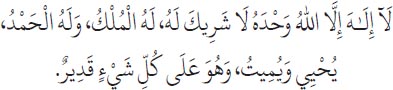
Lā ilāha illa-llāhu waḥdahu lā sharīka lah, lahu-l-mulk, wa lahu-l-ḥamd, yuḥyī wa yumīt, wa Huwa ‘alā kulli shay’in qadīr.
And we relate from the Sunan of Abū Dāwūd, from Muslim ibn al-Ḥārith at-Tamīmī , a Companion, who narrated that the Messenger of Allah secretly told him: “When you end the ṣalāh of Maghrib say: ‘O Allah protect me from Hell-Fire,’ seven times. If you say that and then die during the night, it will be a protection for you from [Hell-Fire]. And after praying Ṣubḥ say the same. If you die on that day, it will be a protection for you from [Hell-Fire].” [3].
, a Companion, who narrated that the Messenger of Allah secretly told him: “When you end the ṣalāh of Maghrib say: ‘O Allah protect me from Hell-Fire,’ seven times. If you say that and then die during the night, it will be a protection for you from [Hell-Fire]. And after praying Ṣubḥ say the same. If you die on that day, it will be a protection for you from [Hell-Fire].” [3].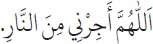
Allāhumma ajirnī mina-n-nār.
We relate in the Musnad of Imam Aḥmad, the Sunan of Ibn Mājah and the book of Ibn as-Sunnī from Umm Salamah  who reported that when the Messenger of Allah had prayed Ṣubḥ he said: “O Allah, I ask You for beneficial knowledge, acceptable deeds and goodly sustenance.” [4].
who reported that when the Messenger of Allah had prayed Ṣubḥ he said: “O Allah, I ask You for beneficial knowledge, acceptable deeds and goodly sustenance.” [4].
Allāhumma innī as’aluka ‘ilman nāfi‘ā, wa ‘amalan mutaqabbalan, wa rizqan ṭayyibā.
And we relate from Ṣuhayb who said: “The Messenger of Allah used to move his lips to say something after the ṣalāh of Fajr. I asked: ‘O Messenger of Allah, what is this that you are saying?’ He replied: ‘O Allah, by You I strive, by You I conquer, and by You I do battle.’” [5].
who said: “The Messenger of Allah used to move his lips to say something after the ṣalāh of Fajr. I asked: ‘O Messenger of Allah, what is this that you are saying?’ He replied: ‘O Allah, by You I strive, by You I conquer, and by You I do battle.’” [5].
Allāhumma bika uḥāwil, wa bika uṣāwil, wa bika uqātil.
The hadiths for the occasions that I have mentioned are many. They will be related in the chapter on the adhkār to say at the beginning of the day, if Allah wills.
We relate from Abū Muḥammad al-Baghāwī who said in Sharḥ al-Sunnah: “‘Alqamah ibn Qays said: ‘It has reached us that the earth cries out to Allah vociferously when a learned man sleeps after the ṣalāh of Ṣubḥ.’” And Allah knows best.
References
[1] At-Tirmidhī (586) and al-Futūḥāt (3/64). This hadith is gharīb, as Ibn Ḥajar states. However, it is strengthened by its supporting narrations.
[2] At-Tirmidhī (3470), who also states that this is a ḥasan ṣaḥīḥ gharīb hadith. It was also graded as ḥasan by Ibn Ḥajar owing to its narrations by witnesses.
[3] Abū Dāwūd (5079). Ibn Ḥajar states that it is ḥasan.
[4] Al- Musnad (6/294), Ibn Mājah (925), Ibn as-Sunnī (108), and an-Nasā’ī (102) in ‘Amal al-yawm wa al-laylah. Ibn Ḥajar states that this hadith is ḥasan by virtue of its supporting narrations.
[5] Al-Futūḥāt (3/71) and Ibn as-Sunnī (115), who states that this hadith is ḥasan owing to its supporting narrations.