
KNOW THAT [THE subject matter of] this chapter is very extensive, and it is not possible to penetrate it deeply, or to fully grasp even one-tenth of it; but I shall allude to the most important of its sources.
The first of these da‘awāt are those mentioned in the Qur’ān, of which Allah  has informed us from His Prophets, blessings and peace be upon them, and from the best people; these are numerous and very well known.
has informed us from His Prophets, blessings and peace be upon them, and from the best people; these are numerous and very well known.Besides those there are what are authentically transmitted as having been employed by the Messenger of Allah  , or those he taught to others. There are very many in this category, a number of which have been mentioned in the previous chapters. Here I will mention ṣaḥīḥ ones, as well as the du‘ā’s found in the Qur’ān and those quoted above. And all success is by Allah.
, or those he taught to others. There are very many in this category, a number of which have been mentioned in the previous chapters. Here I will mention ṣaḥīḥ ones, as well as the du‘ā’s found in the Qur’ān and those quoted above. And all success is by Allah.We relate, with ṣaḥīḥ isnāds, from the Sunans of Abū Dāwūd, at-Tirmidhī, and Ibn Mājah that al-Nu‘mān ibn Bashīr  reported that the Prophet said: “Supplication is worship itself.” [1].According to at-Tirmidhī this is a ḥasan ṣaḥīḥ hadith.
reported that the Prophet said: “Supplication is worship itself.” [1].According to at-Tirmidhī this is a ḥasan ṣaḥīḥ hadith.We relate in the Sunan of Abū Dāwūd, with a sound isnād, that ‘Ā’ishah  narrated that the Messenger of Allah used to regard comprehensive du‘ā as mustaḥabb and leave out anything else. [2].
narrated that the Messenger of Allah used to regard comprehensive du‘ā as mustaḥabb and leave out anything else. [2].We relate in the books of at-Tirmidhī and Ibn Mājah that Abū Hurayrah  reported that Allah’s Messenger said: “There is nothing more noble in the sight of Allah than du‘ā’.” [3].
reported that Allah’s Messenger said: “There is nothing more noble in the sight of Allah than du‘ā’.” [3].We relate in the book of at-Tirmidhī that Abū Hurayrah reported that the Messenger of Allah said: “Whoever is pleased for Allah to answer his prayers in times of difficulty and hardship should say du‘ā’ abundantly in times of ease.” [4].
reported that the Messenger of Allah said: “Whoever is pleased for Allah to answer his prayers in times of difficulty and hardship should say du‘ā’ abundantly in times of ease.” [4].We relate in the Ṣaḥīḥs of al-Bukhārī and Muslim that Anas reported that the du‘ā’ that the Prophet most often said was: “O Allah, [5]. grant us good in this world and in the Hereafter, and protect us from the punishment of Hell-Fire.” [6].
reported that the du‘ā’ that the Prophet most often said was: “O Allah, [5]. grant us good in this world and in the Hereafter, and protect us from the punishment of Hell-Fire.” [6].
Allāhumma ātinā fi-d-dunyā ḥasanatan wa fi-l-ākhirati ḥasanatan wa qinā ‘adhāba-n-Nār.
Muslim added in his narration: “He said, ‘And whenever Anas wanted to supplicate with a single supplication he would supplicate with it and when he wanted to supplicate with a [longer] du‘ā’ he would include this one in it.’”
We relate in the Ṣaḥīḥ of Muslim that Ibn Mas‘ūd reported that the Messenger of Allah used to say: “O Allah, I ask You for guidance, godliness, modesty and prosperity.” [7].
used to say: “O Allah, I ask You for guidance, godliness, modesty and prosperity.” [7].
Allāhumma innī as’aluka-l-hudā wa-t-tuqā wa-l-‘afāfa wa-l-ghinā.
We relate in the Ṣaḥīḥ of Muslim that Ṭāriq ibn Ashyam al-Ashja‘ī, a Companion, narrated that when a man embraced Islam the Prophet taught him the ṣalāh and instructed him to supplicate with these words: “O Allah, forgive me, have mercy on me, guide me, grant me health, and sustain me.”
narrated that when a man embraced Islam the Prophet taught him the ṣalāh and instructed him to supplicate with these words: “O Allah, forgive me, have mercy on me, guide me, grant me health, and sustain me.”
Allāhumma-ghfir lī wa-rḥamnī wa-hdinī wa ‘āfinī wa-rzuqnī.
According to another report by Muslim, Ṭāriq related that he heard a man ask the Prophet : “What should I say when I supplicate to my Lord?” He replied: “Say: O Allah, forgive me, have mercy on me, grant me health, and sustain me; for these will suffice for your worldly life and your life in the Hereafter.” [8].
: “What should I say when I supplicate to my Lord?” He replied: “Say: O Allah, forgive me, have mercy on me, grant me health, and sustain me; for these will suffice for your worldly life and your life in the Hereafter.” [8].
Allāhumma-ghfir lī wa-rḥamnī, wa ‘āfinī wa-rzuqnī.
We also relate from the Ṣaḥīḥ of Muslim that ‘Abdullāh ibn ‘Amr ibn al-‘Āṣ reported that the Messenger of Allah said: “O Allah, Turner of hearts, turn our hearts to You in obedience.” [9].
reported that the Messenger of Allah said: “O Allah, Turner of hearts, turn our hearts to You in obedience.” [9].
Allāhumma yā Muṣarrifa-l-qulūb, ṣarrif qulūbanā ‘alā ṭā‘atik.
We relate in the Ṣaḥīḥs of al-Bukhārī and Muslim that Abū Hurayrah reported that Allah’s Messenger said: “Seek refuge with Allah from the hardship of tribulation, the befalling of misfortune, evil destiny, and the glee of enemies.” [10].
reported that Allah’s Messenger said: “Seek refuge with Allah from the hardship of tribulation, the befalling of misfortune, evil destiny, and the glee of enemies.” [10].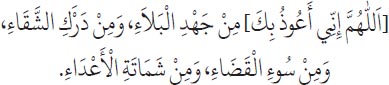
Allāhumma innī a‘ūdhu bika min jahdi-l-balā’, wa min daraki-sh-shaqā’, wa min sū’i-l-qaḍā’, wa min shamātati-l-a‘dā’.
According to a narration from Sufyān he said: “There are three [misfortunes that were originally mentioned] in the hadith, and I have added one; but I do not know which it is.”
We relate in the same Ṣaḥīḥs that Anas reported that the Messenger of Allah used to say: “O Allah, I seek Your protection from feebleness and laziness, and from cowardice, old age and avarice; I seek Your protection from punishment in the grave, and I seek Your protection from the trials of life and death.” [11].
reported that the Messenger of Allah used to say: “O Allah, I seek Your protection from feebleness and laziness, and from cowardice, old age and avarice; I seek Your protection from punishment in the grave, and I seek Your protection from the trials of life and death.” [11].
Allāhumma innī a‘ūdhu bika min al-‘ajzi wa-l-kasal, wa-l-jubni wa-l-harami wa-l-bukhl, wa a‘ūdhu bika min ‘adhābi-l-qabr, wa a‘ūdhu bika min fitnati-l-maḥyā wa-l-mamāt.
Another narration adds: “. . .and the burden of debt and being overpowered by men.”

Wa ḍala‘i-d-dayn, wa ghalabati-r-rijāl. [12].
I say that ḍala‘i-d-dayn, ‘the burden of debt’, means its serious nature and the heaviness of carrying it, and al-maḥyā wa-l-mamāt means ‘life and death’.
We relate again from the same Ṣaḥīḥs that ‘Abdullāh ibn ‘Amr ibn al-‘Āṣ narrated that Abū Bakr aṣ-Ṣiddīq related that he said to the Messenger of Allah : “Teach me a du‘ā’ to supplicate with in my ṣalāh.” He replied: “Say: O Allah, I have done my soul much harm and no one forgives sins but You, so grant me Your forgiveness and have mercy on me. You are the Most Forgiving, the Most Merciful.” [13].
related that he said to the Messenger of Allah : “Teach me a du‘ā’ to supplicate with in my ṣalāh.” He replied: “Say: O Allah, I have done my soul much harm and no one forgives sins but You, so grant me Your forgiveness and have mercy on me. You are the Most Forgiving, the Most Merciful.” [13].
Allāhumma innī ẓalamtu nafsī ẓulman kathīrā, wa lā yaghfiru-dh-dhunūba illā Ant, fa-ghfir lī maghfiratan min ‘indika wa-rḥamnī, innaka Anta-l-Ghafūru-r-Raḥīm.
I say that [this hadith] is related with either kathīran ‘much’ with a thā’ or kabīran ‘great [harm]’ with a bā’, as we have already explained in the chapter on the adhkār of the ṣalāh. So it is mustaḥabb when making supplication to say kathīran kabīran ‘much great [harm]’, thus combining the two. Although this du‘ā’ is narrated with respect to the ṣalāh it is a good and precious ṣaḥīḥ [narration] and is mustaḥabb in every place on any occasion. One narration reads, “[in my ṣalāh] and in my house”. [14].
We relate in both Ṣaḥīḥs that Abū Mūsā al-Ash‘arī reported that the Messenger of Allah used to supplicate with this du‘ā’: “O Allah, forgive me my sins, my ignorance, my excesses in my affairs, and that which You know better than I. O Allah, forgive me those sins which I committed seriously or in jest, by mistake or deliberately, and all of that [is my fault]. O Allah, forgive me my past and future sins, those I have committed in secret or in public, and that which You know better than I. You are the Bringer Forward and the Sender Back, and You have power over all things.” [15].
reported that the Messenger of Allah used to supplicate with this du‘ā’: “O Allah, forgive me my sins, my ignorance, my excesses in my affairs, and that which You know better than I. O Allah, forgive me those sins which I committed seriously or in jest, by mistake or deliberately, and all of that [is my fault]. O Allah, forgive me my past and future sins, those I have committed in secret or in public, and that which You know better than I. You are the Bringer Forward and the Sender Back, and You have power over all things.” [15].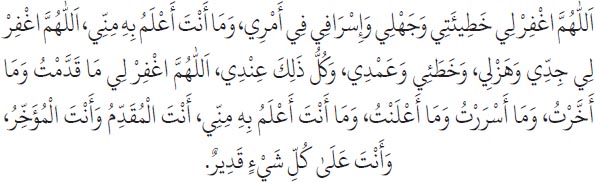
Allāhumma-ghfir lī khaṭī’atī wa jahlī wa isrāfī fī amrī, wa mā Anta a‘lamu bihi minnī. Allāhumma-ghfir lī jiddī wa hazlī, wa khaṭa’ī wa ‘amdī, wa kullu dhālika ‘indī. Allāhumma-ghfir lī mā qaddamtu wa mā akhkhart, wa mā asrartu wa mā a‘lant, wa mā Anta a‘lamu bihi minnī. Anta-l-Muqaddimu wa Anta-l-Mu’akhkhir, wa Anta ‘alā kulli shay’in qadīr.
We relate in the Ṣaḥīḥ of Muslim that ‘Ā’ishah reported that the Messenger of Allah used to say in his du‘ā’: “O Allah, I seek Your protection from the evil of that which I have done and the evil of that which I have not done.” [16].
reported that the Messenger of Allah used to say in his du‘ā’: “O Allah, I seek Your protection from the evil of that which I have done and the evil of that which I have not done.” [16].
Allāhumma innī a‘ūdhu bika min sharri mā ‘amiltu wa sharri mā lam a‘mal.
We relate in the Ṣaḥīḥ of Muslim that Ibn ‘Umar narrated: “One of the du‘ā’s of Allah’s Messenger was: ‘O Allah, I seek Your protection from the cessation of Your bounty, from the transformation of the well-being You grant, from Your sudden vengeance, and from all that occasions Your displeasure.’” [17].
narrated: “One of the du‘ā’s of Allah’s Messenger was: ‘O Allah, I seek Your protection from the cessation of Your bounty, from the transformation of the well-being You grant, from Your sudden vengeance, and from all that occasions Your displeasure.’” [17].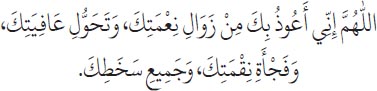
Allāhumma innī a‘ūdhu bika min zawāli ni‘matik, wa taḥawwuli ‘āfiyatik, wa faj’ati niqmatik, wa jamī‘i sakhaṭik.
We relate in the Ṣaḥīḥ of Muslim that Zayd ibn Arqam reported that the Messenger of Allah used to say: “O Allah, I seek Your protection from feebleness and laziness, from cowardice and avarice, from senility, and from punishment in the grave. O Allah, grant my soul its godliness and purify it, for You are the best of those who purify it. You are its Guardian and its Master. O Allah, I seek Your protection from knowledge that does not benefit, from a heart that is not utterly humble, from a self that is insatiable, and from supplications that are not accepted.” [18].
reported that the Messenger of Allah used to say: “O Allah, I seek Your protection from feebleness and laziness, from cowardice and avarice, from senility, and from punishment in the grave. O Allah, grant my soul its godliness and purify it, for You are the best of those who purify it. You are its Guardian and its Master. O Allah, I seek Your protection from knowledge that does not benefit, from a heart that is not utterly humble, from a self that is insatiable, and from supplications that are not accepted.” [18].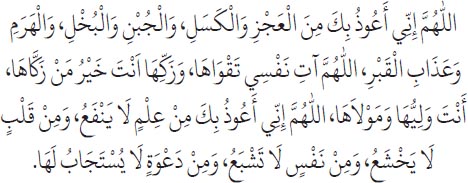
Allāhumma innī a‘ūdhu bika mina-l-‘ajzi wa-l-kasal, wa-l-jubni wa-l-bukhl, wa-l-harami wa ‘adhābi-l-qabr. Allāhumma āti nafsī taqwāhā wa zakkihā. Anta Khayru man zakkāhā, Anta Waliyyuhā wa Mawlāhā. Allāhumma innī a‘ūdhu bika min ‘ilmin lā yanfa‘, wa min qalbin lā yakhsha‘, wa min nafsin lā tashba‘, wa min da‘watin lā yustajābu lahā.
We relate in the Ṣaḥīḥ of Muslim that ‘Alī reported that the Messenger of Allah said: “O Allah, guide me and rectify me.”
reported that the Messenger of Allah said: “O Allah, guide me and rectify me.”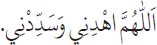
Allāhumma-hdinī wa saddidnī.
According to another report he said: “O Allah, I ask You for guidance and rectitude.” [19].

Allāhumma innī as’aluka-l-hudā wa-s-sadād.
We relate in the Ṣaḥīḥ of Muslim that Sa‘d ibn Abī Waqqāṣ narrated that a Bedouin came to the Messenger of Allah and said: “Teach me something that I can say.” He replied: “Say: ‘There is no god but Allah, One without partner. Allah is incomparably greatest and abundant praise is due to Allah. Glory be to Allah, the Lord of the Worlds. There is no power or strength except by Allah, the All-Mighty, the All-Wise.’” He said: “Those are for my Lord; what is there for me?” He said: “O Allah, forgive me, have mercy on me, guide me, sustain me, and grant me health and well-being.” [20].The narrator had some doubt about “And grant me health and well-being.”
narrated that a Bedouin came to the Messenger of Allah and said: “Teach me something that I can say.” He replied: “Say: ‘There is no god but Allah, One without partner. Allah is incomparably greatest and abundant praise is due to Allah. Glory be to Allah, the Lord of the Worlds. There is no power or strength except by Allah, the All-Mighty, the All-Wise.’” He said: “Those are for my Lord; what is there for me?” He said: “O Allah, forgive me, have mercy on me, guide me, sustain me, and grant me health and well-being.” [20].The narrator had some doubt about “And grant me health and well-being.”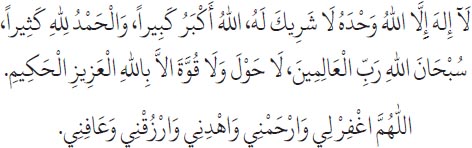
Lā ilāha illa-llāhu waḥdahu lā sharīka lah, Allāhu akbaru kabīrā, wa-l-ḥamdu li-llāhi kathīrā, Subḥāna-llāhi Rabbi-l-‘ālamīn. Lā ḥawla wa lā quwwata illā bi-llāhi-l-‘Azīzi-l-Ḥakīm.
Allāhumma-ghfir lī wa-rḥamnī wa-hdinī wa-rzuqnī wa ‘āfinī.
We relate in the Ṣaḥīḥ of Muslim that Abū Hurayrah reported that the Messenger of Allah used to say: “O Allah, put right for me my religion, which is the preservation of my affairs; put right for me my worldly life, in which is my existence; put right for me my Hereafter, to which is my return; make life an increase for me in every good; and make death for me a release from every evil.” [21].
reported that the Messenger of Allah used to say: “O Allah, put right for me my religion, which is the preservation of my affairs; put right for me my worldly life, in which is my existence; put right for me my Hereafter, to which is my return; make life an increase for me in every good; and make death for me a release from every evil.” [21].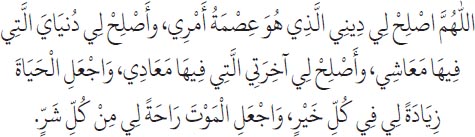
Allāhumma aṣliḥ lī dīni-lladhī huwa ‘iṣmatu amrī, wa aṣliḥ lī dunyāya-llatī fīhā ma‘āshī, wa aṣliḥ lī ākhirati-llatī fīhā ma‘ādī, wa-j‘ali-l-ḥayāta ziyādatan lī fī kulli khayr, wa-j‘ali-l-mawta rāḥatan lī min kulli sharr.
We relate in the Ṣaḥīḥs of al-Bukhārī and Muslim that ‘Abdullāh ibn ‘Abbās reported that the Messenger of Allah used to say: “O Allah, unto You I surrender myself, in You I believe, in You I put my trust, to You I turn in repentance, and with Your help I dispute. O Allah, I seek refuge by Your power—there is no god but You—lest You lead me astray. You are the Ever-Living Who does not die, while jinn and mankind do.” [22].
reported that the Messenger of Allah used to say: “O Allah, unto You I surrender myself, in You I believe, in You I put my trust, to You I turn in repentance, and with Your help I dispute. O Allah, I seek refuge by Your power—there is no god but You—lest You lead me astray. You are the Ever-Living Who does not die, while jinn and mankind do.” [22].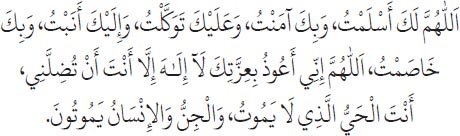
Allāhumma laka aslamt, wa bika āmant, wa ‘alayka tawakkalt, wa ilayka anabt, wa bika khāṣamt. Allāhumma innī a‘ūdhu bi-‘izzatika—lā ilāha illā Anta—an tuḍillanī. Anta-l-Ḥayyu-lladhī lā yamūt, wa-l-jinnu wa-l-insānu yamūtūn.
We relate in the Sunans of Abū Dāwūd, at-Tirmidhī, an-Nasā’ī and Ibn Mājah that Buraydah narrated that the Messenger of Allah heard a man say: “O Allah, I ask You because I bear witness that You are Allah, there is no god but You, the One, the Unique, the One Who does not beget and is not begotten and to Whom no-one is equivalent.” He said: “You have asked of Allah by the name which, if asked by it, He gives, and if implored by it, He responds and accepts.” [23].
narrated that the Messenger of Allah heard a man say: “O Allah, I ask You because I bear witness that You are Allah, there is no god but You, the One, the Unique, the One Who does not beget and is not begotten and to Whom no-one is equivalent.” He said: “You have asked of Allah by the name which, if asked by it, He gives, and if implored by it, He responds and accepts.” [23].According to another report he said: “You have asked Allah by His Greatest Name.” According to at-Tirmidhī, this is a ḥasan hadith. [24].
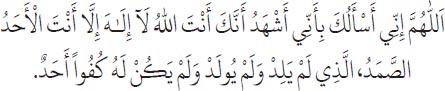
Allāhumma innī as’aluka bi-annī ashhadu annaka Anta-llāhu lā ilāha illā Anta-l-Aḥadu-ṣ-Ṣamad, alladhī lam yalid wa lam yūlad wa lam yaku-l-lahu kufuwan aḥad.
We relate in the Sunans of Abū Dāwūd and an-Nasā’ī that Anas reported that he was sitting with the Messenger of Allah while a man was performing ṣalāh, then supplicated, saying: “O Allah, I ask You because to You belongs all praise. There is no god but You, the Benefactor, Originator of the heavens and the earth. O Owner of Majesty and Honour, O Living, O Self-Subsisting.” The Prophet then commented: “He has supplicated to Allah by His Supreme Name; if called on [by it], He responds; and if asked [by it], He gives.” [25].
reported that he was sitting with the Messenger of Allah while a man was performing ṣalāh, then supplicated, saying: “O Allah, I ask You because to You belongs all praise. There is no god but You, the Benefactor, Originator of the heavens and the earth. O Owner of Majesty and Honour, O Living, O Self-Subsisting.” The Prophet then commented: “He has supplicated to Allah by His Supreme Name; if called on [by it], He responds; and if asked [by it], He gives.” [25].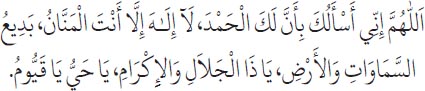
Allāhumma innī as’aluka bi-anna laka-l-ḥamd, lā ilāha illā Anta-l-Mannān, Badī‘u-s-samāwāti wa-l-arḍ, yā Dha-l-Jalāli wa-l-Ikrām, yā Ḥayyu yā Qayyūm.
We relate in the Sunans of Abū Dāwūd, at-Tirmidhī, an-Nasā’ī and Ibn Mājah, with ṣaḥīḥ isnāds, that ‘Ā’ishah reported that the Messenger of Allah used to supplicate with these words: “O Allah, I seek Your protection from the trials of Hell-Fire, the punishment of Hell-Fire, and the evil of riches and poverty.” [26].
reported that the Messenger of Allah used to supplicate with these words: “O Allah, I seek Your protection from the trials of Hell-Fire, the punishment of Hell-Fire, and the evil of riches and poverty.” [26].
Allāhumma innī a‘ūdhu bika min fitnati-n-Nāri wa ‘adhābi-n-Nār, wa min sharri-l-ghinā wa-l-faqr.
We relate in the book of at-Tirmidhī from Ziyād ibn ‘Ilāqah from his paternal uncle, whose name was Quṭbah ibn Mālik , who reported that the Messenger of Allah used to say: “O Allah, I seek Your protection from abhorrent qualities of character, deeds and caprices.” [27].At-Tirmidhī states that this is a ḥasan hadith.
, who reported that the Messenger of Allah used to say: “O Allah, I seek Your protection from abhorrent qualities of character, deeds and caprices.” [27].At-Tirmidhī states that this is a ḥasan hadith.
Allāhumma innī a‘ūdhu bika min munkarāti-l-akhlāqi wa-l-a‘māli wa-l-ahwā’.
We relate in the Sunans of Abū Dāwūd, at-Tirmidhī and an-Nasā’ī that Shakal ibn Ḥumayd —which is written with a fatḥah on the shīn and the kāf—said: “Messenger of Allah, teach me a du‘ā’.” He replied: “Say: O Allah, I seek Your protection from the evil of my hearing, the evil of my sight, the evil of my tongue, the evil of my heart, and the evil of my sperm [28]..” [29].According to at-Tirmidhī, this is a ḥasan hadith.
—which is written with a fatḥah on the shīn and the kāf—said: “Messenger of Allah, teach me a du‘ā’.” He replied: “Say: O Allah, I seek Your protection from the evil of my hearing, the evil of my sight, the evil of my tongue, the evil of my heart, and the evil of my sperm [28]..” [29].According to at-Tirmidhī, this is a ḥasan hadith.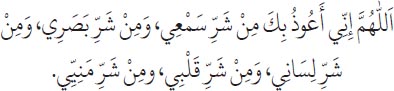
Allāhumma innī a‘ūdhu bika min sharri sam‘ī, wa min sharri baṣarī, wa min sharri lisānī, wa min sharri qalbī, wa min sharri maniyyī.
We relate in the books of Abū Dāwūd and an-Nasā’ī, with ṣaḥīḥ isnāds, that Anas related that the Messenger of Allah used to say: “O Allah, I seek Your protection from vitiligo, insanity, leprosy, and [all] severe illness.” [30].
related that the Messenger of Allah used to say: “O Allah, I seek Your protection from vitiligo, insanity, leprosy, and [all] severe illness.” [30].
Allāhumma innī a‘ūdhu bika mina-l-baraṣi wa-l-junūni wa-l-judhāmi wa sayyi’i-l-asqām.
We also relate from them both that Abū al-Yasar, the Companion —written with a fatḥah on the yā’ and the sīn—reported that the Messenger of Allah used to supplicate saying: “O Allah, I seek refuge with You from destruction, from a fatal fall, from drowning, from fire, from senility, and from Shayṭān leading me astray at the time of death; and I seek refuge with You from dying for Your Cause whilst fleeing; and I seek refuge with You from dying from a sting or bite.” [31].This is the wording of Abū Dāwūd; another narration adds, “And anxiety.” [32].
—written with a fatḥah on the yā’ and the sīn—reported that the Messenger of Allah used to supplicate saying: “O Allah, I seek refuge with You from destruction, from a fatal fall, from drowning, from fire, from senility, and from Shayṭān leading me astray at the time of death; and I seek refuge with You from dying for Your Cause whilst fleeing; and I seek refuge with You from dying from a sting or bite.” [31].This is the wording of Abū Dāwūd; another narration adds, “And anxiety.” [32].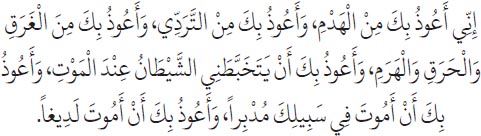
Innī a‘ūdhu bika mina-l-hadm, wa a‘ūdhu bika mina-t-taraddī, wa a‘ūdhu bika mina-l-gharaqi wa-l-ḥaraqi wa-l-haram, wa a‘ūdhu bika an yatakhabbaṭani-sh-Shayṭānu ‘inda-l-mawt, wa a‘ūdhu bika an amūta fī sabīlika mudbirā, wa a‘ūdhu bika an amūta ladīghā.
We also relate from them both, with ṣaḥīḥ isnāds, that Abū Hurayrah reported that the Messenger of Allah used to say: “O Allah, I seek refuge with You from hunger, for it is an evil bedfellow; and I seek refuge with You from treachery, for it is an evil companion.” [33].
reported that the Messenger of Allah used to say: “O Allah, I seek refuge with You from hunger, for it is an evil bedfellow; and I seek refuge with You from treachery, for it is an evil companion.” [33].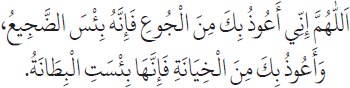
Allāhumma innī a‘ūdhu bika mina-l-jū‘i fa-innahu bi’sa-ḍ-ḍajī‘, wa a‘ūdhu bika mina-l-khiyānati fa-innahā bi’sati-l-biṭānah.
We relate in the book of at-Tirmidhī that ‘Alī narrated that a slave who had contracted to buy his freedom came to him and said: “I am unable to pay the price for my freedom, so help me.” He replied: “Should I not teach you words that the Messenger of Allah taught me? If you had debts like mountains Allah would settle them for you. Say: “O Allah, suffice me with what You have made lawful so that I do not need anything You have made unlawful, and make me independent of all but You by Your generosity.” [34].At-Tirmidhī says that this is a ḥasan hadith.
narrated that a slave who had contracted to buy his freedom came to him and said: “I am unable to pay the price for my freedom, so help me.” He replied: “Should I not teach you words that the Messenger of Allah taught me? If you had debts like mountains Allah would settle them for you. Say: “O Allah, suffice me with what You have made lawful so that I do not need anything You have made unlawful, and make me independent of all but You by Your generosity.” [34].At-Tirmidhī says that this is a ḥasan hadith.
Allāhumma-kfinī bi-ḥalālika ‘an ḥarāmik, wa-ghninī bi-faḍlika ‘amman siwāk.
And we relate from the same source that ‘Imrān ibn al-Ḥuṣayn reported that the Prophet taught his father Ḥusayn two things to say when supplicating: “O Allah, inspire me with right guidance and give me refuge from the evil of my self.” [35].According to at-Tirmidhī, this is a ḥasan hadith.
reported that the Prophet taught his father Ḥusayn two things to say when supplicating: “O Allah, inspire me with right guidance and give me refuge from the evil of my self.” [35].According to at-Tirmidhī, this is a ḥasan hadith.
Allāhumma alhimnī rushdī, wa a‘idhnī min sharri nafsī.

We relate in the book of at-Tirmidhī that Shahr ibn Ḥawshab narrated that he asked Umm Salamah : “Mother of the Believers, what was the most frequent du‘ā’ of Allah’s Messenger when he was with you?” She replied: “His most frequent du‘ā’ was: ‘O Overturner of hearts, make my heart firm in Your religion.’” [38].At-Tirmidhī says that this hadith is ḥasan.
: “Mother of the Believers, what was the most frequent du‘ā’ of Allah’s Messenger when he was with you?” She replied: “His most frequent du‘ā’ was: ‘O Overturner of hearts, make my heart firm in Your religion.’” [38].At-Tirmidhī says that this hadith is ḥasan.
Yā Muqalliba-l-qulūb, thabbit qalbī ‘alā dīnik.
We relate in the book of at-Tirmidhī that ‘Ā’ishah reported that the Messenger of Allah used to say: “O Allah, grant me good health in my body, and grant me good health in my eyesight, and make it outlast me. There is no god but Allah, the Forbearing, the Most Generous. Glory be to Allah, Lord of the Exalted Throne. Praise be to Allah, Lord of the Worlds.” [39].
reported that the Messenger of Allah used to say: “O Allah, grant me good health in my body, and grant me good health in my eyesight, and make it outlast me. There is no god but Allah, the Forbearing, the Most Generous. Glory be to Allah, Lord of the Exalted Throne. Praise be to Allah, Lord of the Worlds.” [39].
Allāhumma ‘āfinī fī jasadī, wa ‘āfinī fī baṣarī, wa-j‘alhu-l-wāritha minnī. Lā ilāha illa-llāhu-l-Ḥalīmu-l-Karīm. Subḥāna-llāhi Rabbi-l-‘Arshi-l-‘aẓīm, wa-l-ḥamdu li-llāhi Rabbi-l-‘ālamīn.
We relate in [the same source] that Abū ad-Dardā’ reported that the Messenger of Allah said: “The du‘ā’ of Dāwūd  was: ‘O Allah, I ask You for Your love, the love of those who love You, and deeds that make me attain Your love. O Allah, make Your love more beloved to me than my own self, my family, or cool water.” [40].At-Tirmidhī states that this is a ḥasan hadith.
reported that the Messenger of Allah said: “The du‘ā’ of Dāwūd was: ‘O Allah, I ask You for Your love, the love of those who love You, and deeds that make me attain Your love. O Allah, make Your love more beloved to me than my own self, my family, or cool water.” [40].At-Tirmidhī states that this is a ḥasan hadith.
Allāhumma innī as’aluka ḥubbaka wa ḥubba man yuḥibbuk, wa-l-‘amala-lladhī yuballighunī ḥubbak. Allāhumma-j‘al ḥubbaka aḥabba ilayya min nafsī wa ahlī wa mina-l-mā’il-bārid.
We relate in [the same book] from Sa‘d ibn Abī Waqqāṣ who reported that the Messenger of Allah said: “The supplication of Dhū an-Nūn to his Lord while he was in the belly of the fish was, ‘There is no god but You. Glory be to You, indeed I have been one of the wrongdoers.’ No Muslim supplicates with this for anything without his prayer being answered.” [41].According to al-Ḥākim Abū ‘Abdullāh, this has a ṣaḥīḥ isnād.
who reported that the Messenger of Allah said: “The supplication of Dhū an-Nūn to his Lord while he was in the belly of the fish was, ‘There is no god but You. Glory be to You, indeed I have been one of the wrongdoers.’ No Muslim supplicates with this for anything without his prayer being answered.” [41].According to al-Ḥākim Abū ‘Abdullāh, this has a ṣaḥīḥ isnād.
Lā ilāha illā Anta subḥānaka innī kuntu mina-ẓ-ẓālimīn.
We relate in [the book of at-Tirmidhī] and in the book of Ibn Mājah that Anas narrated that a man came to the Messenger of Allah and asked: “Messenger of Allah, which du‘ā’ is the best?” He replied: “Ask your Lord for well-being and exemption in this world and the Hereafter.” Then he came back the next day and asked: “Messenger of Allah, which du‘ā’ is the best?” He told [the man] the same thing. Then he came back on the third day and asked him the same question, and he replied: “If you have been granted good health and well-being in this world and you have been granted them in the Hereafter, you have triumphed.” [42].At-Tirmidhī says that this hadith is ḥasan.
narrated that a man came to the Messenger of Allah and asked: “Messenger of Allah, which du‘ā’ is the best?” He replied: “Ask your Lord for well-being and exemption in this world and the Hereafter.” Then he came back the next day and asked: “Messenger of Allah, which du‘ā’ is the best?” He told [the man] the same thing. Then he came back on the third day and asked him the same question, and he replied: “If you have been granted good health and well-being in this world and you have been granted them in the Hereafter, you have triumphed.” [42].At-Tirmidhī says that this hadith is ḥasan.We relate in the book of at-Tirmidhī that al-‘Abbās ibn ‘Abd al-Muṭṭalib reported, “I said, ‘Messenger of Allah, teach me something that I can ask of Allah .’ He said, ‘Ask Allah for well-being.’ I then waited a few days and then I came and said, ‘Messenger of Allah, teach me something that I can ask of Allah .’ He said: ‘O ‘Abbās, uncle of Allah’s Messenger, ask Allah for well-being in this world and the Hereafter.’” [43].According to at-Tirmidhī, this hadith is ṣaḥīḥ.
reported, “I said, ‘Messenger of Allah, teach me something that I can ask of Allah .’ He said, ‘Ask Allah for well-being.’ I then waited a few days and then I came and said, ‘Messenger of Allah, teach me something that I can ask of Allah .’ He said: ‘O ‘Abbās, uncle of Allah’s Messenger, ask Allah for well-being in this world and the Hereafter.’” [43].According to at-Tirmidhī, this hadith is ṣaḥīḥ.We also relate from Abū Umāmah , who narrated: “The Messenger of Allah supplicated with many du‘ā’s but we did not memorise any of them. I said, ‘Messenger of Allah, you have supplicated with many du‘ā’s, but we have not memorised any of them.’ He replied: ‘Should I not show you one that combines all of them? Say: O Allah, I ask You for the good that Your Prophet Muḥammad asked of You, and I seek refuge with You from that which Your Prophet Muḥammad sought refuge. For You are the One Whose help is to be sought, and only by You can it be attained; and there is no power or strength except by Allah.’” [44].At-Tirmidhī says that this hadith is ḥasan.
, who narrated: “The Messenger of Allah supplicated with many du‘ā’s but we did not memorise any of them. I said, ‘Messenger of Allah, you have supplicated with many du‘ā’s, but we have not memorised any of them.’ He replied: ‘Should I not show you one that combines all of them? Say: O Allah, I ask You for the good that Your Prophet Muḥammad asked of You, and I seek refuge with You from that which Your Prophet Muḥammad sought refuge. For You are the One Whose help is to be sought, and only by You can it be attained; and there is no power or strength except by Allah.’” [44].At-Tirmidhī says that this hadith is ḥasan.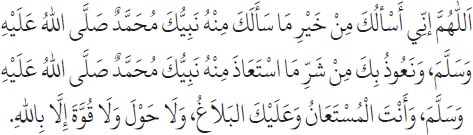
Allāhumma innī as’aluka min khayri mā sa’alaka minhu Nabiyyuka Muḥammadun ṣalla-llāhu ‘alayhi wa sallam, wa na‘ūdhu bika min sharri ma-sta‘ādha minhu Nabiyyuka Muḥammadun ṣalla-llāhu ‘alayhi wa sallam. Wa Anta-l-Musta‘ānu wa ‘alayka-l-balāgh, wa lā ḥawla wa lā quwwata illā bi-llāh.
We also relate in it that Anas reported that the Messenger of Allah said: “Be constant (aliẓẓū) in saying, O Possessor of Majesty and Honour.” [45].
reported that the Messenger of Allah said: “Be constant (aliẓẓū) in saying, O Possessor of Majesty and Honour.” [45].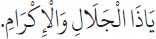
Yā Dha-l-Jalāli wa-l-Ikrām.
We relate it also from the Book of an-Nasā’ī, from Rabī‘ah ibn ‘Āmir, a Companion . [46].Al-Ḥākim states that the hadith’s isnād is ṣaḥīḥ. [47].
. [46].Al-Ḥākim states that the hadith’s isnād is ṣaḥīḥ. [47].I say that aliẓẓū is [written] with a kasrah on the lām and a shaddah on the ẓā’. It means ‘adhere to this supplication and repeat it often’.
We relate in the Sunans of Abū Dāwūd, at-Tirmidhī and Ibn Mājah that ‘Abdullāh ibn ‘Abbās reported that the Prophet used to make du‘ā’ saying: “O my Lord, help me and do not assist [others] against me; [48]. aid me and do not aid [others] against me; [49].plot for me and do not plot against me; [50]. guide me and make guidance easy for me; and help me against those who harm and oppress me. O my Lord, make me grateful to You, remembering You, fearful of You, obedient to You, and submissive—or repentant—to You. Accept my repentance and wash away my sins; accept my supplication and establish my proof. [51]. Guide my heart, make my tongue righteous, and remove my heart’s vile traits.” [52].
reported that the Prophet used to make du‘ā’ saying: “O my Lord, help me and do not assist [others] against me; [48]. aid me and do not aid [others] against me; [49].plot for me and do not plot against me; [50]. guide me and make guidance easy for me; and help me against those who harm and oppress me. O my Lord, make me grateful to You, remembering You, fearful of You, obedient to You, and submissive—or repentant—to You. Accept my repentance and wash away my sins; accept my supplication and establish my proof. [51]. Guide my heart, make my tongue righteous, and remove my heart’s vile traits.” [52].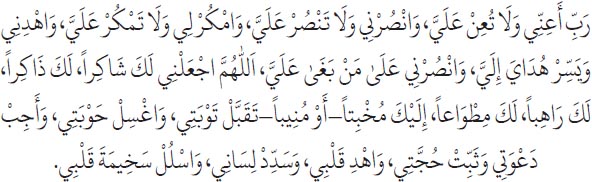
Rabbī a‘innī wa lā tu‘in ‘alayy, wa-nṣurnī wa lā tanṣur ‘alayy, wa-mkur lī wa lā tamkur ‘alayy, wa-hdinī wa yassir hudāya ilayy, wa-nṣurnī ‘alā man baghā ‘alayy. Allāhumma-j‘alnī laka shākirā, laka dhākirā, laka rāhibā, wa laka miṭwā‘ā, ilayka mukhbitā—aw munībā. Taqabbal tawbatī, wa-ghsil ḥawbatī, wa ajib da‘watī, wa thabbit ḥujjatī, wa-hdi qalbī, wa saddid lisānī, wa-slul sakhīmata qalbī.
And in a narration of at-Tirmidhī there is: “. . .tender-hearted, penitent.”

Awwāhan munīban.
I say: “As-sakhīmah with a fatḥah on the letter sīn, and a kasrah on the letter khā’, is ‘spite’ and its plural is sakhā’im. That is the meaning of as-sakhīmah here.”
Another hadith reads, “Whoever draws forth his sakhīmah in the pathway of the Muslims, then may there be upon him the curse of Allah,” by which is meant ‘faeces’.
We relate in the Musnad of Imam Aḥmad ibn Ḥanbal, as well as from the Sunan of Ibn Mājah, that ‘Ā’ishah narrated that the Messenger of Allah said to her: “Say: ‘O Allah, I ask of You all good, that which is immediate and that which is in the future, that which I know and that which I do not know. And I seek refuge with You from all evil, that which is immediate and that which is in the future, that which I know and that which I do not know. I ask You for Paradise and words and deeds which bring one close to it. And I seek refuge with You from Hell and words and deeds which bring one close to it. I ask You for the good that Your slave and Messenger Muḥammad asked for, and I seek refuge with You from the evil that Your slave and Messenger Muḥammad sought refuge from. And I ask You, in [all] that You have decreed for me, to make its outcome rightly guided.’” [53].Al-Ḥakim states that this hadith is ṣaḥīḥ.
narrated that the Messenger of Allah said to her: “Say: ‘O Allah, I ask of You all good, that which is immediate and that which is in the future, that which I know and that which I do not know. And I seek refuge with You from all evil, that which is immediate and that which is in the future, that which I know and that which I do not know. I ask You for Paradise and words and deeds which bring one close to it. And I seek refuge with You from Hell and words and deeds which bring one close to it. I ask You for the good that Your slave and Messenger Muḥammad asked for, and I seek refuge with You from the evil that Your slave and Messenger Muḥammad sought refuge from. And I ask You, in [all] that You have decreed for me, to make its outcome rightly guided.’” [53].Al-Ḥakim states that this hadith is ṣaḥīḥ.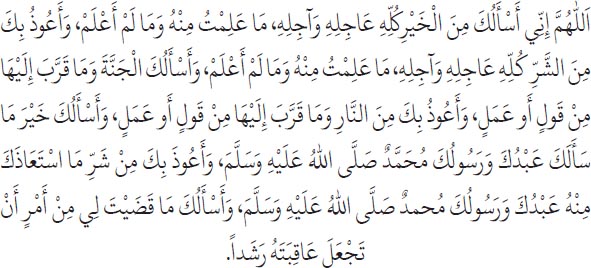
Allāhumma innī as’aluka mina-l-khayri kullihi ‘ājilihi wa ājilih, mā ‘alimtu minhu wa mā lam a‘lam, wa a‘ūdhu bika mina-sh-sharri kullihi ‘ājilihi wa ājilih, mā ‘alimtu minhu wa mā lam a‘lam, Allāhumma innī as’aluka-l-Jannata wa mā qarraba ilayhā min qawlin aw ‘amal, wa a‘ūdhu bika mina-n-Nāri wa mā qarraba ilayhā min qawlin aw ‘amal. Wa as’aluka khayra mā sa’alaka ‘abduka wa Rasūluka Muḥammadun ṣalla-llāhu ‘alayhi wa sallam, wa a‘ūdhu bika min sharri ma-sta‘ādhaka minhu ‘abduka wa Rasūluka Muḥammadun ṣalla-llāhu ‘alayhi wa sallam, wa as’aluka mā qaḍayta lī min amrin an taj‘ala ‘āqibatahu rashadā.”
I have found in the Mustadrak of al-Ḥākim that Ibn Mas‘ūd reported that the du‘ā’ of Allah’s Messenger used to be: “O Allah, we ask You for that which causes Your Mercy and deserves Your forgiveness; for safety from all sin; for the reward of all virtue; for the attainment of Paradise; and for salvation from Hell.” [54].Al-Ḥākim states that this hadith is ṣaḥīḥ according to the conditions of Muslim.
reported that the du‘ā’ of Allah’s Messenger used to be: “O Allah, we ask You for that which causes Your Mercy and deserves Your forgiveness; for safety from all sin; for the reward of all virtue; for the attainment of Paradise; and for salvation from Hell.” [54].Al-Ḥākim states that this hadith is ṣaḥīḥ according to the conditions of Muslim.
Allāhumma innā nas’aluka mūjibāti raḥmatik, wa ‘azā’ima maghfiratik, wa-s-salāmata min kulli ithm, wa-l-ghanīmata min kulli birr, wa-l-fawza bi-l-Jannah, wa-n-najāta mina-n-Nār.
Another narration in [al-Mustadrak] is from Jābir ibn ‘Abdullāh , who related that a man came to the Messenger of Allah and said: “My sins, my sins!” He said this twice or thrice. The Messenger of Allah then told him: “Say: O Allah, Your forgiveness is vaster than my sins, and Your Mercy is more hopeful for me than my deeds.” The man said those words, and then [the Prophet] said: “Repeat.” [The man] repeated them and then he said: “Repeat.” [The man] repeated them. Then [the Prophet ] said to him: “Stand up; Allah has forgiven you.” [55].
, who related that a man came to the Messenger of Allah and said: “My sins, my sins!” He said this twice or thrice. The Messenger of Allah then told him: “Say: O Allah, Your forgiveness is vaster than my sins, and Your Mercy is more hopeful for me than my deeds.” The man said those words, and then [the Prophet] said: “Repeat.” [The man] repeated them and then he said: “Repeat.” [The man] repeated them. Then [the Prophet ] said to him: “Stand up; Allah has forgiven you.” [55].
Allāhumma maghfiratuka awsa‘u min dhunūbī, wa raḥmatuka arjā ‘indī min ‘amalī.
Also in [al-Mustadrak] there is a report from Abū Umāmah that the Messenger of Allah said: “Allah has an angel who has been assigned to those who say: ‘O Most Merciful of those who show mercy.’ If a person says it three times, the angel tells him: ‘The Most Merciful of those who show mercy has turned towards you, so ask.’” [56].
that the Messenger of Allah said: “Allah has an angel who has been assigned to those who say: ‘O Most Merciful of those who show mercy.’ If a person says it three times, the angel tells him: ‘The Most Merciful of those who show mercy has turned towards you, so ask.’” [56].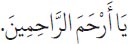
Yā Arḥama-r-Rāḥimīn.
References
[1] Abū Dāwūd (1479), al-Futūḥāt (7/191), and at-Tirmidhī (3244), who states that this hadith is ḥasan ṣaḥīḥ. As-Sakhāwī grades it as ḥasan.
[2] Abū Dāwūd (1428) and al-Futūḥāt (7/192). As-Sakhāwī grades it as ḥasan.
[3] Ibn Mājah (3829) and at-Tirmidhī (3367), who states that this hadith is ḥasan gharīb. As-Sakhāwī grades it as ḥasan gharīb thanks to its supporting narrations.
[4] At-Tirmidhī (3379), who states that this hadith is gharīb. There are, however, narrations which support it, such as the one reported by al-Ḥākim (1/544), who grades it as ṣaḥīḥ; and adh-Dhahabī agrees.
[5] In the Qur’ān this du‘ā ’ begins Rabbanā (‘Our Lord’), rather than All ā humma (‘O Allah’).
[6] See Qur’ān (2:201). Al-Bukhārī (6389), Muslim (2690), and Abū Dāwūd (1519).
[7] Muslim (2721) and at-Tirmidhī (3484).
[8] Muslim (2697, 34, 36).
[9] Muslim (2654), with a slight variant in the wording.
[10] Al-Bukhārī (6616), Muslim (2707), and an-Nasā’ī (8/269–270).
[11] Al-Bukhārī (6367), Muslim (2706), Abū Dāwūd (1540), at-Tirmidhī (3481), and an-Nasā’ī (8/257–258).
[12] Al-Bukhārī (2893).
[13] Al-Bukhārī (834), Muslim (2705), at-Tirmidhī (3521), and an-Nasā’ī (3/53).
[14] The Ṣaḥīḥ of Ibn Khuzaymah (2705), as-Sunan al-kubrā of an-Nasā’ī (9936), Abū Ya‘lā (32), and Ibn as-Sunnī (159).
[15] Al-Bukhārī (6398) and Muslim (2719).
[16] Muslim (2716), Abū Dāwūd (1550), and an-Nasā’ī (3/56).
[17] Muslim (2739) and Abū Dāwūd (1545).
[18] Muslim (2732), at-Tirmidhī (3567), and an-Nasā’ī (8/260).
[19] Muslim (2725).
[20] Muslim (2696).
[21] Muslim (2720).
[22] Al-Bukhārī (7383) and Muslim (2717).
[23] Abū Dāwūd (1493), Ibn Mājah (2857), al-Futūḥāt (7/211), at-Tirmidhī (3471), and al-Ḥākim (1/504), who states that this hadith is ṣaḥīḥ ; adh-Dhahabī agrees. As-Sakhāwī grades it as ḥasan.
[24] Abū Dāwūd (1494) and at-Tirmidhī (3475).
[25] Abū Dāwūd (1495), at-Tirmidhī (3538), Ibn Mājah (3858), an-Nasā’ī (3/52), and al-Ḥākim (1/503–504), who states that this hadith is ṣaḥīḥ; adh-Dhahabī agrees. As-Sakhāwī grades it as ḥasan.
[26] Abū Dāwūd (880), at-Tirmidhī (3489), an-Nasā’ī (8/278) al-Futūḥāt (7/214), and Ibn Mājah (3838). As-Sakhāwī mentions that this supplication contains wording from a ṣaḥīḥ hadith found in the books of al-Bukhārī and Muslim.
[27] At-Tirmidhī (3585) and al-Futūḥāt (7/214). As-Sakhāwī grades this hadith as ḥasan.
[28] That is, “of the private parts.”
[29] Abū Dāwūd (1551), at-Tirmidhī (3487), an-Nasā’ī (8/259–260), and al-Ḥākim (1/533), who states that this hadith is ṣaḥīḥ ; adh-Dhahabī agrees.
[30] Abū Dāwūd (1554) and an-Nasā’ī (8/271).
[31] Abū Dāwūd (1552) and an-Nasā’ī (1/282–283).
[32] Abū Dāwūd (1553).
[33] Abū Dāwūd (1547) and an-Nasā’ī (8/263).
[34] At-Tirmidhī (3558).
[35] At-Tirmidhī (3479), who states that this hadith is gharīb. Ibn Ḥajar grades it as ḥasan.
[36] The Sunan of Abū Dāwūd and the Sunan of an-Nasā’ī.
[37] Abū Dāwūd (1546) and an-Nasā’ī (8/264).
[38] At-Tirmidhī (3517). It is reported from Anas in the book by al-Ḥākim (1/526), who states that it is ṣaḥīḥ ; adh-Dhahabī agrees.
[39] At-Tirmidhī (3476), who states that this hadith is ḥasan gharīb.
[40] At-Tirmidhī (3485).
[41] At-Tirmidhī (3500).
[42] Ibn Mājah (3847) and at-Tirmidhī (3507), who states that this hadith is ḥasan gharīb by this line of narration.
[43] At-Tirmidhī (3509) and Ibn Mājah (3848).
[44] At-Tirmidhī (3516), who states that this hadith is ḥasan gharīb.
[45] Ibn Mājah (3522); and al-Ḥākim (1/498–499), who states that this hadith is ṣaḥīḥ, and adh-Dhahabī agrees.
[46] as-Sunan al-kubrā of an-Nasā’ī (7669).
[47] al-Mustadrak of al-Ḥākim (1:499).
[48] This means, ‘Help me to obey You and do not give power to those who would prevent me from obeying You.’
[49] This means, ‘Give me power over the kāfirūn and do not give them power over me.’
[50] This means that Allah makes one perform acts of obedience but does not accept them from one.
[51] That is, ‘against Your enemies in this world and the Hereafter’.
[52] Abū Dāwūd (1510), at-Tirmidhī (3546), Ibn Mājah (3830), and al-Ḥākim (1/519–520), who states that this hadith is ṣaḥīḥ ; adh-Dhahabī agrees.
[53] Aḥmad (6/137) and Ibn Mājah (3846). Ibn ‘Allān states that this hadith is reported by Ibn Ḥibbān and al-Ḥākim in their Ṣaḥīḥ s, and that it is ḥasan.
[54] Al-Ḥākim (1/525).
[55] Al-Ḥākim (1/543), who comments that none of the narrators’ reputations have been impugned; and adh-Dhahabī agrees.
[56] Al-Ḥākim (1/544).