
KNOW THAT THE chosen position of the jurists, the hadith scholars and the masses of the ‘ulamā’ of all parties of early and later generations is that du‘ā’ is mustaḥabb. Allah  says: “And your Lord has said ‘Call on Me; I will respond to you.’” [1].
says: “And your Lord has said ‘Call on Me; I will respond to you.’” [1].
Allah also says: “Call on your Lord with entreaty and in secret.” [2].
also says: “Call on your Lord with entreaty and in secret.” [2].
The [Qur’ānic] verses in this regard are many and well-known.
As for the authentic hadiths, they are too well-known to cite and too obvious to mention; and we have already cited enough of these recently in the da‘awāt. And success is by Allah.
We relate in the Risālah of Imam Abū al-Qāsim al-Qushayrī  that he said: “People disagree as to whether du‘ā’ is better than silence and contentment. Some hold that du‘ā’ is worship, because of the aforementioned hadith, ‘Du‘ā’ is worship,’ [3].and because du‘ā’ is [a way of] showing one’s need for Allah . Others hold that silence and calmness in the face of Allah’s decree is more perfect, and contentment with what has been ordained is more fitting. Others say that one should be a person who makes du‘ā’ with his tongue but is contented in his heart, so that he fulfils both of these [virtuous acts].”
that he said: “People disagree as to whether du‘ā’ is better than silence and contentment. Some hold that du‘ā’ is worship, because of the aforementioned hadith, ‘Du‘ā’ is worship,’ [3].and because du‘ā’ is [a way of] showing one’s need for Allah . Others hold that silence and calmness in the face of Allah’s decree is more perfect, and contentment with what has been ordained is more fitting. Others say that one should be a person who makes du‘ā’ with his tongue but is contented in his heart, so that he fulfils both of these [virtuous acts].”Al-Qushayrī says: “It is more fitting that one say that moments differ. In some cases du‘ā’ is better than silence and it is the correct etiquette, and in some cases silence is better than du‘ā’ and it is the correct etiquette. That can only be known at the time. If one finds in one’s heart an indication to make du‘ā’ then du‘ā’ is more fitting, and if one finds an indication to be silent then silence is more perfect.”
He also says: “It is correct to say that if there is a share for the Muslims in it or Allah has a right to it, du‘ā’ is better, because it is worship. If it is for oneself, silence is better.”
has a right to it, du‘ā’ is better, because it is worship. If it is for oneself, silence is better.”He also says: “One of the conditions of du‘ā is that one’s food be lawful. Yaḥyā ibn Mu‘ādh ar-Rāzī said: ‘How can I supplicate to You while I am disobedient? And how can I not supplicate to You when You are Generous?’”
said: ‘How can I supplicate to You while I am disobedient? And how can I not supplicate to You when You are Generous?’”One of the rules of making du‘ā’ is [to have] presence of heart. The proof of this will be quoted later, if Allah wills. Some say that what is meant by du‘ā’ is to manifest one’s poverty, for in any case Allah does whatever He wants.
does whatever He wants.Imam al-Ghazālī states in al-Iḥyā’ [4].that the etiquettes of du‘ā’ are ten.
First, waiting for auspicious times, like the Day of ‘Arafah, the month of Ramaḍān, Friday, the last third of the night, and the time before daybreak.
Second, taking advantage of especially favourable circumstances, such as during prostration, when armies join battle, when rain falls, when the iqāmah is called for ṣalāh, and after it. I [Imam an-Nawawī] say: [at times] when one’s heart is soft.
Third, facing the qiblah, raising the hands, and passing them over the face at the end.
Fourth, lowering the voice to a point between silence and being [readily] audible.
Fifth, not making an affectation of rhyme, which has been interpreted as a transgression [of adab] in du‘ā’. It is preferable to restrict oneself to those da‘awāt that have been transmitted, for not everyone is good at du‘ā’ and so one might be in danger of transgressing.
Some say that one should supplicate with the tongue of humility and need, not with a tongue of eloquence and fluency. It is said that the ‘ulamā and the abdāl do not exceed seven phrases in du‘ā’, and this is attested to by what Allah says: “Lord, condemn us not if we forget or fall into error. [Lord, lay not upon us a burden like that which You laid upon those before us. Lord, lay not upon us a burden that we have not the strength to bear. Pardon us, forgive us, and have mercy on us. You are our Protector, so grant us victory over the disbelieving people]”. [5].He has not mentioned more than this in any du‘ā’ [prescribed for His] servants.
says: “Lord, condemn us not if we forget or fall into error. [Lord, lay not upon us a burden like that which You laid upon those before us. Lord, lay not upon us a burden that we have not the strength to bear. Pardon us, forgive us, and have mercy on us. You are our Protector, so grant us victory over the disbelieving people]”. [5].He has not mentioned more than this in any du‘ā’ [prescribed for His] servants.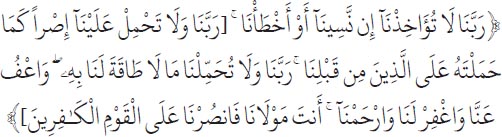
I say that similar to this is the saying of Allah in Sūrat Ibrāhīm: “[Remember] when Ibrāhīm said, ‘Lord, make this city a place of security, and protect my sons and me from worshipping idols.” [6].
in Sūrat Ibrāhīm: “[Remember] when Ibrāhīm said, ‘Lord, make this city a place of security, and protect my sons and me from worshipping idols.” [6].
The preferred view, held by the masses of the ‘ulamā’, is that there is no restriction on [the number of phrases], and that it is not makrūh to say more than seven: on the contrary, it is mustaḥabb to say as much du‘ā’ as possible.
Sixth, humble entreaty, humility and fear. Allah says: “They were ever quick to perform good works; they used to call on Us in yearning and awe and humble themselves before Us.” [7].
says: “They were ever quick to perform good works; they used to call on Us in yearning and awe and humble themselves before Us.” [7].
Allah says: “Call on your Lord with humble entreaty and in private.” [8].
says: “Call on your Lord with humble entreaty and in private.” [8].
Seventh, being committed in one’s request, being convinced it will be accepted and having sincere hope of that. The proofs of this are numerous and well-known. Sufyān ibn ‘Uyaynah, may Allah be merciful to him, said: “No-one should be prevented by what he knows about himself from making du‘ā’, for Allah answered the most evil of His Creation, Iblīs, when “he said, ‘Give me respite until the Day they are resurrected.’ [Allah] said, “Be among those given respite.”’” [9].
answered the most evil of His Creation, Iblīs, when “he said, ‘Give me respite until the Day they are resurrected.’ [Allah] said, “Be among those given respite.”’” [9].Eighth, persistence in making du‘ā’ and repeating it thrice. One should not be impatient about its acceptance and think [the response] slow.
Ninth, beginning one’s du‘ā’ with the remembrance of Allah . I [Imam an-Nawawī] say: “And praying for blessings upon His Messenger  , after praising and extolling Allah. One should also conclude the du‘ā’ the same way.”
. I [Imam an-Nawawī] say: “And praying for blessings upon His Messenger , after praising and extolling Allah. One should also conclude the du‘ā’ the same way.”Tenth, the most important of them and the essential thing for acceptance, is repentance, remedying injustices, and turning towards Allah .
.THE BENEFIT IN DU‘Ā’ DESPITE THE FACT THAT NOTHING CAN UNDO DESTINY
Imam al-Ghazālī says: “If it be asked: ‘What is the benefit of du‘ā’ when destiny cannot be avoided?’ then know that one of the things that are predestined is the avoidance of tribulation by means of du‘ā’. Du‘ā’ is the means of warding off tribulations and for the existence of mercy, just as a shield is the means of defence against a weapon and water is the cause of plants coming out of the earth. As a shield wards off an arrow, so they oppose one another; it is likewise with du‘ā’ and tribulation. It is not a condition of acknowledging and accepting destiny that one not carry a weapon, for Allah says: ‘They should be on their guard and keep hold of their weapons.’ [10].
says: ‘They should be on their guard and keep hold of their weapons.’ [10].
So Allah decrees the event and its means and cause. Among the benefits [of making du‘ā’] are those things we have already mentioned: presence and attention of the heart and neediness, which are the pinnacle of slavehood and gnosis of Allah. And Allah knows best.”
decrees the event and its means and cause. Among the benefits [of making du‘ā’] are those things we have already mentioned: presence and attention of the heart and neediness, which are the pinnacle of slavehood and gnosis of Allah. And Allah knows best.”References
[1] Qur’ān 40:60.
[2] Qur’ān 7:55.
[3] Abū Dāwūd (1479) and at-Tirmidhī (3244).
[4] Iḥyā ’ ‘ulūm ad-dīn (1:304).
[5] Qur’ān 2:286.
[6] Qur’ān 14:35. He means that this long du‘ā’ does not exceed seven requests. “When Ibrāhīm said, ‘My Lord, make this land a place of safety and keep me and my sons from worshipping idols. My Lord, they have misguided many of mankind. If anyone follows me, he is with me; but if anyone disobeys me, You are Ever-Forgiving, Most Merciful. Our Lord, I have settled some of my offspring by Your Sacred House in an uncultivated valley. Our Lord, let them establish ṣalāh . Make the hearts of mankind incline towards them and provide them with fruits, so that perhaps they may be thankful. Our Lord, You know what we keep hidden and what we divulge. Nothing is hidden from Allah either on the earth or in heaven. Praise be to Allah Who, despite my old age, has given me Ismā‘īl and Isḥāq. My Lord is the Hearer of Prayer. My Lord, make me and my descendants people who establish ṣalāh . My Lord, accept my prayer. Our Lord, forgive me and my parents and the believers on the Day the Reckoning takes place.’”
[7] Qur’ān 21:90.
[8] Qur’ān 7:55.
[9] Qur’ān 7:14–15.
[10] Qur’ān 4:102.