
KNOW THAT THE adhkār and da‘awāt of Ḥajj are innumerable, but we will draw attention to the most important. The adhkār of Ḥajj are of two categories: adhkār for the journey and adhkār during the Ḥajj itself. We will defer the adhkār for the journey, because they will be mentioned in the chapters on the adhkār of travelling. Those adhkār which pertain to the actual Ḥajj will be mentioned in the section on the deeds and actions of Ḥajj. I will omit the evidence and the hadiths for most of it, to avoid lengthening the book and boring the reader, since this chapter is very long. I will therefore be brief, Allah willing.
When a person wishes to enter iḥrām [1].he should perform ghusl and wuḍū’ and put on his lower wrapper and upper wrapper. We have already mentioned what to say when performing wuḍū’, bathing, and putting on clothes. Then he should offer two rak‘ahs. We have already mentioned the adhkār of ṣalāh. It is mustaḥabb to recite Qul Yā ayyuha-l-kāfirūn (Sūrah 109) after the Fātiḥah in the first rak‘ah and Qul Huwa-llāhu Aḥad (Sūrah 112) in the second. It is mustaḥabb, after finishing the ṣalāh, to make du‘ā’ for whatever one wishes. We have already mentioned a selection of adhkār for after ṣalāh. When about to put on iḥrām, one should make the intention in one’s heart. It is mustaḥabb to support the heart with the tongue. One should say: I make the intention for Ḥajj, or: I have put on iḥrām for it for the sake of Allah  . At Your service, Allah, at Your service! and the remainder of the talbiyah. The intention is wājib and the words are Sunnah. Saying it with the heart alone suffices, but saying it with the tongue alone will not.
. At Your service, Allah, at Your service! and the remainder of the talbiyah. The intention is wājib and the words are Sunnah. Saying it with the heart alone suffices, but saying it with the tongue alone will not.According to Imam Abū al-Fatḥ Sulaym ibn Ayyūb ar-Razī, it is good to say after this: O Allah, I consecrate my soul, my hair, my skin, my flesh and my blood to You.

Allāhumma laka aḥramu nafsī wa sha‘rī wa basharī wa laḥmī wa damī.
Others state that one should also say: O Allah, I have made intention for Ḥajj, so help me with it and accept it from me.

Allāhumma innī nawaytu-l-Ḥajja fa-a‘innī ‘alayh, wa taqabbalhu minnī.
Then one should say the talbiyah, which is: At Your service, Allah, at Your service. At Your service, You have no partner, at Your service. Truly all praise, favour and sovereignty is Yours; You have no partner.
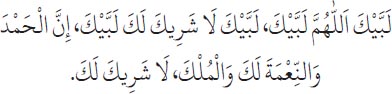
Labbayka-llāhumma labbayk, labbayka lā sharīka laka labbayk, inna-l-ḥamda wa-n-ni‘mata laka wa-l-mulk, lā sharīka lak.
That is the talbiyah of the Messenger of Allah  . It is mustaḥabb to say in the first talbiyah: ‘At Your service for Ḥajj,’ if intending to perform Ḥajj, and to say: ‘At Your service for ‘Umrah,’ if the intention is to put on iḥrām for ‘Umrah. One does not repeat the mention of Ḥajj or ‘Umrah in the talbiyah thereafter, according to the correct and preferred view.
. It is mustaḥabb to say in the first talbiyah: ‘At Your service for Ḥajj,’ if intending to perform Ḥajj, and to say: ‘At Your service for ‘Umrah,’ if the intention is to put on iḥrām for ‘Umrah. One does not repeat the mention of Ḥajj or ‘Umrah in the talbiyah thereafter, according to the correct and preferred view.Know that the talbiyah is Sunnah. If a person leaves it out, his Ḥajj and ‘Umrah will still be valid and he will not have to make any penance; but he will have forfeited immense rewards and the emulation of the Messenger of Allah . This is correct and it is our view and that of the majority of the ‘ulamā’. Some of our [Shāfi‘ī] colleagues say that it is wājib and make it a condition for the validity of the Ḥajj; but the first view is the correct one. All the same, it is mustaḥabb to safeguard it in emulation of the Messenger of Allah and to avoid controversy. And Allah knows best.
. This is correct and it is our view and that of the majority of the ‘ulamā’. Some of our [Shāfi‘ī] colleagues say that it is wājib and make it a condition for the validity of the Ḥajj; but the first view is the correct one. All the same, it is mustaḥabb to safeguard it in emulation of the Messenger of Allah and to avoid controversy. And Allah knows best.If a man puts on iḥrām on behalf of someone else he should say: “I intend to perform Ḥajj and I consecrate this to Allah on behalf of So-and-so.” At Your service, Allah, at Your service on behalf of So-and-so, and the rest of what a person would say when putting on iḥrām for himself.
CONCERNING THE TALBIYAH AND WHAT IS RECOMMENDED IN IT
It is mustaḥabb to ask for peace and blessings upon the Messenger of Allah after the talbiyah, and to make du‘ā’ for oneself and whomever else one wishes, for concerns of this world and the Hereafter. One should ask Allah for His pleasure with one and for Paradise, and seek protection in Him from Hell-Fire. It is mustaḥabb to say the talbiyah abundantly. This is mustaḥabb under all conditions: standing, sitting, walking, riding laying down, dismounting or travelling, in a state of minor or major impurity or during menstruation. It is mustaḥabb [to do it] in changing conditions, times or places, like the coming of night or day, at dawn, the gathering of friends, standing up or sitting down, ascending or descending, riding or dismounting, after ṣalāh and in any mosques. The correct view is that one does not say talbiyah whilst performing ṭawāf or sa‘y, because there are special adhkār for those moments.
after the talbiyah, and to make du‘ā’ for oneself and whomever else one wishes, for concerns of this world and the Hereafter. One should ask Allah for His pleasure with one and for Paradise, and seek protection in Him from Hell-Fire. It is mustaḥabb to say the talbiyah abundantly. This is mustaḥabb under all conditions: standing, sitting, walking, riding laying down, dismounting or travelling, in a state of minor or major impurity or during menstruation. It is mustaḥabb [to do it] in changing conditions, times or places, like the coming of night or day, at dawn, the gathering of friends, standing up or sitting down, ascending or descending, riding or dismounting, after ṣalāh and in any mosques. The correct view is that one does not say talbiyah whilst performing ṭawāf or sa‘y, because there are special adhkār for those moments.It is mustaḥabb to raise the voice while saying talbiyah, unless that is difficult. A woman must not raise her voice, because her voice generates the risk of temptation. It is mustaḥabb to repeat the talbiyah thrice or more. One should say it continually and not interrupt it, whether by speaking or anything else. If someone greets him, he should reply, but it is makrūh to greet people in this condition. If one sees something that impresses him, he should say: I am present; the [real] life is the life of the Hereafter, in imitation of the Messenger of Allah .
.Know that the talbiyah continues to be mustaḥabb until one stones the Jamrat al-‘aqabah on the day of slaughtering or performs ṭawāf al-ifādah, if he does that first. If he starts with one of them, the talbiyah should cease when he starts it. One should then busy himself with takbīr. According to ash-Shāfi‘ī, a person performing ‘Umrah should say the talbiyah until he has touched the corner of the Ka‘bah.
WHAT IT IS RECOMMENDED FOR A PERSON IN IḤRĀM TO SAY WHEN HE REACHES THE ḤARAM OF MAKKAH
When a person in iḥrām reaches the Sanctuary of Makkah, Allah increases him in honour and it is mustaḥabb for him to say: Allah, this is Your sanctuary and security, so make me unlawful to Hell-Fire, make me safe from Your punishment on the day You resurrect Your servants; and make me one of Your friends and one of the people who obey You and let him make whatever du‘ā’ he wishes.
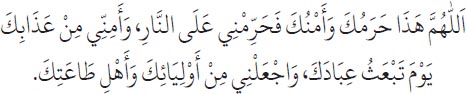
Allāhumma hādhā ḥaramuka wa amnuka fa-ḥarrimnī ‘alā-n-Nār, wa amminnī min ‘adhābika yawma tab‘athu ‘ibādak, wa-j‘alnī min awliyā’ika wa ahli ṭā‘atik.
WHAT IT IS RECOMMENDED FOR THE PERSON IN IḤRĀM TO SAY WHEN HIS GAZE FALLS UPON THE KA‘BAH
When a person enters Makkah and his gaze falls on the Ka‘bah and he reaches the Mosque, it is mustaḥabb for him to lift his hands and supplicate. It is reported that the du‘ā’ of a Muslim is accepted upon seeing the Ka‘bah. One should say: Allah, increase this House in honour, esteem, respect and reverence. And increase those who honour and respect it—of those who perform Ḥajj or ‘Umrah—in honour, respect, esteem and piety.

Allāhumma zid hādhā-l-Bayta tashrīfan wa ta‘ẓīman wa takrīman wa mahābah, wa zid man sharrafahu wa karramahu mimman ḥajjahu awi-‘tamarahu tashrīfan wa takrīman wa ta‘ẓīman wa birrā.
One should also say: O Allah, You are Peace and from You is peace. Make us live, Lord, in peace.

Allāhumma Anta-s-Salāmu wa minka-s-salām, ḥayyinā Rabbanā bi-s-salām.
Then one should make du‘ā’ for all of the good of this world and the Hereafter that he desires. On entering the Mosque, he should say what we have discussed in the beginning of this book about all mosques.
ON THE ADHKĀR OF ṬAWĀF
It is mustaḥabb, when touching the Black Stone the first time and also when commencing ṭawāf, to say: In the name of Allah; Allah is greater. O Allah, with belief in You and faith in Your Book, and in fulfillment of Your pact and following the Sunnah of Your Prophet . It is desirable to repeat this du‘ā’ when coming parallel to the stone in every circumambulation.
. It is desirable to repeat this du‘ā’ when coming parallel to the stone in every circumambulation.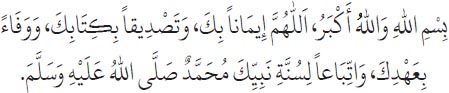
Bismi-llāhi wa-llāhu akbar, Allāhumma īmānan bik, wa taṣdīqan bi-Kitābik, wa wafā’an bi-‘ahdik, wa-ttibā‘an li-Sunnati Nabiyyika Muḥammadin ṣalla-llāhu ‘alayhi wa sallam.
When running in the first three circuits of ṭawāf one should say: O Allah, may my Ḥajj be accepted, my sins forgiven, and my effort rewarded.

Allāhumma-j‘alhu Ḥajjan mabrūrā, wa dhanban maghfūrā, wa sa‘yan mashkūrā.
He should say during the remaining four circuits: O Allah, forgive and have mercy on and pardon that which You know. You are most Mighty and Most Noble.
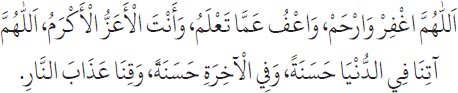
Allāhumma-ghfir wa-rḥam, w-a‘fu ‘ammā ta‘lam, wa Anta-l-A‘azzu-l-Akram. Allāhumma ātinā fi-d-dunyā ḥasanah, wa fi-l-ākhirati ḥasanah, wa qinā ‘adhāba-n-Nār.
According to ash-Shāfi‘ī, the best thing that one can say during ṭawāf is: O Allah our Lord, grant us good in this world . . ..”463 and he said, “I regard it as mustaḥabb that it be said throughout it.”

Allāhumma Rabbanā ātinā fi-d-dunyā ḥasanah . . .
It is mustaḥabb to make du‘ā’, between his ṭawāfs, for whatever one wishes concerning his religious and worldly life. If one person makes du‘ā’ and a group says Āmīn, that is good.
It is reported that al-Ḥasan stated that du‘ā’ is accepted in fifteen places: in ṭawāf; at the Multazimah; under the Mīzāb (waterspout); inside the House [i.e. the Ka‘bah]; at the well of Zamzam; on Ṣafā; on Marwā; on the Mas‘ā; behind the Maqām of Ibrāhīm; on ‘Arafāt; at Muzdalifah; at Minā; and at the three Jamarāt. Anyone who fails to exert himself in du‘ā’ at these places is deprived [of immense benefits].
The position of ash-Shāfi‘ī and the majority of our colleagues is that it is mustaḥabb to recite Qur’ān in ṭawāf, because it is a place and occasion for dhikr and the best dhikr is the recitation of the Qur’ān. Abū ‘Abdullāh al-Ḥalīmī—one of the foremost colleagues of ash-Shāfi‘ī—chose the position that the recitation of Qur’ān during [ṭawāf]is not mustaḥabb. The correct view is the first-mentioned. Our colleagues state that recitation is better than those da‘awāt which have not been conveyed from the Messenger of Allah . Those da‘awāt which have been conveyed from the Messenger of Allah are better than recitation, according to the correct view. Others say that recitation is better. Abū Muḥammad al-Juwaynī said: “It is mustaḥabb to recite the entire Qur’ān in ṭawāf during the days of Ḥajj, and the reward is great.” And Allah knows best.
. Those da‘awāt which have been conveyed from the Messenger of Allah are better than recitation, according to the correct view. Others say that recitation is better. Abū Muḥammad al-Juwaynī said: “It is mustaḥabb to recite the entire Qur’ān in ṭawāf during the days of Ḥajj, and the reward is great.” And Allah knows best.It is mustaḥabb, after finishing ṭawāf and the two rak‘ahs of ṣalāh of ṭawāf, to make du‘ā’ for whatever one wishes. Among the da‘awāt which have been transmitted is: O Allah, I am Your servant and the son of two of Your servants. I have come to You with many sins and evil deeds. This is the sanctuary of those who seek protection in You from Hell-Fire, so forgive me. Surely You are the Most Forgiving, the Most Merciful.

Allāhumma anā ‘abduk wa-bnu ‘abdayk, ataytuka bi-dhunūbin kathīratin wa a‘mālin sayyi’ah, wa hādhā maqāmu-l-‘ā’idhi bika mina-n-Nāri fa-ghfir lī, innaka Anta-l-Ghafūru-r-Raḥīm.
DU‘Ā’ AT THE MULTAZAM, WHICH IS IN BETWEEN THE DOOR OF THE KA‘BAH AND THE BLACK STONE
As we said earlier, du‘ā’ is answered at the Multazam, which is between the door of the Ka‘bah and the Black Stone. One of the da‘awāt is: O Allah, to You belongs all praise, praise that is commensurate with Your bounties and equal to Your abundance. I praise You with all of Your praises—those which I know and those which I do not know—for all of Your favours—those which I know and those which I do not know—and under all conditions. O Allah, convey blessings and salutations to Muḥammad and on the family of Muḥammad. O Allah, protect me from Shayṭān the rejected, and protect me from all evil. Make me content with what You have given me as sustenance, and bless me in it. O Allah, make me one of the most noble delegation to You. Make me adhere to the path of steadfastness until I meet You, Lord of the Universe. [2].Then the pilgrim should make du‘ā’ for whatever he likes.
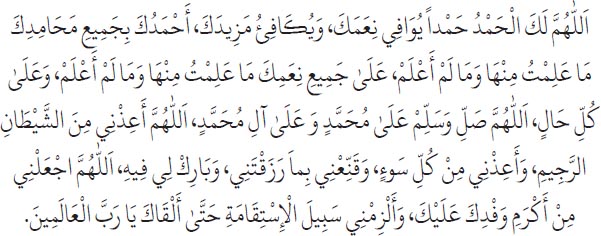
Allāhumma laka-l-ḥamdu ḥamdan yuwāfī ni‘amak, wa yukāfī mazīdak. Aḥmaduka bi-jamī‘i maḥāmidika mā ‘alimtu minhā wa mā lam a‘lam, wa ‘alā jamī‘i ni‘amika mā ‘alimtu minhā wa mā lam a‘lam, wa ‘alā kulli ḥāl. Allāhumma ṣalli ‘alā Muḥammadin wa ‘alā āli Muḥammad. Allāhumma a‘idhnī mina-sh-Shayṭāni-r-rajīm, wa a‘idhnī min kulli sū’, wa qanni‘nī bi-mā razaqtanī wa bārik lī fīh. Allāhumma-j‘alnī min akrami wafdika ‘alayk, wa alzimnī sabīla-l-istiqāmati ḥattā alqāka yā Rabba-l-‘ālamīn.
DU‘Ā’ IN THE ḤIJR
Al-Ḥijr has a kasrah on the ḥā’ and a sukūn on the jīm, and it is counted as part of the House. We have shown above that du‘ā’ in it is answered. Among the da‘awāt is: O Lord, I have come to You from afar, hoping for Your kindness and grace. Make me attain to enough of Your kindness to make me independent of the kindness of others beside You, O You Who are known for kindness. [3].

Yā Rabbi ataytuka min shiqqatin ba‘īdatin mu’ammilan ma‘rūfaka fa-anilnī ma‘rūfan min ma‘rūfika tughnīnī bihi ‘an ma‘rūfi man siwāk, yā Ma‘rūfan bi-l-ma‘rūf.
DU‘Ā’ IN THE HOUSE
We stated earlier that du‘ā’ within the House is answered. We relate in the Book of an-Nasā’ī from Usāmah ibn Zayd  , who reported that when the Messenger of Allah entered the House he went to the wall facing the back of the Ka‘bah and placed his face and cheek on it. He praised Allah and extolled Him, appealed to Him and asked Him for forgiveness. Then he turned to one of the corners of the Ka‘bah with takbīr, tahlīl and tasbīḥ, extolling Allah and pleading to Him and begging forgiveness. Then he left. [4].
, who reported that when the Messenger of Allah entered the House he went to the wall facing the back of the Ka‘bah and placed his face and cheek on it. He praised Allah and extolled Him, appealed to Him and asked Him for forgiveness. Then he turned to one of the corners of the Ka‘bah with takbīr, tahlīl and tasbīḥ, extolling Allah and pleading to Him and begging forgiveness. Then he left. [4].DU‘Ā’ DURING SA‘Y
We have stated earlier that du‘ā’ in sa‘y is answered. It is Sunnah to prolong standing on Ṣafā, to face the Ka‘bah and make takbīr, and to supplicate by saying: Allah is greater, Allah is greater, Allah is greater. To Allah belongs all praise. Allah is greater for what He has guided us to. Praise be to Allah for what He has granted us. There is no god but Allah. He is Alone and has no partner. To Him belongs sovereignty and to Him belongs all praise. He gives life and causes death; in His hands is all good; and He has power over all things. There is no god but Allah; He fulfilled His promise, assisted His slave and defeated the tribes on His own. There is no god but Allah and we worship none but Him, performing our religion sincerely for Him, even if the disbelievers dislike it. O Allah, You have said: “Call on Me and I will answer your prayers.” You do not break Your promise. I ask You, as You have guided me to Islam, not to strip me of it, so that You cause me to die as a Muslim.
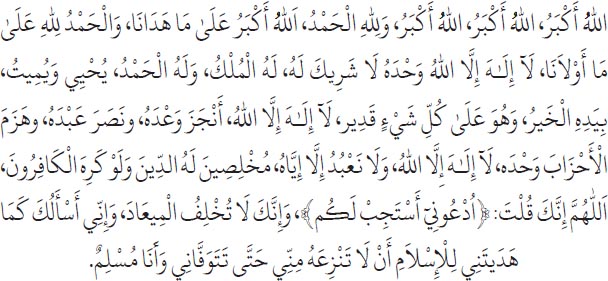
Allāhu akbar, Allāhu akbar, Allāhu akbar, wa li-llāhi-l-ḥamd. Allāhu akbaru ‘alā mā hadānā, wa-l-ḥamdu li-llāhi ‘alā mā awlānā, lā ilāha illa-llāhu waḥdahu lā sharīka lah, lahu-l-mulk, wa lahu-l-ḥamd, yuḥyī wa yumīt, bi-yadihi-l-khayr, wa Huwa ‘alā kulli shay’in qadīr. Lā ilāha illa-llāh, anjaza wa‘dah, wa naṣara ‘abdah, wa hazama-l-aḥzāba waḥdah, lā ilāha illa-llāh, wa lā na‘budu illā iyyāh, mukhliṣīna lahu-d-dīna wa law kariha-l-kāfirūn. Allāhumma innaka qulta: Ud‘ūnī astajib lakum, wa innaka lā tukhlifu-l-mī‘ād, wa innī as’aluka kamā hadaytanī li-l-Islāmi an lā tanzi‘ahu minnī ḥattā tatawaffānī wa anā Muslim.
Then the pilgrim should supplicate for good in this world and the Hereafter. He should repeat this dhikr and du‘ā’ thrice. He should not say the talbiyah. When he reaches Marwah he should ascend it and say the same dhikr and du‘ā’ that he said on Ṣafā.

Allāhu akbar, Allāhu akbar, Allāhu akbar.
We narrated that Ibn ‘Umar  said while on Ṣafā: “O Allah protect us by Your Dīn and obedience to You and obedience to Your Messenger, may Allah bless him and grant him peace, and avert us from [contravening] Your limits. O Allah, make us love You and love Your angels, and Your Messengers and Prophets, and make us love Your righteous servants. O Allah, make us beloved to You, to Your angels, to Your Messengers and Prophets, and to Your righteous servants. O Allah, make the easy easy for us to attain and ward off from us the difficult. Forgive us in the Hereafter and this world and make us leaders of the God-fearing.” [5].
said while on Ṣafā: “O Allah protect us by Your Dīn and obedience to You and obedience to Your Messenger, may Allah bless him and grant him peace, and avert us from [contravening] Your limits. O Allah, make us love You and love Your angels, and Your Messengers and Prophets, and make us love Your righteous servants. O Allah, make us beloved to You, to Your angels, to Your Messengers and Prophets, and to Your righteous servants. O Allah, make the easy easy for us to attain and ward off from us the difficult. Forgive us in the Hereafter and this world and make us leaders of the God-fearing.” [5].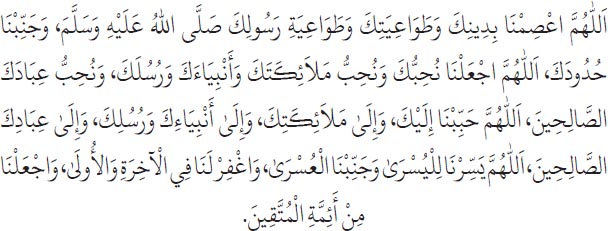
Allāhumma-‘ṣimnā bi-dīnika wa ṭawā‘iyatika wa ṭawā‘iyati Rasūlika ṣalla-llāhu ‘alayhi wa sallam, wa jannibnā ḥudūdak. Allāhumma-j‘alnā nuḥibbuka wa nuḥibbu malā’ikataka wa Anbiyā’aka wa Rusulak, wa nuḥibbu ‘ibādaka-ṣ-ṣāliḥīn. Allāhumma ḥabbibnā ilayk, wa ilā malā’ikatik, wa ilā Anbiyā’ika wa Rusulik, wa ilā ‘ibādika-ṣ-ṣāliḥīn. Allāhumma yassirnā li-l-yusrā, wa jannibnā-l-‘usrā, wa-ghfir lanā fi-l-ākhirati wa-l-ūlā, wa-j‘alnā min a’immati-l-muttaqīn.
When going between Ṣafā and Marwah one should say: O my Lord, forgive, have mercy, and pardon that which You know. Truly You are the Most Mighty, the Most Noble. O Allah, grant us good in this world and in the Hereafter, and protect us from the punishment of Hell-Fire.
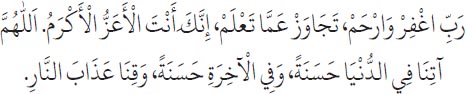
Rabbi-ghfir wa-rḥam, tajāwaz ‘ammā ta‘lam, wa Anta-l-A‘azzu-l-Akram. Allāhumma ātinā fi-d-dunyā ḥasanah, wa fi-l-ākhirati ḥasanah, wa qinā ‘adhāba-n-Nār.
Among the da‘awāt chosen for sa‘y, and for every place, is: O Allah, Turner of hearts, make my heart firm in Your religion. O Allah, I ask You for that which brings Your Mercy, the resolution of Your forgiveness, security from all sin, triumph in Paradise, and deliverance from Hell-Fire. O Allah, I ask of You guidance and piety and modesty and independence. O Allah, assist me in Your remembrance, gratitude to You, and excellent worship of You. O Allah, I ask You of all good—that which I know and that which I do not know. I seek Your protection from all evil—that which I know and that which I do not know. I ask You for Paradise and those words and deeds which draw one close to it. And I seek Your protection from Hell and words and deeds which draw one close to it.
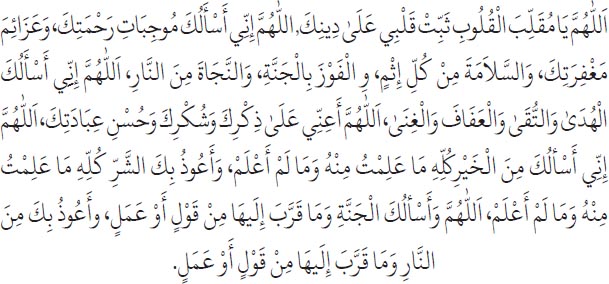
Allāhumma yā Muqalliba -l-qulūbi thabbit qalbī ‘alā dīnik. Allāhumma innī as’aluka mūjibāti raḥmatik, wa ‘azā’ima maghfiratik, wa-s-salāmata min kulli ithm, wa-l-fawza bi-l-Jannah, wa-n-najāta mina-n-Nār. Allāhumma innī as’aluka-l-hudā wa-t-tuqā wa-l-‘afāfa wa-l-ghinā. Allāhumma a‘innī ‘alā dhikrika wa shukrika wa ḥusni ‘ibādatik. Allāhumma innī as’aluka min al-khayri kullihi mā ‘alimtu minhu wa mā lam a‘lam. Wa a‘ūdhu bika mina-sh-sharri kullihi mā ‘alimtu minhu wa mā lam a‘lam. Wa as’aluka-l-Jannata wa mā qarraba ilayhā min qawlin aw ‘amal, wa a‘ūdhu bika mina-n-Nāri wa mā qarraba ilayhā min qawlin aw ‘amal.
To recite Qur’ān is better. One ought to combine these adhkār and da‘awāt with recitation of Qur’ān. If a person can only do one, he should do whichever is the most important.
THE ADHKĀR WHICH ONE SAYS WHEN LEAVING MAKKAH FOR ‘ARAFĀT
It is mustaḥabb, when leaving Makkah to go to Minā, to say O Allah, for You I hope and on You I call, so make me attain my pious hopes, and forgive me my sins, and bestow on me what You have bestowed on those who obey You. Truly You have power over all things. [6].

Allāhumma iyyāka arjū, wa laka ad‘ū, fa-ballighnī ṣāliḥa amalī, wa-ghfir lī dhunūbī, wa-mnun ‘alayya bi-mā mananta ‘alā ahli ṭā‘atik, innaka ‘alā kulli shay’in qadīr.
When setting off from Minā to ‘Arafāt one should say: O Allah, to You I turn and Your Noble Countenance I seek; so forgive my sins, accept my pilgrimage, have mercy on me, and do not let me fail; You have power over all things. [7].

Allāhumma ilayka tawajjaht, wa wajhaka-l-karīma aradt, fa-j‘al dhanbī maghfūrā, wa Ḥajjī mabrūrā, wa-rḥamnī wa lā tukhayyibnī, innaka ‘alā kulli shay’in qadīr.
One should say the talbiyah, recite the Qur’ān and say a great deal of adhkār, du‘ā’ and [Allah’s] words: O Allah, grant us good in this world and in the Hereafter and spare us the punishment of Hell-Fire.

Allāhumma ātinā fi-d-dunyā ḥasanah, wa fi-l-ākhirati ḥasanah, wa qinā ‘adhāba-n-Nār.
THE ADHKĀR AND DU‘Ā’S THAT ARE MUSTAḤABB AT ‘ARAFĀT
We have mentioned, discussing the adhkār of ‘Īd, the hadith in which the Messenger of Allah said: “The best du‘ā’ is on the Day of ‘Arafāt; and the best that I and all the Prophets before me have said is: There is no god but Allah. He is One and has no partner. To Him belongs sovereignty and to Him belongs all praise, and He has power over all things.”
said: “The best du‘ā’ is on the Day of ‘Arafāt; and the best that I and all the Prophets before me have said is: There is no god but Allah. He is One and has no partner. To Him belongs sovereignty and to Him belongs all praise, and He has power over all things.”
Lā ilāha illa-llāhu waḥdahu lā sharīka lah, lahu-l-mulk, wa lahu-l-ḥamd, wa Huwa ‘alā kulli shay’in qadīr.
It is mustaḥabb to say dhikr and du‘ā’ in abundance, and to exert oneself in this. This is the best day of the year for du‘ā’ and it is the greatest aspect of the Ḥajj and its purpose; and it is what [the Ḥajj] is based on. It is essential that one devote every effort to doing dhikr, making du‘ā’, reciting Qur’ān, supplicating with various da‘awāt and performing a variety of adhkār. The pilgrim should make du‘ā’ for himself and do dhikr at every place. He should supplicate alone and in a group. He should make du‘ā’ for himself, his parents, his relatives, his mentors, his companions, friends and loved ones, all those who have treated him well, and all the Muslims. He should be extremely careful not to neglect any of these, because he will not be able to make amends for it, unlike other acts. He should not burden himself with making his du‘ā’ rhyme, for that would engross his heart and remove his lowliness, self-abasement, neediness, poverty, humility and submission. There is no harm in supplicating with a rhymed du‘ā’ that one has memorised, as long as one does not distract himself with the encumbrance of its order and grammar.
It is Sunnah to lower the voice in du‘ā’ and to increase in asking for forgiveness and articulating repentance for all transgressions, coupled with belief in one’s heart and persistence and repetition of the du‘ā’. The pilgrim should not consider the acceptance and answering of his du‘ā’ to be slow. He should start and end his du‘ā’ with praise and exaltation of Allah , and asking for peace and blessings upon the Messenger of Allah . He should be careful to face the Ka‘bah and to be in a state of ritual purity.
, and asking for peace and blessings upon the Messenger of Allah . He should be careful to face the Ka‘bah and to be in a state of ritual purity.‘Alī reported that the greater part of the du‘ā’ of the Prophet on the Day of ‘Arafāt at the Place of Standing was: “O Allah, to You belongs praise like that which we say and better than we can say. O Allah, my ṣalāh, my sacrifice, my life and my death are for you. To You is my return and for You is my legacy. I seek Your protection from punishment in the grave, delusion in the heart, and disunity in my affairs. O Allah, I seek Your protection from the evil of that which the wind brings.” [8].
reported that the greater part of the du‘ā’ of the Prophet on the Day of ‘Arafāt at the Place of Standing was: “O Allah, to You belongs praise like that which we say and better than we can say. O Allah, my ṣalāh, my sacrifice, my life and my death are for you. To You is my return and for You is my legacy. I seek Your protection from punishment in the grave, delusion in the heart, and disunity in my affairs. O Allah, I seek Your protection from the evil of that which the wind brings.” [8].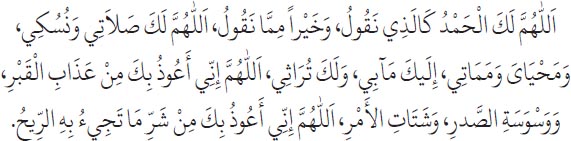
Allāhumma laka-l-ḥamdu ka-lladhī naqūl, wa khayran mimmā naqūl. Allāhumma laka ṣalātī wa nusukī, wa maḥyāya wa mamātī, ilayka ma’ābī, wa laka turāthī. Allāhumma innī a‘ūdhu bika min ‘adhābi-l-qabr, wa waswasati-ṣ-ṣadr, wa shatāti-l-amr, Allāhumma innī a‘ūdhu bika min sharri mā tajī’u bihi-r-rīḥ.
It is mustaḥabb to say the talbiyah many times between repetitions of this, and also to invoke peace and blessings upon the Messenger of Allah , and to weep copiously in dhikr and du‘ā’. For it is here [at ‘Arafāt] that tears are shed, the absolution of faults is sought and the fulfilment of petitions is expected. It is an immense place and a magnificent gathering. The best of the sincere servants of Allah gather in it, and it is the greatest gathering in the world.
, and to weep copiously in dhikr and du‘ā’. For it is here [at ‘Arafāt] that tears are shed, the absolution of faults is sought and the fulfilment of petitions is expected. It is an immense place and a magnificent gathering. The best of the sincere servants of Allah gather in it, and it is the greatest gathering in the world.The following are some of the most favoured du‘ās:
Allah, grant us good in this world and good in the Hereafter, and spare us the punishment of Hell-Fire.

Allāhumma ātinā fi-d-dunyā ḥasanah, wa fi-l-ākhirati ḥasanah, wa qinā ‘adhāba-n-Nār.
O Allah, I have wronged myself greatly and none forgives sins but You. So grant me Your forgiveness and have mercy on me. You are the Most Forgiving and the Most Merciful.

Allāhumma innī ẓalamtu nafsī ẓulman kathīrā, wa innahū lā yaghfiru-dh-dhunūba illā Anta fa-ghfir lī maghfiratan min ‘indik, wa-rḥamnī. Innaka Anta-l-Ghafūru-r-Raḥīm.
O Allah, give me such forgiveness as will rectify my affairs in both Worlds, and have such mercy on me that I may be gladdened by it in both Worlds. Grant me such sincere repentance that I never go back on it ever. Make me adhere to the path of steadfastness and make me never deviate from it.
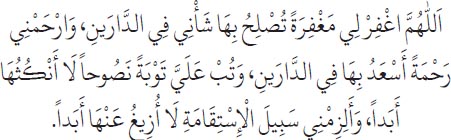
Allāhumma-ghfir lī maghfiratan tuṣliḥu bihā sha’nī fi-d-dārayn, wa-rḥamnī raḥmatan as‘adu bihā fi-d-dārayn, wa tub ‘alayya tawbatan naṣūḥan lā ankuthuhā abadā, wa-lzimnī sabīla-l-istiqāmati lā uzīghu ‘anhā abadā.
O Allah, take me from the disgrace of sin to the honour of obedience. Make me independent of the unlawful by the lawful; and of disobedience to You by obedience to You; and of all besides You, by Your Grace.

Allāhumma-nqulnī min dhulli-l-ma‘ṣiyati ilā ‘izzi-ṭ-ṭā‘ah, wa aghninī bi-ḥalālika ‘an ḥarāmik, wa bi-ṭā‘atika ‘an ma‘ṣiyatik, wa bi-faḍlika ‘amman siwāk.
Enlighten my heart and my grave, protect me from all evil, and amass for me all goodness.

Wa nawwir qalbī wa qabrī, wa a‘idhnī mina-sh-sharri kullih, wa-jma‘ liya-l-khayra kullah.
DA‘AWĀT THAT ARE MUSTAḤABB WHEN SETTING OUT FROM ‘ARAFĀT FOR MUZDALIFAH
As was stated earlier, it is mustaḥabb to say talbiyah at all places in abundance, and this is the most essential place of all. One should recite Qur’ān and make du‘ā’ as much as possible. It is mustaḥabb to say: There is no god but Allah and Allah is greater [9].and to repeat that and to say: O Allah, it is You Whom I desire and You I hope for, so accept my rituals and grant me ability. Grant me in it better than that which I seek. Do not let me fail. You are Allah, the Most Generous and the Most Gracious.

Allāhumma ilayka arghab, wa iyyāka arjū fa-taqabbal nusukī, wa waffiqnī, wa-rzuqnī fīhi mina-l-khayri akthara mimmā aṭlub, wa lā tukhayyibnī. Innaka-llāhu-l-Jawādu-l-Karīm.
That night is one of the nights of ‘Īd. We have already mentioned the merit of spending it in dhikr and du‘ā’. Combined with the dignity of the night is the dignity of the place; of being in the Holy Sanctuary, in a state of iḥrām and in the company of the pilgrims, and of having performed these tremendous acts of worship and noble supplications in the appointed places.
THE ADHKĀR THAT ARE MUSTAḤABB AT THE HOLY SANCTUARY
Allah says: “Then when you pour down from (Mount) ‘Arafāt, celebrate the praises of Allah at the sacred monument, and celebrate His praises as He has guided you, even though you were indeed astray before.” [10].
says: “Then when you pour down from (Mount) ‘Arafāt, celebrate the praises of Allah at the sacred monument, and celebrate His praises as He has guided you, even though you were indeed astray before.” [10].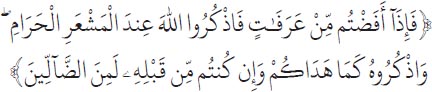
So it is mustaḥabb to say du‘ā’ in abundance at Muzdalifah on that night and to recite talbiyah, adhkār and Qur’ān, because it is an auspicious night, as we stated in the previous section. Among the da‘awāt mentioned is: O Allah, I ask You to grant me all good at this place, to rectify all my affairs, and to turn away from me all evil, for none does that but You and none bestows that but You.

Allāhumma innī as’aluka an tarzuqanī fī hādha-l-makāni jawāmi‘a-l-khayri kullih, wa an tuṣliḥa sha’nī kullah, wa an taṣrifa ‘anni-sh-sharra kullah, fa-innahu lā yaf‘alu dhālika ghayruk, wa lā yajūdu bihi illā Ant.
When performing the Ṣubḥ ṣalāh on this day, the pilgrim should perform it at the start of its time and go to great lengths to do it early. Then he should go to the Holy Sanctuary, which is a small mountain at the farthest point of Muzdalifah, called Quzaḥ, with a ḍammah on the qāf and a fatḥah on the zāy. If he can, he should ascend it; if he cannot, he should stand below it facing the Ka‘bah. He should say takbīr, tahlīl, declare His unity and say tasbīḥ, and recite abundant talbiyah and du‘ā’. It is mustaḥabb to say: O Allah, as You have given us ability and You have made us see it, so give us the ability to remember You as You have guided us. Forgive us and have mercy on us as You have promised us. Your Word is the truth: “Then when you pour down from (Mount) ‘Arafāt, celebrate the praises of Allah at the sacred monument, and celebrate His praises as He has guided you, though you were astray before. Then pass on at a quick pace from the place whence it is usual for the multitude so to do. And ask for Allah’s forgiveness, for Allah is Oft-Forgiving, Most Merciful.” [11].
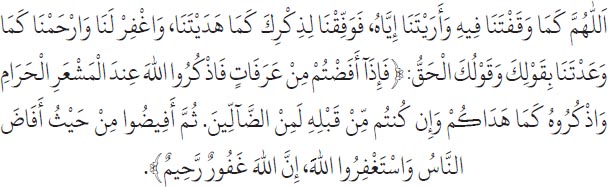
Allāhumma kamā waqaftanā fīhi wa araytanā iyyāh, fa-waffiqnā li-dhikrika kamā hadaytanā, wa-ghfir lanā wa-rḥamnā kamā wa‘adtanā bi-qawlika wa qawluka-l-Ḥaqq: Fa-idhā afaḍtum min ‘Arafātin fa-dhkuru-llāha ‘inda-l-mash‘ari-l-ḥarāmi wa-dhkurūhu kamā hadākum wa in kuntum min qablihi la-mina-ḍ-ḍāllīn, thumma afīḍū min ḥaythu afāḍa-n-nāsu wa-staghfiru-llāh, inna-llāhu Ghafūru-r-Raḥīm.
One should say repeatedly: “Our Lord, grant us good in this world and good in the Hereafter, and spare us the punishment of Hell-Fire.” [12].

Rabbanā ātinā fi-d-dunyā ḥasanatan wa fi-l-ākhirati ḥasanatan wa qinā ‘adhāba-n-Nār.
It is mustaḥabb to say: O Allah, to You belongs all praise, to You belongs all perfection, to You belongs all grandeur and to You belongs all sanctification. O Allah, forgive me for all the sins I have done in the past and protect me from that which remains. Grant me pious deeds which will make You pleased with me, O Owner of immense bounty.
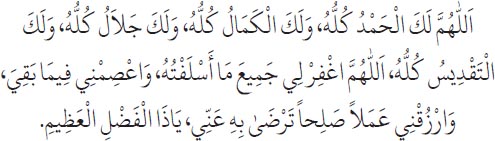
Allāhumma laka-l-ḥamdu kulluh, wa laka-l-kamālu kulluh, wa laka jalālu kulluh, wa laka-t-taqdīsu kulluh. Allāhumma-ghfir lī jamī‘a mā aslaftuh, wa‘ṣimnī fīmā baqī, wa-rzuqnī ‘amalan ṣāliḥan tarḍā bihi ‘annī, yā Dhā-l-faḍli-l-‘aẓīm.
O Allah, I seek intercession with You through Your chosen servants and I seek access to you by You. I ask You to provide me all good and to bestow on me what You have bestowed on Your friends; and that you correct my condition in the Hereafter and in this world, Most Merciful of those who show mercy.
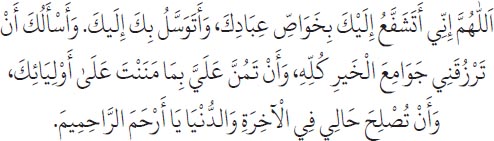
Allāhumma innī atashaffa‘u ilayka bi-khawāṣṣi ‘ibādik, wa atawassalu bika ilayk, wa as’aluka an tarzuqanī jawāmi‘a-l-khayri kullih, wa an tamunna ‘alayya bi-mā mananta ‘alā awliyā’ik, wa an tuṣliḥa ḥālī fī-l-ākhirati wa-d-dunyā yā Arḥama-r-rāḥimīn.
ADHKĀR WHICH ARE MUSTAḤABB WHEN GOING FROM THE HOLY SANCTUARY TO MINĀ
When the dawn lightens, the pilgrim will set off from the Holy Sanctuary, going towards Minā. The rituals here are talbiyah, dhikr and du‘ā’ and these should be recited abundantly. One should be zealous about the talbiyah, for these are the last moments for it and he may not be able to do it again in his lifetime.
ADHKĀR WHICH ARE MUSTAḤABB AT MINĀ ON THE DAY OF THE SACRIFICE
When the pilgrim has set off from the Holy Sanctuary and reached Minā it is mustaḥabb to say: Praise be to Allah, Who has made me reach this place safe and sound. O Allah, this is Minā; I have come to it, and I am Your servant and under Your authority. I ask You to bestow upon me that which You have bestowed upon Your friends. O Allah, I seek Your protection from deprivation and calamity in my religion, Most Merciful of those who show mercy.
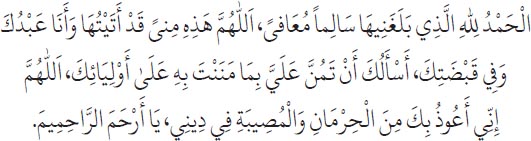
Al-ḥamdu li-llāhi-lladhī balaghanīhā sāliman mu‘āfā. Allāhumma hādhihi Minā qad ataytuhā wa anā ‘abduka wa fī qabḍatik, as’aluka an tamunna ‘alayya bi-mā mananta bihi ‘alā awliyā’ik. Allāhumma innī a‘ūdhu bika mina-l-ḥirmāni wa-l-muṣībati fī dīnī, yā Arḥama-r-rāḥimīn.
While stoning the jamarat al-‘aqabah, one should stop the talbiyah with the first stone that he throws. He should engage in takbīr and say the takbīr with every stone. It is not Sunnah to stand and make du‘ā’. If one has a hady animal with him he should slaughter it by dhabḥ [if a sheep or cattle] or naḥr [if a camel]. It is mustaḥabb to say, when slaughtering: In the name of Allah, Allah is greater. O Allah, convey blessings and salutations to Muḥammad and his family. O Allah, this is from You and for You, so accept it from me. (Or accept it from So-and-so if the sacrifice is for someone else.)
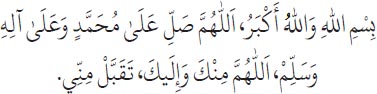
Bismi-llāhi wa-llāhu akbar, Allāhumma ṣalli ‘alā Muḥammadin wa ‘alā ālihi wa sallim, Allāhumma minka wa ilayk, taqabbal minnī.
Some of the ‘ulamā’ say that when a man shaves his head after slaughtering [the animal], it is mustaḥabb for him to hold his own forelock, say takbīr thrice, and say: Praise be to Allah for what He has guided us to, and all praise is due to Allah for what He has favoured us with. O Allah, this is my forelock, so accept it from me and forgive my sins. O Allah, forgive me and those who shave and shorten [their hair], You Who are Vast in forgiveness. O Allah, accept my du‘ā’.
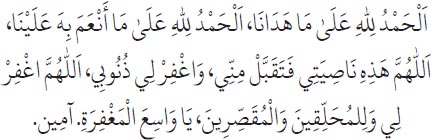
Al-ḥamdu li-llāhi ‘alā mā hadānā, al-ḥamdu li-llāhi ‘alā mā an‘ama bihi ‘alaynā, Allāhumma hādhihi nāṣiyatī fa-taqabbal minnī, wa-ghfir lī dhunūbī. Allāhumma-ghfir lī wa li-l-muḥalliqīna wa-l-muqaṣṣirīn, yā Wāsi‘a-l-maghfirah. Āmīn.
When he has finished shaving, he should say the takbīr and say: Praise be to Allah, Who has completed for us these rituals. O Allah, increase us in faith, certainty, ability and assistance, and forgive us and our fathers and mothers and all the Muslims.

Al-ḥamdu li-llāhi-lladhī qaḍā ‘annā nusukā Allāhumma zidnā īmānan wa yaqīnā, wa tawfīqan wa ‘awnā, wa-ghfir lanā wa li-ābā’inā wa ummahātinā wa-l-Muslimīna ajma‘īn.
THE ADHKĀR WHICH ARE MUSTAḤABB AT MINĀ ON THE DAYS OF TASHRĪQ
We relate in the Ṣaḥīḥ of Muslim, from Nubayshah al-Khayr who reported that the Messenger of Allah said: “The Days of Tashrīq are days of eating and drinking and remembrance of Allah.” [13].It is mustaḥabb to do dhikr in abundance, the best of this being the recitation of Qur’ān. It is Sunnah, on the days of stoning, to stand at the first jamarah, facing the Ka‘bah, and praise Allah, saying takbīr, tahlīl and tasbīḥ. One should make du‘ā’ with presence of heart, humility, and submission, and one should remain there for as long as it takes to recite Sūrat al-Baqarah. One should do the same at the next, which is al-jamarat al-wusṭā, but not stand at the third, which is jamarat al-‘aqabah.
who reported that the Messenger of Allah said: “The Days of Tashrīq are days of eating and drinking and remembrance of Allah.” [13].It is mustaḥabb to do dhikr in abundance, the best of this being the recitation of Qur’ān. It is Sunnah, on the days of stoning, to stand at the first jamarah, facing the Ka‘bah, and praise Allah, saying takbīr, tahlīl and tasbīḥ. One should make du‘ā’ with presence of heart, humility, and submission, and one should remain there for as long as it takes to recite Sūrat al-Baqarah. One should do the same at the next, which is al-jamarat al-wusṭā, but not stand at the third, which is jamarat al-‘aqabah.ON THE TAKBĪR, THE TAḤLĪL AND OTHER THINGS BEING MUSTAḤABB ON THE CONCLUSION OF THE ḤAJJ BY SETTING OFF FROM MINĀ
When the pilgrim sets off from Minā, there remain no adhkār that are specific to Ḥajj, but he is still a traveller. It is mustaḥabb for him to say takbīr, tahlīl, taḥmīd, tamjīd and other adhkār which are mustaḥabb for the traveller. The explanation of this will follow, if Allah wills.
If he enters Makkah intending ‘Umrah he should do the same adhkār during his ‘Umrah that he would do on the Ḥajj during those rituals that the Ḥajj and ‘Umrah have in common, which are iḥrām, ṭawāf, sa‘y, sacrifice and shaving the head. And Allah knows best.
WHAT TO SAY WHEN DRINKING ZAMZAM WATER
We relate from Jābir , who narrated that the Messenger of Allah said: “Zamzam water is for what it is drunk for.” [14].Such has been the practice of the ‘ulamā’ and the virtuous; they drank it for their lofty purposes and achieved them. According to the ‘ulamā’, it is mustaḥabb for anyone who drinks it for forgiveness, cure from an ailment or any other reason, to say when drinking: O Allah, it has been conveyed to me that the Messenger of Allah said: “The water of Zamzam is for what it is drunk for.” O Allah, I have drunk it so that You may forgive me and that You may do such-and-such for me; so forgive me and do so. Alternatively, one may say: O Allah, I have drunk it seeking a cure, so cure me. And Allah knows best.
, who narrated that the Messenger of Allah said: “Zamzam water is for what it is drunk for.” [14].Such has been the practice of the ‘ulamā’ and the virtuous; they drank it for their lofty purposes and achieved them. According to the ‘ulamā’, it is mustaḥabb for anyone who drinks it for forgiveness, cure from an ailment or any other reason, to say when drinking: O Allah, it has been conveyed to me that the Messenger of Allah said: “The water of Zamzam is for what it is drunk for.” O Allah, I have drunk it so that You may forgive me and that You may do such-and-such for me; so forgive me and do so. Alternatively, one may say: O Allah, I have drunk it seeking a cure, so cure me. And Allah knows best.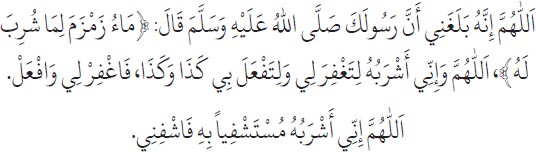
Allāhumma innahu balaghanī annā Rasūlaka ṣalla-llāhu ‘alayhi wa sallama qāl: “Mā’u Zamzama li-mā shuriba lah”, Allāhumma wa innī ashrabuhu li-taghfira lī wa li-taf‘ala bī (add appropriate words), fa-ghfir lī wa-f‘al.
Or:
Allāhumma innī ashrabuhu mustashfiyan bihi fa-shfinī.
ON THE ṬAWĀF OF LEAVE-TAKING AND THE DU‘Ā’ AT THE MULTAZAM
When the pilgrim intends to leave Makkah to return home, he should perform the ṭawāf of greeting, then go to the Multazam and cling to it. Then he should say: O Allah, the House is Your House and this is Your slave and the son of Your male slave and the son of Your female slave. You have conveyed me upon one of Your creatures, which You have subjugated so that You may make me move about in Your land. You have made me arrive, by Your grace, so that I may fulfil Your rituals. If You are pleased with me, be more pleased with me. If not, then [be so] from now on, before my home makes me distant from Your House. This is the time of my departure, if You give me permission—not wishing to substitute You or Your House [for anything else], and not out of aversion to You or Your House. O Allah, accompany me with good health in my body and protection of my religion. Make my return good, and grant me obedience to You for as long as You let me live. Accumulate for me my benefit in the Hereafter and this world. You have power over all things. [15].
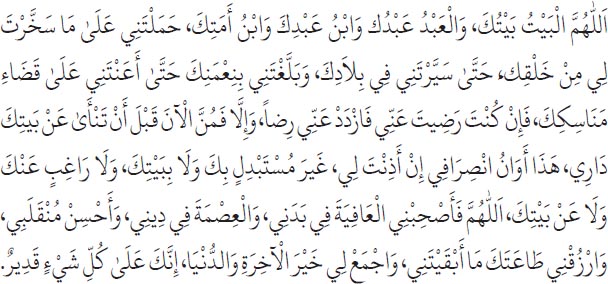
Allāhumma-l-Baytu Baytuk, wa-l-‘abdu ‘abduka wa-bnu ‘abdika wa-bna amatik. Ḥamaltanī ‘alā mā sakhkharta lī min khalqika ḥattā sayyartanī fī bilādik, wa balaghtanī bi-ni‘matika ḥattā a‘antanī ‘alā qaḍā’i manāsikik, fa-in kunta raḍīta ‘annī fā-zdad ‘annī riḍā, wa illā fa munna-l-āna qabla an tan’ā ‘an baytika dārī. Hādhā awānu-nṣirāfī in adhinta lī, ghayra mustabdilin bika wa lā bi-Baytik, wa lā rāghibin ‘anka wa lā ‘an Baytik. Allāhumma fa-aṣḥibni-l-‘āfiyata fī badanī, wa-l-‘iṣmata fī dīnī, wa aḥsin munqalabī, wa-rzuqnī ṭā‘ataka mā abqaytanī, wa-jma‘ lī khayra-l-ākhirati wa-d-dunyā, innaka ‘alā kulli shay’in qadīr.
One should begin and end this du‘ā’ with the praise of Allah and invoking salutations and blessings upon the Messenger of Allah , as we have stated earlier about other du‘ā’. If a woman is menstruating then it is mustaḥabb for her to stand at the door of the Mosque and to supplicate with this du‘ā’ before setting off. And Allah knows best.
, as we have stated earlier about other du‘ā’. If a woman is menstruating then it is mustaḥabb for her to stand at the door of the Mosque and to supplicate with this du‘ā’ before setting off. And Allah knows best.VISITING THE GRAVE OF THE MESSENGER OF ALLAH , AND THE ADHKĀR RELATED TO IT
Know that it is imperative for every pilgrim to visit the Messenger of Allah , whether it is on his way or not, for visiting him is one of the most important acts of drawing near to Allah and the most profitable of endeavours and the best of devotions. So as he goes toward the tomb, he should repeatedly invoke blessings on the Messenger of Allah on the way. When his gaze falls upon the trees of Madīnah, its Holy Sanctuary, and its landmarks, he should invoke abundant greetings and blessings upon the Messenger of Allah , asking Allah to benefit him by the visit and to grant him felicity in both Worlds. He should say: O Allah, open for me the doors of Your Mercy and grant me, by this visit to Your Messenger, what You have granted Your friends and the people who obey You. Forgive me and have mercy on me, O Best of those who are asked of.
, whether it is on his way or not, for visiting him is one of the most important acts of drawing near to Allah and the most profitable of endeavours and the best of devotions. So as he goes toward the tomb, he should repeatedly invoke blessings on the Messenger of Allah on the way. When his gaze falls upon the trees of Madīnah, its Holy Sanctuary, and its landmarks, he should invoke abundant greetings and blessings upon the Messenger of Allah , asking Allah to benefit him by the visit and to grant him felicity in both Worlds. He should say: O Allah, open for me the doors of Your Mercy and grant me, by this visit to Your Messenger, what You have granted Your friends and the people who obey You. Forgive me and have mercy on me, O Best of those who are asked of.
Allāhumma-ftaḥ ‘alayya abwāba raḥmatik, wa-rzuqnī fī ziyārati Nabiyyika ṣalla-llāhu ‘alayhi wa sallama mā razaqtahu awliyā’aka wa ahla ṭā‘atik, wa-ghfir lī wa-rḥamnī yā Khayra mas’ūl.
When a person wants to enter the Mosque, it is mustaḥabb to say what is said upon entering other mosques, and we have already presented that in the beginning of the book. When he has performed the ṣalāh of greeting the Mosque, he should go to the Noble Tomb and face it with his back to the qiblah, standing about four cubits away from the wall of the grave. He should give greetings, without raising his voice, and say: Peace be upon you, Messenger of Allah; peace be upon you, Best of the Creation of Allah; peace be upon you, Beloved of Allah; peace be upon you, Master of the Messengers and Seal of the Prophets. Peace be upon you, your Family, your Companions, your Household, the Prophets, and all of the pious. I bear witness that you conveyed the Message, that you fulfilled the Trust, and that you advised the Ummah. May Allah give you the finest reward that He has ever given a Prophet on behalf of his Ummah. [16].
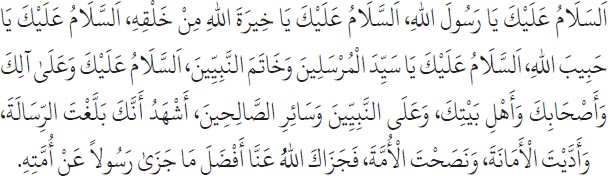
As-salāmu ‘alayka yā Rasūla-llāh, as-salāmu ‘alayka yā Khīrata-llāh min khalqih, as-salāmu ‘alayka yā Ḥabība-llāh, as-salāmu ‘alayka yā Sayyida-l-Mursalīna wa Khātama-n-Nabiyyīn, as-salāmu ‘alayka wa ‘alā ālika wa aṣḥābika wa ahli Baytik, wa ‘ala-n-Nabiyyīna wa sā’iri-ṣ-ṣāliḥīn. Ashhadu annaka ballaghta-r-risālata wa adayta-l-amānata wa naṣaḥta-l-Ummah, fa-jazāka-llāhu ‘annā afḍala mā jazā Rasūlan ‘an Ummatih.
If anyone has requested the pilgrim to convey greetings to the Messenger of Allah he should say: Peace be upon you, Messenger of Allah, from So-and-so. Then he should go back about one cubit to the right and greet Abū Bakr . Then he should move another cubit to the right and greet ‘Umar ibn al-Khaṭṭāb . Then he should go back to the first place he stood at and face the Messenger of Allah , and intercede through him for himself and intercede to his Lord and supplicate for himself, his parents, his companions, his loved ones and those who have treated him well, and for all the Muslims. He should try hard to make the du‘ā’ a lengthy one. He should take advantage of this noble place to praise Allah and magnify Him, and say There is no god but Allah. He should pray for blessings upon the Messenger of Allah . Then he should go to the Rawḍah, which is between the Grave and the Pulpit of the Messenger of Allah , and make du‘ā’.
he should say: Peace be upon you, Messenger of Allah, from So-and-so. Then he should go back about one cubit to the right and greet Abū Bakr . Then he should move another cubit to the right and greet ‘Umar ibn al-Khaṭṭāb . Then he should go back to the first place he stood at and face the Messenger of Allah , and intercede through him for himself and intercede to his Lord and supplicate for himself, his parents, his companions, his loved ones and those who have treated him well, and for all the Muslims. He should try hard to make the du‘ā’ a lengthy one. He should take advantage of this noble place to praise Allah and magnify Him, and say There is no god but Allah. He should pray for blessings upon the Messenger of Allah . Then he should go to the Rawḍah, which is between the Grave and the Pulpit of the Messenger of Allah , and make du‘ā’.We relate in the Ṣaḥīḥs of al-Bukhārī and Muslim from Abū Hurayrah who reported that the Messenger of Allah said: “What lies between my Tomb and my Pulpit is one of the gardens of Paradise.” [17].
who reported that the Messenger of Allah said: “What lies between my Tomb and my Pulpit is one of the gardens of Paradise.” [17].When the pilgrim is about to leave Madīnah to go back to his home country it is desirable that he bid farewell to the Mosque with two rak‘ahs, and he should supplicate for whatever he likes. Then he should go to the Tomb and greet as he greeted the first time. He should supplicate and bid the Prophet farewell, saying: O Allah, do not make this the last time that I visit the Sanctuary of Your Messenger, but grant me an easy way of returning to Your Two Sanctuaries by Your grace and kindness. Grant me forgiveness and well-being in this world and the Hereafter, and return us safely and successfully to our homelands, Āmīn.
farewell, saying: O Allah, do not make this the last time that I visit the Sanctuary of Your Messenger, but grant me an easy way of returning to Your Two Sanctuaries by Your grace and kindness. Grant me forgiveness and well-being in this world and the Hereafter, and return us safely and successfully to our homelands, Āmīn.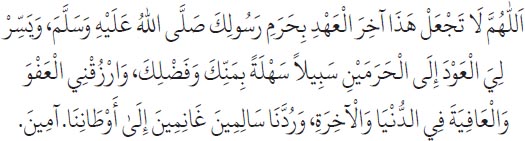
Allāhumma lā taj‘al hādhā ākhira-l-‘ahdi bi-ḥarami Rasūlika ṣalla-llāhu ‘alayhi wa sallam, wa yassir liya-l-‘awda ila-l-Ḥaramayni sabīlan sahlatan bi-mannika wa faḍlik, wa-rzuqni-l-‘afwa wa-l-‘āfiyata fi-d-dunyā wa-ākhirah, wa ruddanā sālimīna ghānimīna ilā awṭāninā. Āmīn.
These are the last of the da‘awāt of Ḥajj that Allah has given us the ability to compile. Even though it is long in relation to the length of the book, it is brief in comparison to what we have memorised. We ask Allah, the Noble and Generous, to grant us the ability to obey Him, and to unite us with our brothers in the Abode of Honour.
I have explained this in the chapter on Pilgrimage as well as the full aspects and extra things relating to it; and Allah alone knows the truth. All praise, blessings, success and protection are from Him.
I relate also from ‘Utbī, who said: “I was sitting beside the grave of the Prophet when a bedouin came and said, “Peace be upon you, O Messenger of Allah. I heard Allah (Most High) say, ‘And if only they had come to you when they had wronged themselves and sought forgiveness from Allah, and the Messenger had sought forgiveness for them, they would assuredly have found Allah Oft-Relenting and Merciful’. [18].
when a bedouin came and said, “Peace be upon you, O Messenger of Allah. I heard Allah (Most High) say, ‘And if only they had come to you when they had wronged themselves and sought forgiveness from Allah, and the Messenger had sought forgiveness for them, they would assuredly have found Allah Oft-Relenting and Merciful’. [18].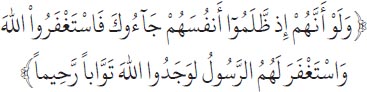
“I have come to you seeking forgiveness for my sins, seeking my Lord through your intercession,” after which he began to recite the following lines of poetry:
O best of those whose bones are buried in the plains,
So that plains and hills became fragrant from their scent.
My self be the ransom for the grave where you lie;
All virtue, giving, and nobility are there.
He said: “Then he turned and my eyes were prompted and I saw the Prophet in a vision and he said to me, ‘O ‘Utbī! meet the bedouin and tell him the good news that Allah (Most High) has forgiven him’”.
in a vision and he said to me, ‘O ‘Utbī! meet the bedouin and tell him the good news that Allah (Most High) has forgiven him’”.References
[1] Iḥrām is the state of ritual consecration of a person intending to perform the minor pilgrimage (‘Umrah) or major pilgrimage (Hajj).
[2] Al-Futūḥāt (4/391). Ibn Ḥajar stated that he could not find a source for this invocation.
[3] Al-Futūḥāt (4/393). Ibn Ḥajar mentioned that this hadith was reported in al-Muntaẓim and the Muṭhir al-‘azm of Ibn al-Jawzī, who narrated it from Mālik ibn Dīnār with a weak chain.
[4] An-Nasā’ī (5/19–20). This hadith is ṣaḥīḥ. See al-Futūḥāt (4/394).
[5] Al-Futūḥāt (4/400). Ibn Ḥajar states that this hadith is mawqūf ṣaḥīḥ.
[6] Al-Futūḥāt (4/405). Ibn Ḥajar said that he could not find the source for this invocation. However, it is found in al-Manāsik by Abū Isḥāq al-Ḥarbī, who did not reference anyone else with regard to it.
[7] See previous footnote.
[8] Related by at-Tirmidhī (3515), who states that this hadith is gharīb from this route (wajh), and its chain is not strong. The same thing is stated by Ibn Ḥajar. Al-Futūḥāt (5/6).
[9] Al-Futūḥāt (5/10). According to Ibn Ḥajar, this hadith was reported by Ibn Khuzaymah from the Messenger of Allah .
.[10] Qur’ān 2:198.
[11] Qur’ān 2:198–199.
[12] Qur’ān 2:201.
[13] Muslim (1141).
[14] Al-Futūḥāt (5/28). According to Ibn Ḥajar, this hadith is gharīb from this route (wajh), but ḥasan thanks to its supporting narrations.
[15] Al-Futūḥāt (5/29). Ibn ‘Allān states that this hadith was reported by al-Bayhaqī, with a chain from him to ash-Shāfi‘ī, and that these are the words of ash-Shāfi‘ī.
[16] Al-Futūḥāt (5/34). Ibn Ḥajar said that part of this hadith was reported from Ibn ‘Umar in a mawqūf ṣaḥīḥ report.
[17] Al-Bukhārī (1196), Muslim (1390). Ibn Ḥajar states that both al-Bukhārī and Muslim report this hadith with the word ‘house’ instead of ‘grave’. Al-Futūḥāt (5/37).
[18] Qur’ān 4:64??.