
WE RELATE FROM the Ṣaḥīḥ of Muslim from ‘Ā’ishah  who related that when the wind blew violently the Prophet
  would say: “O Allah, I ask You for the good of it, the good that is in it, and the good that it was sent with; and I seek Your protection from the evil of it, the evil that is in it, and the evil that it was sent with.” [1].
who related that when the wind blew violently the Prophet would say: “O Allah, I ask You for the good of it, the good that is in it, and the good that it was sent with; and I seek Your protection from the evil of it, the evil that is in it, and the evil that it was sent with.” [1].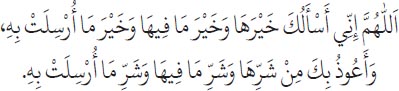
Allāhumma innī as’aluka khayrahā wa khayra mā fīhā wa khayra mā ursilat bih, wa a‘ūdhu bika min sharrihā wa sharri mā fīhā wa sharri mā ursilat bih.
We relate in the Sunan of Abū Dāwūd, and from Ibn Mājah with a ḥasan isnād from Abū Hurayrah  who reported that the Messenger of Allah said: “The wind is one of the mercies of Allah
  towards His servants. It brings mercy and it brings punishment. So when you feel it, do not curse it: ask Allah for the good of it and ask His protection from the harm of it.” [2].I say: “His words ‘from the wind of Allah’, with fatḥah on the letter rā’ are said by the scholars to mean ‘from the mercy of Allah (Most High) towards His servant.’
who reported that the Messenger of Allah said: “The wind is one of the mercies of Allah towards His servants. It brings mercy and it brings punishment. So when you feel it, do not curse it: ask Allah for the good of it and ask His protection from the harm of it.” [2].I say: “His words ‘from the wind of Allah’, with fatḥah on the letter rā’ are said by the scholars to mean ‘from the mercy of Allah (Most High) towards His servant.’We relate in the Sunans of Abū Dāwūd, an-Nasā’ī and Ibn Mājah from ‘Ā’ishah who related that when the Prophet saw a cloud forming on the horizon he would leave what he was doing, even if he was in ṣalāh, and say: “O Allah, I ask Your protection from its evil.”
who related that when the Prophet saw a cloud forming on the horizon he would leave what he was doing, even if he was in ṣalāh, and say: “O Allah, I ask Your protection from its evil.”
Allāhumma innī a‘ūdhu bika min sharrihā.
When it rained he would say: “O Allah, make it a beneficial rain.” [3].

Allāhumma ṣayyiban hanī’ā.
I say: the word nāshi’an, with hamzah, means ‘clouds that have not completely gathered together’. The word ṣayyib, with kasrah and shaddah on the yā’, means ‘heavy rain’, i.e. rain that pours down. The word is in the accusative case ending (mansūban), owing to the elision of the verb, the meaning being, ‘I ask You for a downpour (as’aluka ṣayyiban) or ‘make it a downpour’ (ij‘alhu ṣayyiban).
We relate in the book of at-Tirmidhī and others from Ubayy ibn Ka‘b , who related that the Messenger of Allah said: “Do not curse the wind. If you see something that you dislike, say: O Allah, we ask You for the good of this wind, the good that is in it, and the good that it has been commanded to do; and we ask You for protection from the evil of this wind, the evil that is in it, and the evil that it has been commanded to do.” [4].At-Tirmidhī describes this hadith as ḥasan ṣaḥīḥ. Other hadiths, from ‘Ā’ishah , Abū Hurayrah, ‘Uthmān ibn Abī ’l-‘Āṣ, Anas, Ibn ‘Abbās and Jābir , have been related in this chapter.
, who related that the Messenger of Allah said: “Do not curse the wind. If you see something that you dislike, say: O Allah, we ask You for the good of this wind, the good that is in it, and the good that it has been commanded to do; and we ask You for protection from the evil of this wind, the evil that is in it, and the evil that it has been commanded to do.” [4].At-Tirmidhī describes this hadith as ḥasan ṣaḥīḥ. Other hadiths, from ‘Ā’ishah , Abū Hurayrah, ‘Uthmān ibn Abī ’l-‘Āṣ, Anas, Ibn ‘Abbās and Jābir , have been related in this chapter.
Allāhumma innā nas’aluka min khayri hādhihi-r-rīḥ, wa khayri mā fīhā, wa khayri mā umirat bih, wa na‘ūdhu bika min sharri hādhihi-r-rīḥ, wa sharri mā fīhā, wa sharri mā umirat bih.
We relate with a ṣaḥīḥ isnād from the book of Ibn as-Sunnī that Salamah ibn al-Akwa‘ reported that when the wind became severe the Messenger of Allah said: “O Allah, make it pregnant and not barren.” [5].I say that laqhan means ‘pregnant with water like a pregnant female camel’. The word ‘aqīm applies to something that has no water in it, like barren animals that do not bear offspring.
reported that when the wind became severe the Messenger of Allah said: “O Allah, make it pregnant and not barren.” [5].I say that laqhan means ‘pregnant with water like a pregnant female camel’. The word ‘aqīm applies to something that has no water in it, like barren animals that do not bear offspring.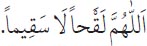
Allāhumma laqḥan lā saqīmā.
We relate in Anas ibn Mālik and from Jābir ibn ‘Abdullāh  , who related that the Messenger of Allah said: “When something significant happens or the wind blows violently you should say the takbīr, because it lightens dark dust storms.” [6].
, who related that the Messenger of Allah said: “When something significant happens or the wind blows violently you should say the takbīr, because it lightens dark dust storms.” [6].Imam ash-Shāfi‘ī, may Allah have mercy on him, said in his book al-Umm with his isnād from Ibn ‘Abbās who narrated: “Never did the wind blow strongly without the Prophet kneeling down and saying: ‘O Allah, make it a mercy and do not make it a punishment. O Allah, make it [various] winds and not [one] wind.’” [7].
who narrated: “Never did the wind blow strongly without the Prophet kneeling down and saying: ‘O Allah, make it a mercy and do not make it a punishment. O Allah, make it [various] winds and not [one] wind.’” [7].
Allāhumma-j‘alhā raḥmatan wa lā taj‘alhā ‘adhābā, Allāhumma-j‘alhā riyāḥan wa lā taj‘alhā rīḥā.
Ibn ‘Abbās said that in the Book of Allah is written: “We sent against them a furious wind. . ..” [8].
said that in the Book of Allah is written: “We sent against them a furious wind. . ..” [8].
Allah also says: “We sent against them the barren wind.” [9].
also says: “We sent against them the barren wind.” [9].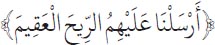
Allah also says: “And We sent the fruitful winds.” [10].
also says: “And We sent the fruitful winds.” [10].
Allah says: “Among His signs is that He sends the winds bearing glad tidings.” [11].
says: “Among His signs is that He sends the winds bearing glad tidings.” [11].Ash-Shāfi‘ī related a munqaṭi‘ [12].hadith from a man who came to the Prophet and complained of poverty. The Messenger of Allah said: “Perhaps you curse the wind.”
and complained of poverty. The Messenger of Allah said: “Perhaps you curse the wind.”According to ash-Shāfi‘ī, it is not befitting for anyone to curse the wind, because it is one of the obedient creations of Allah and one of His troops; He has made it a mercy, but can make it a punishment if He wishes.
and one of His troops; He has made it a mercy, but can make it a punishment if He wishes.References
[1] Muslim (899) and al-Bukhārī (3206).
[2] Abū Dāwūd (5097), Ibn Mājah (3727), and al-Futūḥāt (4/272). Ibn Ḥajar grades this hadith as ḥasan ṣaḥīḥ.
[3] Abū Dāwūd (5099), an-Nasā’ī in al-Kubrā, Ibn Mājah (3889), and al-Futūḥāt (4/274). Ibn Ḥajar grades it as ṣaḥīḥ.
[4] At-Tirmidhī (2253).
[5] Ibn as-Sunnī (300), with a slight variation in the wording. Ibn Ḥajar states that this hadith is ṣaḥīḥ. It was reported by al-Bukhārī in al-Adab al-mufrad like this and also by Ibn Ḥibbān in his Ṣaḥīḥ. Laqḥ means a pregnant camel, while ‘aqīm means one that does not bear offspring. The rain should thus be pregnant, bearing rain, and not barren.
[6] Ibn as-Sunnī (285) and al-Futūḥāt (4/276). Ibn Ḥajar states that this hadith is gharīb and its chain is very weak; it includes Muḥammad ibn Zadan, whose transmission is weak, and his shaykh ‘Anbasah ibn ‘Abd ar-Raḥmān is disregarded as a narrator.
[7] Al-Umm (1/253) and al-Futūḥāt (4/277). Ibn Ḥajar states that this hadith is ḥasan. It is reported by al-Bayhaqī in al-Ma‘rifah.
[8] Qur’ān 54:19.
[9] Qur’ān 51:41.
[10] Qur’ān 15:22.
[11] Qur’ān 30:46.
[12] Al-Umm (1/253) and al-Futūḥāt (4/280–281). Ibn Ḥajar states that this hadith is mu‘ḍal because there are two consecutive narrators missing, and I have not found any supporting narration or follow-up report for this narration.