
IT IS MUSTAḤABB, [when asking for rain], to perform in abundance du‘ā’, dhikr, repentance, submission, humility and the well-known adhkār and supplications. Among these are: ‘O Allah, grant us comforting rain, nourishing, wholesome, fertile and fruitful, flowing copiously, spreading over the land, pouring heavily, wide-ranging and long-lasting. O Allah, send it down on hillocks, the roots of trees, and the floors of valleys. O Allah, we ask You for forgiveness; You are the Most Forgiving. Pour down the rain on us in abundance. O Allah, grant us rain and do not make us despondent. O Allah, make crops grow for us, make the cows’ udders flow for us, give us to drink from the blessings of the sky, and make the blessings of the earth grow for us. O Allah, remove from us fatigue, hunger and nakedness. Remove from us the calamities that none but You can remove.’ It is mustaḥabb, if there is a pious person in the community, that the people pray for rain through his intercession, saying: Allah, we ask You for rain and we ask for intercession on the part of Your servant So-and-so.
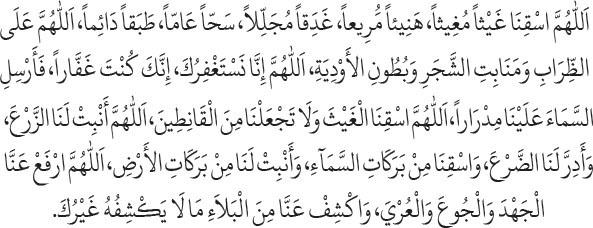
Allāhumma-sqinā ghaythan mughīthā, hanī’an marī‘ā, ghadaqan mujallilā, saḥḥan ‘āmmā, ṭabaqan dā’imā. Allāhumma ‘ala-ẓ-ẓirābi wa manabiti-sh-shajari wa buṭūni-l-awdiyah. Allāhumma innā nastaghfiruka innaka kunta Ghaffārā, fa-arsili-s-samā’a ‘alaynā midrārā. Allāhumma-sqina-l-ghaytha wa lā taj‘alnā min al-qāniṭīn. Allāhumma anbit lana-z-zar‘, wa adirra lana-ḍ-ḍar‘, wa-sqinā min barakāti-s-samā’, wa anbit lanā min barakāti-l-arḍ. Allāhumma-rfa‘ ‘annā-l-jahda wa-l-jū‘a wa-l-‘ury, wa-kshif ‘annā mina-l-balā’i mā lā yakshifuhu ghayruk.
We relate in the Ṣaḥīḥ of al-Bukhārī that when there was a drought ‘Umar ibn al-Khaṭṭāb  used to pray for rain through the intercession of al-‘Abbās ibn ‘Abd al-Muṭṭalib. He would say: “Allah, we used to appeal to You through our Prophet
  and You granted us rain. We are now appealing to You through the mediation of the uncle of our Prophet, so grant us rain.” Then it rained. [1].
used to pray for rain through the intercession of al-‘Abbās ibn ‘Abd al-Muṭṭalib. He would say: “Allah, we used to appeal to You through our Prophet and You granted us rain. We are now appealing to You through the mediation of the uncle of our Prophet, so grant us rain.” Then it rained. [1].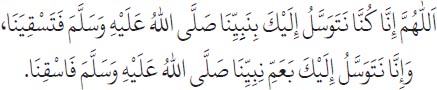
Allāhumma innā kunnā natawassalu ilayka bi-Nabiyyinā ṣalla-llāhu ‘alayhi wa sallam fa tasqiyanā, wa innā natawassalu ilayka bi-‘ammi Nabiyyinā ṣalla-llāhu ‘alayhi wa sallam fa-sqinā.
It is reported that Mu‘āwiyah and others prayed for rain by means of the pious. [2].It is mustaḥabb to recite in the ṣalāh for rain what is recited in the ṣalāh of ‘Īd, which we have already explained. One should perform seven takbīrāt at the beginning of the first [rak‘ah] and five in the second, as in the ṣalāh of ‘Īd. All the rulings and regulations relating to the takbīrāt of ‘Īd apply here. Then [the khaṭīb] should deliver two sermons in which he should seek forgiveness and supplicate at length.
We relate in the Sunan of Abū Dāwūd with a ṣaḥīḥ isnād according to the criteria of Muslim, from Jābir ibn ‘Abdullāh who related: “Some women came to the Messenger of Allah weeping because of the lack of rain, and he said: ‘O Allah, grant us rain that is a relief, wholesome, fertile and fruitful, beneficial and not harmful, coming sooner rather than later’ [3].and then the sky covered them [with rain-clouds].”
who related: “Some women came to the Messenger of Allah weeping because of the lack of rain, and he said: ‘O Allah, grant us rain that is a relief, wholesome, fertile and fruitful, beneficial and not harmful, coming sooner rather than later’ [3].and then the sky covered them [with rain-clouds].”
Allāhumma-sqinā ghaythan mughīthā, marī‘an marī’ā, nāfi‘an ghayra ḍārr, ‘ājilan ghayra ājil.
We relate in the same source with a ṣaḥīḥ isnād that ‘Amr ibn Shu‘ayb reported from his father, who reported from his grandfather, who related that the Messenger of Allah said when praying for rain: “O Allah, give Your slaves and Your beasts water to drink, and spread out Your Mercy and revive Your dead land.” [4].
said when praying for rain: “O Allah, give Your slaves and Your beasts water to drink, and spread out Your Mercy and revive Your dead land.” [4].
Allāhumma-sqi ‘ibādaka wa bahā’imaka wa-nshur raḥmataka wa-ḥyi baladaka-l-mayyit.
We relate in the same source with a ṣaḥīḥ isnād, which Abū Dāwūd and others consider excellent, from ‘Ā’ishah  who related that the people complained to the Messenger of Allah about the lack of rain. He instructed that a minbar be positioned in the place where ṣalāh was offered. He made an appointment for the people to come out. The Messenger of Allah came out when the upper edge of the sun was appearing. He sat on the minbar, magnified and praised Allah
  , and then said: “You have complained about the barrenness of your homes, and the delay of the rain beyond its proper (ibbān) time. Allah has commanded you to supplicate to Him, and He has promised you that He will answer your prayers.” Then he said: “Praise be to Allah, Lord of the Worlds, the All-Merciful, the Compassionate, Owner of the Day of Judgment. There is no god but Allah; He does as He wishes. O Allah, You are Allah and there is no God but You, the Infinitely Rich, and we are poor. Send down the rain and make what You have sent down strength for us, and provision for a time.” [5].
who related that the people complained to the Messenger of Allah about the lack of rain. He instructed that a minbar be positioned in the place where ṣalāh was offered. He made an appointment for the people to come out. The Messenger of Allah came out when the upper edge of the sun was appearing. He sat on the minbar, magnified and praised Allah , and then said: “You have complained about the barrenness of your homes, and the delay of the rain beyond its proper (ibbān) time. Allah has commanded you to supplicate to Him, and He has promised you that He will answer your prayers.” Then he said: “Praise be to Allah, Lord of the Worlds, the All-Merciful, the Compassionate, Owner of the Day of Judgment. There is no god but Allah; He does as He wishes. O Allah, You are Allah and there is no God but You, the Infinitely Rich, and we are poor. Send down the rain and make what You have sent down strength for us, and provision for a time.” [5].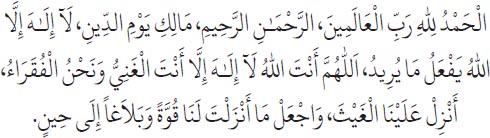
Al-ḥamdu li-llāhi Rabbi-l-‘ālamīn, ar-Raḥmāni-r-Raḥīm, Māliki Yawmi-d-Dīn, lā ilāha illa-llāhu yaf‘alu mā yurīd. Allāhumma Anta-llāhu lā ilāha illā Anta-l-Ghaniyyu wa naḥnu-l-fuqarā’, Anzil ‘alayna-l-ghaytha wa-j‘al mā anzalta lanā quwwatan wa balāghan ilā ḥīn.
Then he lifted his hands and he continued to raise them until the whites of his armpits showed. After that he turned his back to the people and he turned his cloak whilst raising his hands. Then he turned towards the people and came and performed two rak‘ahs. Allah made the clouds form and there were thunder and lightning, and it rained, by the permission of Allah . He had hardly finished his rak‘ah before there was a flood. When he saw them hastening to find shelter he smiled until his molars showed. Then he said: “I bear witness that Allah has power over all things, and that I am the servant and Messenger of Allah.”
made the clouds form and there were thunder and lightning, and it rained, by the permission of Allah . He had hardly finished his rak‘ah before there was a flood. When he saw them hastening to find shelter he smiled until his molars showed. Then he said: “I bear witness that Allah has power over all things, and that I am the servant and Messenger of Allah.”
Ashhadu anna-llāha ‘alā kulli shay’in qadīr, wa annī ‘abdu-llāhi wa Rasūluh.
I say: the ‘ibbān’ of a thing is ‘its time’, and is written with kasrah on the hamzah and a doubling of the bā’. The meaning of ‘lack of rain’ (quḥūṭ al-maṭar) with a ḍammah on the letter ḥā’ is its ‘cessation’. The word ‘barren’ (jadb) means the opposite of fertile.
His saying: ‘and then it rained’ is written with the letter alif [on the verb, e.g. amṭarat]. It has two forms [or words]: maṭarat and amṭarat. No consideration is given to the view of those who say that one cannot use [the form] amṭara with the letter alif except for [Divine] punishment [of disbelievers]. [6].And ‘his molars (nawākhidh) showed’ means ‘his teeth appeared’ with the letter dhāl.
Be aware that this hadith states explicitly that the sermon came before the rak‘ah; this is stated unequivocally in the Ṣaḥīḥs of al-Bukhārī and Muslim. This should be interpreted as showing permissibility. It is well-known in the books of jurisprudence of our [Shāfi‘ī] colleagues that it is mustaḥabb to perform the ṣalāh before the sermon, since there are other hadiths that state that the Messenger of Allah performed the ṣalāh before the sermon. And Allah knows best.
performed the ṣalāh before the sermon. And Allah knows best.It is mustaḥabb to say both silent and audible du‘ā’s, and to lift the hands while saying them. Imam ash-Shāfi‘ī said that one of the du‘ā’s should be: O Allah, You have commanded us to supplicate to You and You have promised us Your response. We have made du‘ā’ to You as You have commanded, so respond to us as You have promised us.

Allāhumma amartanā bi-du‘ā’ik, wa wa‘adtanā ijābatak, wa qad da‘awnāka kamā amartanā, fa-ajibnā kamā wa‘adtanā. Allāhumma-mnun ‘alaynā bi-maghfiratika mā qārafnā, wa ijābatika fī suqyānā wa sa‘ati rizqinā.
One should make du‘ā’ for all believing men and women, invoke blessings upon the Prophet , and recite verses of the Qur’ān. The Imam should say: I ask for forgiveness from Allah for me and for you. He should say the du‘ā’ for distress, and the du‘ā’: Allah, grant us good in this world and in the Hereafter, as well as other da‘awāt that are mentioned in authentic hadiths.
, and recite verses of the Qur’ān. The Imam should say: I ask for forgiveness from Allah for me and for you. He should say the du‘ā’ for distress, and the du‘ā’: Allah, grant us good in this world and in the Hereafter, as well as other da‘awāt that are mentioned in authentic hadiths.According to Imam ash-Shāfi‘ī, the Imam should deliver two sermons as he does in the ṣalāh of ‘Īd. In them, he should magnify Allah , praise Him, pray for blessings upon the Prophet and seek forgiveness profusely so that it becomes the bulk of his speech. He should say many times: “Ask forgiveness from your Lord, for He is Oft-Forgiving. He will send you rain in abundance.” [7].
, praise Him, pray for blessings upon the Prophet and seek forgiveness profusely so that it becomes the bulk of his speech. He should say many times: “Ask forgiveness from your Lord, for He is Oft-Forgiving. He will send you rain in abundance.” [7].
Istaghfirū Rabbakum, innahu kāna Ghaffārā, yursili-s-samā’a ‘alaykum midrārā.
It is reported that ‘Umar prayed for rain and most of his du‘ā’ was seeking forgiveness. According to ash-Shāfi‘ī, most of his du‘ā’ was repentance. He started his du‘ā’ with it and he said it between his utterances and he ended with it, so that it was the bulk of his speech. He roused and encouraged the people to repent, be obedient and draw closer to Allah .
prayed for rain and most of his du‘ā’ was seeking forgiveness. According to ash-Shāfi‘ī, most of his du‘ā’ was repentance. He started his du‘ā’ with it and he said it between his utterances and he ended with it, so that it was the bulk of his speech. He roused and encouraged the people to repent, be obedient and draw closer to Allah .References
[1] Al-Bukhārī (1010).
[2] Such as his prayer for rain by means of Yazīd ibn al-Aswad, may Allah have mercy on him, which Ibn Sa‘d mentions in aṭ-Ṭabaqāt (7:444).
prayer for rain by means of Yazīd ibn al-Aswad, may Allah have mercy on him, which Ibn Sa‘d mentions in aṭ-Ṭabaqāt (7:444).[3] Abū Dāwūd (1169).
[4] Abū Dāwūd (1176).
[5] Abū Dāwūd (1173).
[6] e.g. “. . . and We rained down on them stones of hard baked clay. . .” Qur’ān 11: 81.
[7] Qur’ān 71:10–11.