
WE RELATE FROM the Ṣaḥīḥs of al-Bukhārī and Muslim from ‘Ā’ishah  who said that every night when the Messenger of Allah
  went to bed he put his palms together and blew into them, before reciting into them “Say: Allah is One”, “Say: I seek protection with the Lord of Daybreak”, and “Say: I seek protection with the Lord of Mankind.” Then he passed his hands over as much of his body as he was able to, beginning with his head and face and the front part of his body. He did this thrice. [1].
who said that every night when the Messenger of Allah went to bed he put his palms together and blew into them, before reciting into them “Say: Allah is One”, “Say: I seek protection with the Lord of Daybreak”, and “Say: I seek protection with the Lord of Mankind.” Then he passed his hands over as much of his body as he was able to, beginning with his head and face and the front part of his body. He did this thrice. [1].‘Ā’ishah reported: “When he became sick, he told me to do that for him.” In another hadith in the Ṣaḥīḥ it is said that the Messenger used to blow al-Mu‘awwidhāt over himself during the illness from which he passed away. ‘Ā’ishah said: “When his sickness intensified, I blew them over him using his own hands because of their blessing.” In another narration is, “When he became sick, he used to recite al-Mu‘awwidhāt over himself and blow.” Az-Zuhrī, one of the narrators, was asked how he blew out air. He replied: “He would blow into his hand and then wipe his face.”
reported: “When he became sick, he told me to do that for him.” In another hadith in the Ṣaḥīḥ it is said that the Messenger used to blow al-Mu‘awwidhāt over himself during the illness from which he passed away. ‘Ā’ishah said: “When his sickness intensified, I blew them over him using his own hands because of their blessing.” In another narration is, “When he became sick, he used to recite al-Mu‘awwidhāt over himself and blow.” Az-Zuhrī, one of the narrators, was asked how he blew out air. He replied: “He would blow into his hand and then wipe his face.”I say that related to this is the hadith that has already been mentioned about what should be recited for the insane: that is, al-Fātiḥah.
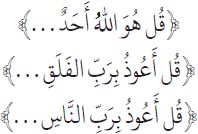
Qul Huwa-llāhu Aḥad. . .
Qul a‘ūdhu bi-Rabbi-l-falaq. . .
Qul a‘ūdhu bi-Rabbi-n-nās. . .
Qul a‘ūdhu bi-Rabbi-l-falaq. . .
Qul a‘ūdhu bi-Rabbi-n-nās. . .
We relate in the Ṣaḥīḥs of al-Bukhārī and Muslim, the Sunan of Abū Dāwūd and other sources, from ‘Ā’ishah who said that when any man became sick, was wounded or had a sore, the Prophet put his finger like this (here Sufyān ibn ‘Uyaynah, the narrator, put his index finger on the ground) and then raised it saying: “In the name of Allah, the dust of our earth by the saliva of one of us, our sick will be cured, by permission of our Lord.” [2].
who said that when any man became sick, was wounded or had a sore, the Prophet put his finger like this (here Sufyān ibn ‘Uyaynah, the narrator, put his index finger on the ground) and then raised it saying: “In the name of Allah, the dust of our earth by the saliva of one of us, our sick will be cured, by permission of our Lord.” [2].
Bismi-llāh, turbatu arḍinā bi-rīqati ba‘ḍinā, yushfā saqīmunā bi-idhni Rabbinā.
In another narration it is “the dust of our earth, and the saliva of one of us”.
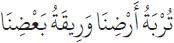
. . . turbatu arḍinā wa rīqatu ba‘ḍinā.
According to the ‘ulamā’, ‘the saliva of one of us’ means the saliva of a human (descendant of Adam). Ibn Fāris said, “Saliva (rīq) is that of humans or others and it may be made feminine, in which case it is rīqah.” Al-Jawharī states in aṣ-Ṣiḥaḥ that rīqah is more specific than rīq.
We relate in the two Ṣaḥīḥs from ‘Ā’ishah who reported that when the Prophet sought protection for someone in his family, he rubbed his right hand and said: “O Allah, Lord of men, remove this discomfort. Cure, for You are the One Who cures; there is no cure but Your cure. May it be a cure that leaves no sickness.” [3].
who reported that when the Prophet sought protection for someone in his family, he rubbed his right hand and said: “O Allah, Lord of men, remove this discomfort. Cure, for You are the One Who cures; there is no cure but Your cure. May it be a cure that leaves no sickness.” [3].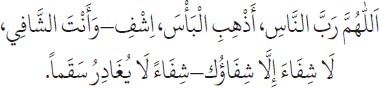
Allāhumma Rabba-n-nās, adhhibi-l-ba’s, ishfi—wa Anta-sh-Shāfī lā shifā’a illā shifā’uk—shifā’an lā yughādiru saqamā.
According to another version the Prophet would make a protective supplication (ruqyah), saying: “Remove the discomfort, O Lord of Men; the healing is in Your hand, for no one can uncover it but You”.
would make a protective supplication (ruqyah), saying: “Remove the discomfort, O Lord of Men; the healing is in Your hand, for no one can uncover it but You”.
Imsaḥi-l-ba’s, Rabba-n-nās, bi-yadika-sh-shifā’, lā kāshifa lahu illā Anta.
We relate in the Ṣaḥīḥ of al-Bukhārī from Anas  who said to Thābit: “Shall I not incant for you with the incantation used by the Messenger of Allah ?” He replied: “Yes.” [Anas] said: “O Allah, Lord of men and Remover of discomfort, cure, for You are the One Who cures; there is no Healer but You. May it be a cure that leaves no sickness.” [4].
who said to Thābit: “Shall I not incant for you with the incantation used by the Messenger of Allah ?” He replied: “Yes.” [Anas] said: “O Allah, Lord of men and Remover of discomfort, cure, for You are the One Who cures; there is no Healer but You. May it be a cure that leaves no sickness.” [4].I say that the meaning of ‘leaves no [sickness]’ (lā yughādiru) is ‘does not leave’ (lā yatruku), and the meaning of ‘discomfort’ (al-ba’s) is distress or illness.
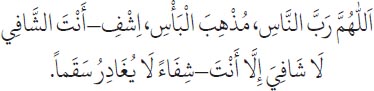
Allāhumma Rabba-n-nās, mudhhiba-l-ba’s, ishfi—Anta-sh-Shāfī, lā shāfiya illā Ant—shifā’an lā yughādiru saqamā.
We relate in the Ṣaḥīḥ of Muslim from ‘Uthmān ibn Abī al-‘Āṣ , who complained to the Messenger of Allah about a pain that he had had in his body. He told him: “Put your hand on the part of your body that is in pain and say: In the name of Allah thrice, then say seven times: I seek protection in the Might and Omnipotence of Allah from the evil of what I feel and from what I fear.” [5].
, who complained to the Messenger of Allah about a pain that he had had in his body. He told him: “Put your hand on the part of your body that is in pain and say: In the name of Allah thrice, then say seven times: I seek protection in the Might and Omnipotence of Allah from the evil of what I feel and from what I fear.” [5].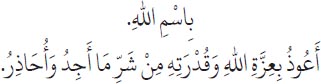
Bismi-llāh.
A‘ūdhu bi-‘izzati-llāhi wa qudratihi min sharri mā ajidu wa uḥādhir.
A‘ūdhu bi-‘izzati-llāhi wa qudratihi min sharri mā ajidu wa uḥādhir.
We relate in the Ṣaḥīḥ of Muslim that Sa‘d ibn Abī Waqqāṣ narrated: “The Prophet visited me when I was sick, and he said: ‘O Allah, heal Sa‘d; O Allah, heal Sa‘d; O Allah, heal Sa‘d.’” [6].
narrated: “The Prophet visited me when I was sick, and he said: ‘O Allah, heal Sa‘d; O Allah, heal Sa‘d; O Allah, heal Sa‘d.’” [6].
Allāhumma, ishfi Sa‘dā, Allāhumma, ishfi Sa‘dā, Allāhumma, ishfi Sa‘dā.
We relate in the Sunans of Abū Dāwūd and at-Tirmidhī with ṣaḥīḥ isnāds, from Ibn ‘Abbās who also related that the Messenger of Allah said: “If anyone visits a sick person whose time has not [yet] come, and says seven times: ‘I ask Allah the Tremendous, Lord of the Mighty Throne, to cure you’, Allah  will cure him of that sickness.” [7].At-Tirmidhī describes this hadith as ḥasan and al-Ḥākim Abū ‘Abdullāh, in his book al-Mustadrak ‘ala-ṣ-Ṣaḥīḥayn, describes it as ṣaḥīḥ according to the standards of al-Bukhārī.
who also related that the Messenger of Allah said: “If anyone visits a sick person whose time has not [yet] come, and says seven times: ‘I ask Allah the Tremendous, Lord of the Mighty Throne, to cure you’, Allah will cure him of that sickness.” [7].At-Tirmidhī describes this hadith as ḥasan and al-Ḥākim Abū ‘Abdullāh, in his book al-Mustadrak ‘ala-ṣ-Ṣaḥīḥayn, describes it as ṣaḥīḥ according to the standards of al-Bukhārī.I say that yashfiya, ‘cure’, has a fatḥah on the first letter.

As’alu-llāha-l-‘Aẓīm, Rabba-l-‘Arshi-l-‘Aẓīm, an yashfiyak.
We relate in the Sunan of Abū Dāwūd, from ‘Abdullāh ibn ‘Amr ibn al-‘Āṣ  , who reported that the Prophet said: “When any of you visit the sick they should say: O Allah, heal Your slave, who hurts an enemy for You or walks to ṣalāh for You.” [8].Abū Dāwūd did not regard it as weak.
, who reported that the Prophet said: “When any of you visit the sick they should say: O Allah, heal Your slave, who hurts an enemy for You or walks to ṣalāh for You.” [8].Abū Dāwūd did not regard it as weak.I say that the meaning of ‘wounds’ (yanka’u), with fatḥah on the first letter and hamzah on the last, is ‘causes him pain, hurts him’ (yu’limuhu wa yūji‘uhu).

Allāhumma, ishfi ‘abdak, yanka’u laka ‘aduwwā, aw yamshī laka ilā ṣalāh.
We relate in the book of at-Tirmidhī from ‘Alī who reported: “Once I had a complaint and the Messenger of Allah passed by me while I was saying: ‘O Allah, if it be that my time has come then give me relief, and if it is delayed then elevate me, and if it is a test then grant me patience.’ The Messenger of Allah asked: ‘What did you say?’ I repeated what I had said. He prodded me with his foot and said: ‘O Allah, grant him health’ or ‘heal him’—Shu‘bah was in doubt [as to which of the two wordings was used]. I never complained about any pain after that.” [9].According to at-Tirmidhī, this hadith is ḥasan ṣaḥīḥ.
who reported: “Once I had a complaint and the Messenger of Allah passed by me while I was saying: ‘O Allah, if it be that my time has come then give me relief, and if it is delayed then elevate me, and if it is a test then grant me patience.’ The Messenger of Allah asked: ‘What did you say?’ I repeated what I had said. He prodded me with his foot and said: ‘O Allah, grant him health’ or ‘heal him’—Shu‘bah was in doubt [as to which of the two wordings was used]. I never complained about any pain after that.” [9].According to at-Tirmidhī, this hadith is ḥasan ṣaḥīḥ.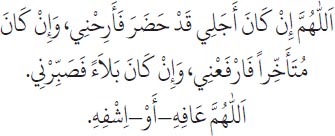
Allāhumma in kāna ajalī qad ḥaḍara fa-ariḥnī, wa in kāna muta’akhkhiran fā-rfa‘nī, wa in kāna balā’an fa-ṣabbirnī. Allāhumma ‘āfih (or) ishfih.
We relate in the books of at-Tirmidhī and Ibn Mājah that Abū Sa‘īd al-Khudrī and Abū Hurayrah attest that the Messenger of Allah said: “Whenever anyone says: There is no god but Allah and Allah is greater, his Lord confirms him and says: ‘There is no god but Me and I am Greater.’ When he says: There is no god but Allah alone, He says: ‘There is no god but Me alone.’ When he says: There is no god but Allah alone without partner, He says: ‘There is no god but Me, Alone without partner.’ When he says: There is no god but Allah and to Him belongs Dominion and to Him belongs all praise, He says: ‘There is no god but Me, to Me belongs Dominion and to Me belongs all praise.’ When he says: There is no god but Allah and there is no power or strength except by Allah, He says: ‘There is no god but Me and there is no power or strength except by Me.’” Then he said: “Whoever says this during an illness and then passes away, Hell-Fire will not consume him.” [10].At-Tirmidhī describes this hadith as ḥasan.
and Abū Hurayrah attest that the Messenger of Allah said: “Whenever anyone says: There is no god but Allah and Allah is greater, his Lord confirms him and says: ‘There is no god but Me and I am Greater.’ When he says: There is no god but Allah alone, He says: ‘There is no god but Me alone.’ When he says: There is no god but Allah alone without partner, He says: ‘There is no god but Me, Alone without partner.’ When he says: There is no god but Allah and to Him belongs Dominion and to Him belongs all praise, He says: ‘There is no god but Me, to Me belongs Dominion and to Me belongs all praise.’ When he says: There is no god but Allah and there is no power or strength except by Allah, He says: ‘There is no god but Me and there is no power or strength except by Me.’” Then he said: “Whoever says this during an illness and then passes away, Hell-Fire will not consume him.” [10].At-Tirmidhī describes this hadith as ḥasan.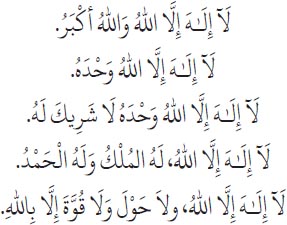
Lā ilāha illa-llāhu wa-llāhu-akbar.
Lā ilāha illa-llāhu waḥdahu lā sharīka lah.
Lā ilāha illa-llāh, lahu-l-mulku wa lahu-l-ḥamd.
Lā ilāha illa-llāh, wa lā ḥawla wa lā quwwata illā bi-llāh.
Lā ilāha illa-llāhu waḥdahu lā sharīka lah.
Lā ilāha illa-llāh, lahu-l-mulku wa lahu-l-ḥamd.
Lā ilāha illa-llāh, wa lā ḥawla wa lā quwwata illā bi-llāh.
We relate in the Ṣaḥīḥ of Muslim as well as the books of at-Tirmidhī, an-Nasā’ī and Ibn Mājah with ṣaḥīḥ isnāds from Abū Sa‘īd al-Khudrī , who narrated that Jibrīl  came to the Prophet and asked: “O Muḥammad, are you sick?” “Yes,” he replied. He said: “In the name of Allah I seek protection for you from everything that harms you, from the evil of every person or the eye of an envious person. May Allah cure you. In the name of Allah I seek protection for you.” [11].At-Tirmidhī categorises this hadith as ḥasan ṣaḥīḥ.
, who narrated that Jibrīl came to the Prophet and asked: “O Muḥammad, are you sick?” “Yes,” he replied. He said: “In the name of Allah I seek protection for you from everything that harms you, from the evil of every person or the eye of an envious person. May Allah cure you. In the name of Allah I seek protection for you.” [11].At-Tirmidhī categorises this hadith as ḥasan ṣaḥīḥ.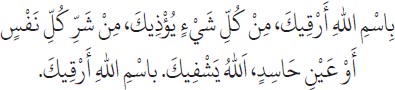
Bismi-llāhi arqīk, min kulli shay’in yu’dhīk, min sharri kulli nafsin aw ‘ayni ḥāsid, Allāhu yashfīk, Bismi-llāhi arqīk.
We relate in the Ṣaḥīḥ of al-Bukhārī from Ibn ‘Abbās who reported that the Messenger of Allah visited a Bedouin. When the Prophet came to the sick person he was visiting he said: “No harm, but purification, if Allah wills.” [12].
who reported that the Messenger of Allah visited a Bedouin. When the Prophet came to the sick person he was visiting he said: “No harm, but purification, if Allah wills.” [12].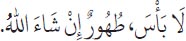
Lā ba’s, ṭuhūrun in shā’a-llāh.
We relate in the book of Ibn as-Sunnī from Anas , who narrated that the Messenger of Allah visited a Bedouin who was sick with fever. He said: “Expiation and purification.” [13].
, who narrated that the Messenger of Allah visited a Bedouin who was sick with fever. He said: “Expiation and purification.” [13].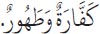
Kaffāratun wa ṭahūr.
We relate in the books of at-Tirmidhī and Ibn as-Sunnī from Abū Umāmah , who reported that the Messenger of Allah said: “The best way to complete a visit to a sick person is to place your hand on his forehead or on his hand and ask him how he is.” This is the version of at-Tirmidhī. According to the version of Ibn as-Sunnī he said: “The completion of a visit to a sick person is to put your hand on him and ask: ‘How are you this morning?’ or ‘How are you this evening?’” [14].At-Tirmidhī said that its isnād is not so good.
, who reported that the Messenger of Allah said: “The best way to complete a visit to a sick person is to place your hand on his forehead or on his hand and ask him how he is.” This is the version of at-Tirmidhī. According to the version of Ibn as-Sunnī he said: “The completion of a visit to a sick person is to put your hand on him and ask: ‘How are you this morning?’ or ‘How are you this evening?’” [14].At-Tirmidhī said that its isnād is not so good.We relate in the book of Ibn as-Sunnī from Salmān , who reported: “The Mes senger of Allah visited me when I was sick. He said: ‘Salmān, may Allah cure your sickness and forgive your sins and grant you well-being in your religion and body until your dying day.” [15].
, who reported: “The Mes senger of Allah visited me when I was sick. He said: ‘Salmān, may Allah cure your sickness and forgive your sins and grant you well-being in your religion and body until your dying day.” [15].
Shafa-llāhu saqamak, wa ghafara dhanbak, wa ‘āfāka fī dīnika wa jismika ilā muddati ajalik.
And we relate, in the same source, from ‘Uthmān ibn ‘Affān who said: “I was once sick and the Messenger of Allah would come to visit me. One day he visited me and said: ‘In the name of Allah, the Beneficent, the Merciful. I seek protection for you with Allah, the One, Besought of All, Who does not beget and is not begotten and Who has no like, from the evil of what you are experiencing.’ When the Messenger of Allah stood up to leave he said: ‘‘Uthmān, seek protection with that, for you have never sought protection with anything like it.’” [16].
who said: “I was once sick and the Messenger of Allah would come to visit me. One day he visited me and said: ‘In the name of Allah, the Beneficent, the Merciful. I seek protection for you with Allah, the One, Besought of All, Who does not beget and is not begotten and Who has no like, from the evil of what you are experiencing.’ When the Messenger of Allah stood up to leave he said: ‘‘Uthmān, seek protection with that, for you have never sought protection with anything like it.’” [16].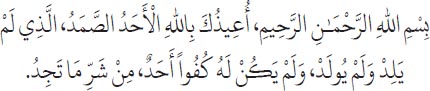
Bismi-llāhi-r-Raḥmāni-r-Raḥmān, u‘īdhuka bi-llāhi-l-Aḥadi-ṣ-Ṣamad, alladhī lam yalid wa lam yūlad, wa lam yaku-l-lahu kufuwan aḥad, min sharri mā tajid.
References
[1] Al-Bukhārī (5016), Muslim (2192), al-Muwaṭṭa’ (2/942–943), Abū Dāwūd (5049), and at-Tirmidhī (3413).
[2] Al-Bukhārī (5745), Muslim (2194), and Abū Dāwūd (3895).
[3] Al-Bukhārī (5743) and Muslim (2191).
[4] Al-Bukhārī (5742).
[5] Muslim (2202), Abū Dāwūd (3891), and an-Nasā’ī (909).
[6] Muslim (1628).
[7] Abū Dāwūd (3106), at-Tirmidhī (2084), al-Ḥākim (1/342), and al-Futūḥāt (4/61). Ibn Ḥajar grades this hadith as ḥasan.
[8] Abū Dāwūd (3107). Ibn Ḥajar grades this hadith as ḥasan.
[9] At-Tirmidhī (3559) and al-Futūḥāt (4/64). Ibn Ḥajar grades this hadith as ṣaḥīḥ.
[10] Ibn Mājah (3794), at-Tirmidhī (3426), and al-Futūḥāt (4/64). Ibn Ḥajar grades it as ḥasan.
[11] Muslim (2186), at-Tirmidhī (972), and Ibn Mājah (3524).
[12] Al-Bukhārī (5656).
[13] Ibn as-Sunnī (540). Ibn Ḥajar grades this hadith as ḥasan gharīb.
[14] At-Tirmidhī (2732) and Ibn as-Sunnī (541).
[15] Ibn as-Sunnī (553) and al-Futūḥāt (4/71). There is some weakness in this hadith’s chain.
[16] Ibn as-Sunnī (558).