
WE RELATE FROM the Ṣaḥīḥs of al-Bukhārī and Muslim from Abū Sa‘īd al-Khudrī  , who narrated: “A party of the Companions of the Messenger of Allah set out on a journey, and they camped on the territory of some Arabs. They asked them for hospitality, but they refused. The leader of that area was stung [by an insect]. They attempted to cure him by all means, but nothing helped him. One of them said: ‘If you went to that party that camped, perhaps they might have something.’ They came to them and said: ‘O party, our leader has been stung. We have made efforts to cure him by every means, but nothing has helped him. Do you have anything?’ One of them said: ‘By Allah, I will incant for you. But by Allah, we asked you to host us, and you did not host us. I will not incant for you until you determine a fee for us.’ They agreed to give them a flock of sheep. He went and blew on the man and recited al-Fātiḥah. It was as if he had been freed from bonds. He went about walking without pain (qalabah). They paid them the fee that they had agreed upon. Then one of them said: ‘Share it.’ The one who had incanted said: ‘Do not do so until we have gone to the Prophet
  and told him what happened and heard what he commands us to do.’ They came to the Prophet and told him about it. He asked: ‘What made you realise that it was an incantation?’ Then [the Prophet ] said: ‘You have done right. Share it and give me also a share with you.’ The Prophet laughed.” [1].One version has, “So he ordered thirty ewes for him.”
, who narrated: “A party of the Companions of the Messenger of Allah set out on a journey, and they camped on the territory of some Arabs. They asked them for hospitality, but they refused. The leader of that area was stung [by an insect]. They attempted to cure him by all means, but nothing helped him. One of them said: ‘If you went to that party that camped, perhaps they might have something.’ They came to them and said: ‘O party, our leader has been stung. We have made efforts to cure him by every means, but nothing has helped him. Do you have anything?’ One of them said: ‘By Allah, I will incant for you. But by Allah, we asked you to host us, and you did not host us. I will not incant for you until you determine a fee for us.’ They agreed to give them a flock of sheep. He went and blew on the man and recited al-Fātiḥah. It was as if he had been freed from bonds. He went about walking without pain (qalabah). They paid them the fee that they had agreed upon. Then one of them said: ‘Share it.’ The one who had incanted said: ‘Do not do so until we have gone to the Prophet and told him what happened and heard what he commands us to do.’ They came to the Prophet and told him about it. He asked: ‘What made you realise that it was an incantation?’ Then [the Prophet ] said: ‘You have done right. Share it and give me also a share with you.’ The Prophet laughed.” [1].One version has, “So he ordered thirty ewes for him.”I say, regarding ‘without’ (qalabah) with a fatḥah on the qāf, the lām and the bā’: it means pain (waja‘).
We relate in the book of Ibn as-Sunnī from ‘Abd ar-Raḥmān ibn Abī Laylā, who reported from a man who reported from his father who said: “A man came to the Prophet and said: ‘My brother is sick.’ He asked: ‘What is your brother’s sickness?’ The man replied: ‘He is mentally deranged.’ He said: ‘Send him to me.’ [The sick man] came and sat in front of him. The Prophet recited al-Fātiḥah and four verses from the beginning of al-Baqarah and two verses from the middle: ‘And your god is One God. There is no god but He, Most Gracious, Most Merciful. Truly in the creation of the heavens and the earth, and in the alternation of the night and the day, and in the sailing of the ships through the ocean for the benefit of mankind, and in the rain which Allah sends down from the skies, and in the life which He gives therewith to an Earth that is dead, and in the beasts of all kinds that He scatters through the earth, and in the changes of the winds, and the clouds which they trail like their slaves between the sky and the earth, indeed there are signs for wise people.’ [2].Then he recited the Verse of the Throne and the last three verses of al-Baqarah. Next he recited a verse from the first part of Sūrat Āl ‘Imrān: ‘Allah bears witness that there is no god but He, as do the angels and those endowed with knowledge, standing firm in justice. There is no god but He, the Mighty, the All-Wise.’ [3].
and said: ‘My brother is sick.’ He asked: ‘What is your brother’s sickness?’ The man replied: ‘He is mentally deranged.’ He said: ‘Send him to me.’ [The sick man] came and sat in front of him. The Prophet recited al-Fātiḥah and four verses from the beginning of al-Baqarah and two verses from the middle: ‘And your god is One God. There is no god but He, Most Gracious, Most Merciful. Truly in the creation of the heavens and the earth, and in the alternation of the night and the day, and in the sailing of the ships through the ocean for the benefit of mankind, and in the rain which Allah sends down from the skies, and in the life which He gives therewith to an Earth that is dead, and in the beasts of all kinds that He scatters through the earth, and in the changes of the winds, and the clouds which they trail like their slaves between the sky and the earth, indeed there are signs for wise people.’ [2].Then he recited the Verse of the Throne and the last three verses of al-Baqarah. Next he recited a verse from the first part of Sūrat Āl ‘Imrān: ‘Allah bears witness that there is no god but He, as do the angels and those endowed with knowledge, standing firm in justice. There is no god but He, the Mighty, the All-Wise.’ [3].“He then recited a verse from Sūrat al-A‘rāf: ‘Your Guardian Lord is Allah, Who created the heavens and the earth in six days, then settled on the Throne. He draws the night as a veil over the day, each seeking the other in rapid succession: and the sun, the moon, and the stars, (all) are subservient to His command. Verily, His are the Creation and the Command. Blessed is Allah, the Cherisher and Sustainer of the Worlds!’ [4].
“Then he recited a verse from Sūrat al-Mu’minūn: ‘So exalted is Allah, the King, the Reality: there is no god but He, Lord of the Noble Throne.’ [5].Next he recited the verse from Sūrat al-Jinn: ‘And exalted is the majesty of our Lord: He has neither taken a wife nor [begotten] a son.’ [6].Finally, he recited ten verses from the beginning of Sūrat aṣ-Ṣāffāt, [7].ten from the end of Sūrat al-Ḥashr, [8].and Qul Huwa-llāhu Aḥad and al-Mu‘awwidhāt.” [9].
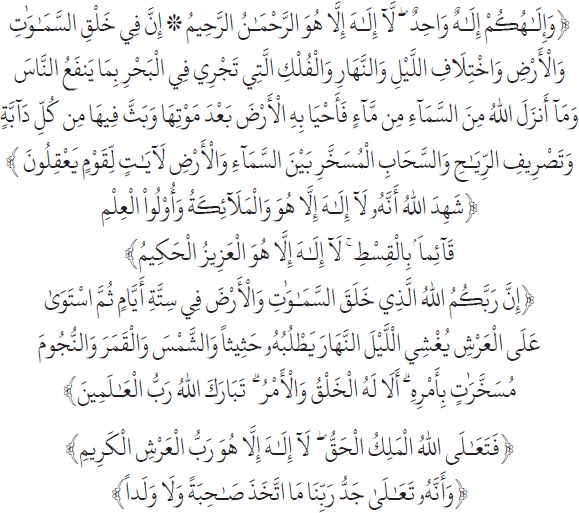
Wa ilāhukum ilāhun wāḥid, lā ilāha illā Huwa-r-Raḥmānu-r-Raḥīm. Inna fī khalqi-s-samāwāti wa-l-arḍi wa-khtilāfi-l-layli wa-n-nahāri wa-l-fulki-llatī tajrī fī-l-baḥri bimā yanfa‘u-n-nāsa wa mā anzala-llāhu mina-s-samā’i mi-m-mā’in fa-aḥyā bihi-l-arḍa ba‘da mawtihā wa baththa fīhā min kulli dābbatin wa taṣrīfi-r-riyāḥi wa-s-saḥābi-l-musakhkhari bayna-s-samā’i wa-l-arḍi la-āyāti-l-li-qawmin ya‘qilūn. Shahida-llāhu annahu lā ilāha illā Huwa wa-l-malā’ikatu wa ūlu-l-‘ilmi qā’imam bi-l-qisṭ. Lā ilāha illā Hū, al-‘Azīzu-l-Ḥakīm. Inna Rabbakumu-llāhu-lladhī khalaqa-s-samāwāti wa-l-arḍa fī sittati ayyāmin thumma-stawā ‘ala-l-‘arsh, yughshi-l-layla-n-nahāra yaṭlubuhu ḥathīthan wa-sh-shamsa wa-l-qamara wa-n-nujūma musakhkharātim bi-amrih, alā lahu-l-khalqu wa-l-amr, tabāraka-llāhu Rabbu-l-‘ālamīn.
Fa-ta‘āla-llāhu-l-Māliku-l-Ḥaqq, lā ilāha illā Hūwa Rabbu-l-‘Arshi-l-karīm. Wa annahu ta‘ālā jaddu Rabbinā, ma-ttakhadha ṣāḥibatan wa lā waladā.
I say: scholars of the language say: ‘mentally deranged’ (lamam) means a type of madness that befalls a man and seizes him.
We relate in the Sunan of Abū Dāwūd with a ṣaḥīḥ isnād from Khārijah ibn aṣ-Ṣalt, who reported that his uncle said: “I came to the Prophet and embraced Islam. Then I returned, and I passed by a group of people who had with them a madman, bound with steel. His family said to me: ‘We have been told that your companion has brought goodness with him. Do you have anything that we can cure him with?’ I recited al-Fātiḥah for him and he was cured, so they gave me a hundred sheep. I went to the Prophet and informed him. He asked: ‘Is there anything other than this?’ and in one narration, ‘Did you say anything else besides?’ I replied: ‘No.’ He said: ‘Take it, for by my life, whoever eats from a false incantation. . ., but you have eaten from a true incantation.’” [10].
and embraced Islam. Then I returned, and I passed by a group of people who had with them a madman, bound with steel. His family said to me: ‘We have been told that your companion has brought goodness with him. Do you have anything that we can cure him with?’ I recited al-Fātiḥah for him and he was cured, so they gave me a hundred sheep. I went to the Prophet and informed him. He asked: ‘Is there anything other than this?’ and in one narration, ‘Did you say anything else besides?’ I replied: ‘No.’ He said: ‘Take it, for by my life, whoever eats from a false incantation. . ., but you have eaten from a true incantation.’” [10].We relate in the book of Ibn as-Sunnī with a different wording which is another version of Abū Dāwūd’s, where Khārijah ibn aṣ-Ṣalt reported that his uncle said: “We went away from the Prophet and came to a district of some Arabs. They said: ‘Do you have a cure? We have a deranged man in bonds.’ They brought the madman, tied up. I recited al-Fātiḥah over him for three days, morning and night. I gathered my saliva and spat on him. It was as if he had been set free after being tied up with rope. They gave me a fee. I said: ‘No.’ They said: ‘Ask the Prophet .’ I asked him and he replied: ‘Eat, for by my life, there are those who eat from a false incantation, but you have eaten from a true incantation.’” [11].
and came to a district of some Arabs. They said: ‘Do you have a cure? We have a deranged man in bonds.’ They brought the madman, tied up. I recited al-Fātiḥah over him for three days, morning and night. I gathered my saliva and spat on him. It was as if he had been set free after being tied up with rope. They gave me a fee. I said: ‘No.’ They said: ‘Ask the Prophet .’ I asked him and he replied: ‘Eat, for by my life, there are those who eat from a false incantation, but you have eaten from a true incantation.’” [11].I say that this uncle’s name was ‘Ilāqah ibn Ṣuḥār but it is also said that his name was ‘Abdullāh.
We relate in the book of Ibn as-Sunnī from ‘Abdullāh ibn Mas‘ūd who recited in the ear of a sick person and he recovered. The Messenger of Allah asked him: “What did you recite in his ear?” He said: “I recited: ‘Did you think that We had created you in jest, and that you would not be brought back to Us? Exalted is Allah, the King, the Real. There is no god but Him, Lord of the Noble Throne. Whoever calls on another god together with Allah, he has no proof thereof at all and his reckoning is with his Lord. Truly the unbelievers have no success. Say: ‘My Lord, forgive and be merciful! You are the Best of the Merciful.’’ [12].until I completed the chapter.” The Messenger of Allah said to him: “If a man had firm faith and recited that on a mountain, it would vanish.” [13].
who recited in the ear of a sick person and he recovered. The Messenger of Allah asked him: “What did you recite in his ear?” He said: “I recited: ‘Did you think that We had created you in jest, and that you would not be brought back to Us? Exalted is Allah, the King, the Real. There is no god but Him, Lord of the Noble Throne. Whoever calls on another god together with Allah, he has no proof thereof at all and his reckoning is with his Lord. Truly the unbelievers have no success. Say: ‘My Lord, forgive and be merciful! You are the Best of the Merciful.’’ [12].until I completed the chapter.” The Messenger of Allah said to him: “If a man had firm faith and recited that on a mountain, it would vanish.” [13].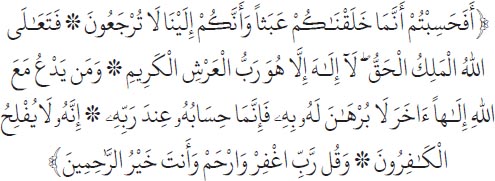
References
[1] Al-Bukhārī (5749) and Muslim (2201).
[2] Qur’ān 2:163–164.
[3] Qur’ān 3:18.
[4] Qur’ān 7:54.
[5] Qur’ān 23:116.
[6] Qur’ān 72:3.
[7] Qur’ān 37.
[8] Qur’ān 59.
[9] Ibn as-Sunnī (637). There is some weakness in the chain of this hadith.
[10] Abū Dāwūd (3896).
[11] Ibn as-Sunnī (635) and Abū Dāwūd (3897).
[12] Qur’ān 23:115.
[13] Ibn as-Sunnī (636) and al-Futūḥāt (4/46). Ibn Ḥajar states that this hadith is gharīb.