
ALLAH  SAYS: “And whenever any incitement to discord is made to you by Shayṭān, seek refuge in Allah. He is the All-Hearing, the All-Knowing.” [1].The best that can be said is that which Allah, exalted is He, instructed us and ordered us to say.
SAYS: “And whenever any incitement to discord is made to you by Shayṭān, seek refuge in Allah. He is the All-Hearing, the All-Knowing.” [1].The best that can be said is that which Allah, exalted is He, instructed us and ordered us to say.
We relate in the Ṣaḥīḥs of al-Bukhārī and Muslim from Abū Hurayrah  who reported that the Messenger of Allah
  said: “Shayṭān will come to one of you and say: ‘Who created this?’ ‘Who created that?’ until he says: ‘Who created your Lord?’ When he reaches that stage, seek protection from Allah and stop.” [2].According to another hadith he said: “People will continue to ask until people say: ‘Allah created Creation, so who created Allah?’ Whoever experiences that must say: ‘I believe in Allah and His Messengers.’” [3].
who reported that the Messenger of Allah said: “Shayṭān will come to one of you and say: ‘Who created this?’ ‘Who created that?’ until he says: ‘Who created your Lord?’ When he reaches that stage, seek protection from Allah and stop.” [2].According to another hadith he said: “People will continue to ask until people say: ‘Allah created Creation, so who created Allah?’ Whoever experiences that must say: ‘I believe in Allah and His Messengers.’” [3].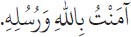
Āmantu bi-llāhi wa Rusulih.
We relate in the book of Ibn as-Sunnī from ‘Ā’ishah  who reported that the Messenger of Allah said: “Whoever experiences any of these insinuations should say thrice, ‘I believe in Allah and His Messengers’, [4].and it will leave him.”
who reported that the Messenger of Allah said: “Whoever experiences any of these insinuations should say thrice, ‘I believe in Allah and His Messengers’, [4].and it will leave him.”We relate in the Ṣaḥīḥ of Muslim from ‘Uthmān ibn Abī al-‘Āṣī who reported: “I said: ‘Messenger of Allah, Shayṭān has interfered with my ṣalāh and and in my recitation and has caused confusion in me.’ The Messenger of Allah said: ‘That shayṭān is called Khinzab. When you sense his presence, seek the protection of Allah from him and spit towards your left thrice.’ I did so, and Allah took away what I had been experiencing. [5].
who reported: “I said: ‘Messenger of Allah, Shayṭān has interfered with my ṣalāh and and in my recitation and has caused confusion in me.’ The Messenger of Allah said: ‘That shayṭān is called Khinzab. When you sense his presence, seek the protection of Allah from him and spit towards your left thrice.’ I did so, and Allah took away what I had been experiencing. [5].I say: ‘Khinzab’ is spelled with khā’ and then a nūn with a sukūn, then a zāy with a fatḥah and then bā’. The ‘ulamā’ differ about how to vowel the khā’: some of them put a fatḥah on it and others put a kasrah, and these two are the most well-known. Some put a ḍammah, as Ibn al-Athīr cited in his Nihāyat al-gharīb, but what is well-known is with a fatḥah or a kasrah.
We relate in the Sunan of Abū Dāwūd with a good isnād from Abū Zumayy who reported: “I asked Ibn ‘Abbās : ‘What is this that I am experiencing?’ He answered: ‘What is it?’ I said: ‘By Allah, I cannot talk about it.’ He asked me: ‘Is it something to do with doubt?’ [When I answered that it was], he smiled and said: ‘No-one was safe from it until Allah revealed: “If you are in doubt concerning what We have revealed unto you [O Prophet], ask those who read the Scripture from before your time. The truth has indeed come to you from your Lord, so be not one of those in doubt.”’ [6].
: ‘What is this that I am experiencing?’ He answered: ‘What is it?’ I said: ‘By Allah, I cannot talk about it.’ He asked me: ‘Is it something to do with doubt?’ [When I answered that it was], he smiled and said: ‘No-one was safe from it until Allah revealed: “If you are in doubt concerning what We have revealed unto you [O Prophet], ask those who read the Scripture from before your time. The truth has indeed come to you from your Lord, so be not one of those in doubt.”’ [6].
Fa-in kunta fī shakki-m-mimmā anzalnā ilayka fa-s’ali-lladhīna yaqra’ūna-l-Kitāba min qablik. La-qad jā’aka-l-ḥaqqu mi-r-Rabbika fa-lā takūnanna mina-l-mumtarīn.
[Ibn ‘Abbās] told me: ‘If you find any [doubt] within yourself, say: “He is the First and the Last, the Manifest and the Hidden, and He has full knowledge of all things.”’ [7].

Huwa-l-Awwalu wa-l-Ākhiru wa-ẓ-Ẓāhiru wa-l-Bāṭin, wa Huwa bi-kulli shay’in ‘Alīm.
We relate with our ṣaḥīḥ isnād from the Riṣalāh of Ustādh Abū al-Qāsim al-Qushayrī, may Allah have mercy upon him, from Aḥmad ibn ‘Aṭā’ ar-Rūdhabārī, the great master , who said: “I was going to extremes of excess in my purification. One night my breast was constricted because of the great volume of water I had poured over myself, and my heart would not be still. I cried out: ‘My Lord! Your pardon, Your pardon! I then heard a voice say ‘Pardon is in knowledge’ and that (state) left me.’”
, who said: “I was going to extremes of excess in my purification. One night my breast was constricted because of the great volume of water I had poured over myself, and my heart would not be still. I cried out: ‘My Lord! Your pardon, Your pardon! I then heard a voice say ‘Pardon is in knowledge’ and that (state) left me.’”Some of the ‘ulamā’ say that it is mustaḥabb for anyone who is troubled by distraction in his wuḍū’, ṣalāh or the like to say: ‘There is no god but Allah.’ This is because when Shayṭān hears dhikr he retreats, i.e. goes back and flees, and ‘There is no god but Allah’ is the foremost of all dhikr. This is why the noble masters of the purest of this [Muslim] Community, the people who instruct the travellers on the spiritual path and instruct desciples, have chosen ‘There is no god but Allah’ for those who make religious retreats, and instructed them to be constant in it. They have declared that the most beneficial cure for insinuation is to turn to the dhikr of Allah and to increase in it. Aḥmad ibn Abī al-Ḥawārī—with either a fatḥah on the rā’ (Abī al-Ḥawāray) or a kasrah—said: “I complained to Abū Sulaymān ad-Dārānī about satanic insinuation. He said: ‘If you want it to stop, then any time you feel it you should become happy. When you become happy it will stop, because there is nothing more hateful to Shayṭān than the happiness of a believer. But if you are grieved by it, it will increase.’” I say: “This is supported by what some of the Imams say: ‘Satanic insinuation only befalls those who have complete faith, for a thief is not tempted by a deserted house.’”
and to increase in it. Aḥmad ibn Abī al-Ḥawārī—with either a fatḥah on the rā’ (Abī al-Ḥawāray) or a kasrah—said: “I complained to Abū Sulaymān ad-Dārānī about satanic insinuation. He said: ‘If you want it to stop, then any time you feel it you should become happy. When you become happy it will stop, because there is nothing more hateful to Shayṭān than the happiness of a believer. But if you are grieved by it, it will increase.’” I say: “This is supported by what some of the Imams say: ‘Satanic insinuation only befalls those who have complete faith, for a thief is not tempted by a deserted house.’”References
[1] Qur’ān 41:36.
[2] Al-Bukhārī and Muslim.
[3] Al-Bukhārī (3276), Muslim (135), and Abū Dāwūd (4721).
[4] Ibn as-Sunnī (629).
[5] Muslim (2203).
[6] Qur’ān 10:94.
[7] Qur’ān 57:3. This hadith is reported by Abū Dāwūd (5110) and in Al-Futūḥāt (4/37). Ibn Ḥajar says the text of this hadith is shādhdh (irregular), as it is reported from Ibn ‘Abbās from the transmission of Sa‘īd ibn Jubayr and Mujāhid that the Prophet never experienced any doubts. This latter was reported by ‘Abd ibn Ḥumayd, aṭ-Ṭabarānī, and Ibn Abī Ḥātim, all with ṣaḥīḥ chains.
never experienced any doubts. This latter was reported by ‘Abd ibn Ḥumayd, aṭ-Ṭabarānī, and Ibn Abī Ḥātim, all with ṣaḥīḥ chains.