
AUTHENTIC REPORTS of the Messenger of Allah  support the view that he used to pronounce takbīr for each rukū‘, and that it is Sunnah. Leaving it out is makrūh tanzīhī; it does not invalidate the ṣalāh and one does not have to prostrate for forgetfulness. That is the ruling for all the takbīrat of ṣalāh except the takbīrat al-iḥrām, which is an essential part of the ṣalāh without which it is not valid. We have discussed the number of the takbīrāt in the first chapter on entering into ṣalāh.
support the view that he used to pronounce takbīr for each rukū‘, and that it is Sunnah. Leaving it out is makrūh tanzīhī; it does not invalidate the ṣalāh and one does not have to prostrate for forgetfulness. That is the ruling for all the takbīrat of ṣalāh except the takbīrat al-iḥrām, which is an essential part of the ṣalāh without which it is not valid. We have discussed the number of the takbīrāt in the first chapter on entering into ṣalāh.Imam Aḥmad has a report which states that all these takbīrāt are compulsory. Is it mustaḥabb to prolong this takbīr? Ash-Shāfi‘ī has two opinions. The later and more authoritative is that it is mustaḥabb to prolong it until one reaches the point of rukū‘, and then one should engage in the adhkār of rukū‘ so that no part of his ṣalāh is devoid of the remembrance of Allah. This is unlike the takbīrat al-iḥrām. The correct view is that one should not prolong it, for that requires the formulation of intention; if one prolongs it, it will become difficult, but if he shortens it, it will be easy. The same ruling applies to the rest of the takbīrāt. We have already discussed this in the chapter on the takbīrat al-iḥrām. And Allah knows best.
When a person has bowed fully in rukū‘, he should engage in the adhkār of rukū‘ and say: Glory be to my Lord, the Tremendous. Glory be to my Lord, the Tremendous. Glory be to my Lord, the Tremendous.

Subḥāna Rabbiya-l-‘Aẓīm, subḥāna Rabbiya-l-‘Aẓīm, subḥāna Rabbiya-l-‘Aẓīm.
It is recorded in the Ṣaḥīḥ of Muslim that Ḥudhayfah  reported that the Messenger of Allah , in his long rukū‘—which was as long as the recitation of the chapters al-Baqarah, an-Nisā’ and Āl ‘Imrān—said: “Glory be to my Lord, the Great.” [1].This means that he repeated “Glory be to my Lord, the Tremendous” in it, as is explained in the Sunan of Abū Dāwūd.
reported that the Messenger of Allah , in his long rukū‘—which was as long as the recitation of the chapters al-Baqarah, an-Nisā’ and Āl ‘Imrān—said: “Glory be to my Lord, the Great.” [1].This means that he repeated “Glory be to my Lord, the Tremendous” in it, as is explained in the Sunan of Abū Dāwūd.It is reported in the Sunan books that he said: “When any of you says Glory be to my Lord, the Tremendous thrice, he has made his rukū‘ complete.” [2].
said: “When any of you says Glory be to my Lord, the Tremendous thrice, he has made his rukū‘ complete.” [2].It is recorded in both Ṣaḥīḥs that ‘Ā’ishah  reported that the Messenger of Allah said in his rukū‘ and sujūd: “Glory be to You, Allah our Lord, and to You be all praise. O Allah, forgive me.” He interpreted the Qur’ān. [3].
reported that the Messenger of Allah said in his rukū‘ and sujūd: “Glory be to You, Allah our Lord, and to You be all praise. O Allah, forgive me.” He interpreted the Qur’ān. [3].
Subḥānaka-llāhumma Rabbanā wa bi-ḥamdik, Allāhumma-ghfir lī.
It is recorded in the Ṣaḥīḥ of Muslim that ‘Alī reported that when the Messenger of Allah performed rukū‘ he used to say: “O Allah, to You have I made rukū‘, in You I believe, and to You have I submitted. My hearing, sight, brain, bones and nerves are humble to You.” [4].
reported that when the Messenger of Allah performed rukū‘ he used to say: “O Allah, to You have I made rukū‘, in You I believe, and to You have I submitted. My hearing, sight, brain, bones and nerves are humble to You.” [4].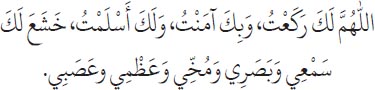
Allāhumma laka raka‘t, wa bika āmant, wa laka aslamt, khasha‘a laka sam‘ī wa baṣarī wa mukhkhī wa ‘aẓmī wa ‘aṣabī.
In the books of the Sunan it reads: “My hearing, sight, brain, bones, nerves and all that my feet rise are humble to Allah, Lord of the Worlds.”

Khasha‘a sam‘ī wa baṣarī wa mukhkhī wa ‘aẓmī wa ma-staqallat bihi qadamī li-llāh Rabbī-l-‘ālamīn.
It is recorded in the Ṣaḥīḥ of Muslim that ‘Ā’ishah reported that the Messenger of Allah used to say in his rukū‘ and sujūd: “Most Glorious and Most Holy, Lord of the angels and the Spirit.” [5].Scholars of the Arabic language say that ‘Subbūḥun Quddūsun’, with the ḍammah on the first of the two but sometimes fatḥah, and these are two variants, the best, most well-known and most often used is that with the ḍammah.
reported that the Messenger of Allah used to say in his rukū‘ and sujūd: “Most Glorious and Most Holy, Lord of the angels and the Spirit.” [5].Scholars of the Arabic language say that ‘Subbūḥun Quddūsun’, with the ḍammah on the first of the two but sometimes fatḥah, and these are two variants, the best, most well-known and most often used is that with the ḍammah.
Subbūḥun Quddūsun Rabbu-l-malā’ikati wa-r-rūḥ.
We relate from ‘Awf ibn Mālik who said: “I stood with the Messenger of Allah and he stood up and recited Sūrat al-Baqarah (the Chapter of the Cow). He did not come to any verse of mercy without stopping and asking for it, and he did not come to any verse of punishment without stopping to seek protection from it. Then he bowed for the same length of time as he stood. He said in his rukū‘: ‘Glory be to the Owner of might, dominion, grandeur and immensity.’ Then he said the same in his sujūd.” [6].This hadith is ṣaḥīḥ and Abū Dāwūd and an-Nasā’ī narrated in their Sunans as well as at-Tirmidhī in his Shamā’il with ṣaḥīḥ isnāds.
who said: “I stood with the Messenger of Allah and he stood up and recited Sūrat al-Baqarah (the Chapter of the Cow). He did not come to any verse of mercy without stopping and asking for it, and he did not come to any verse of punishment without stopping to seek protection from it. Then he bowed for the same length of time as he stood. He said in his rukū‘: ‘Glory be to the Owner of might, dominion, grandeur and immensity.’ Then he said the same in his sujūd.” [6].This hadith is ṣaḥīḥ and Abū Dāwūd and an-Nasā’ī narrated in their Sunans as well as at-Tirmidhī in his Shamā’il with ṣaḥīḥ isnāds.
Subḥāna Dhi-l-jabarūti wa-l-malakūti wa-l-kibriyā’i wa-l-‘aẓamah.
We relate in the Ṣaḥīḥ of Muslim that Ibn ‘Abbās reported that the Messenger of Allah said: “As for the rukū‘, magnify the Lord in it.” [7].
reported that the Messenger of Allah said: “As for the rukū‘, magnify the Lord in it.” [7].Know that this last hadith expresses the essence of this chapter, which is to magnify and glorify the Lord  in rukū‘ using any words and expressions. However, the best thing is to combine all of these adhkār, if possible, in such a manner as not to cause difficulty to others. Preference should be given to the tasbīḥ. If one wishes to limit oneself [to one dhikr], then tasbīḥ is mustaḥabb. The minimum required is three tasbīḥāt. If a person limits himself to saying it once, he will have fulfilled the essence of tasbīḥ. It is mustaḥabb, if one limits oneself to only a few, to employ the others at other times. In this way one will employ all of them. One should do the same with the adhkār mentioned in the other chapters.
in rukū‘ using any words and expressions. However, the best thing is to combine all of these adhkār, if possible, in such a manner as not to cause difficulty to others. Preference should be given to the tasbīḥ. If one wishes to limit oneself [to one dhikr], then tasbīḥ is mustaḥabb. The minimum required is three tasbīḥāt. If a person limits himself to saying it once, he will have fulfilled the essence of tasbīḥ. It is mustaḥabb, if one limits oneself to only a few, to employ the others at other times. In this way one will employ all of them. One should do the same with the adhkār mentioned in the other chapters.Know that the dhikr in rukū‘ is Sunnah in our opinion and according to the majority of ‘ulamā’. If a person leaves it out, whether intentionally or out of forgetfulness, his ṣalāh will not be invalid, he will not be sinning, and he will not have to prostrate for forgetfulness. Imam Aḥmad ibn Ḥanbal and others are of the opinion that it is wājib. Therefore it is imperative for the worshipper to be mindful of it, because of the authentic and explicit hadiths that command one to do it, such as the saying of the Messenger of Allah : “As for the rukū‘, magnify the Lord in it.” This should be done in order not to be unaffected by the difference of opinion between the ‘ulamā’, may Allah have mercy on them. And Allah knows best.
: “As for the rukū‘, magnify the Lord in it.” This should be done in order not to be unaffected by the difference of opinion between the ‘ulamā’, may Allah have mercy on them. And Allah knows best.It is makrūh to recite Qur’ān in rukū‘ and sujūd, although if one recites anything besides al-Fātiḥah his ṣalāh is not invalidated. Likewise, if one recites al-Fātiḥah his ṣalāh will not be invalidated, according to the most reliable opinions. Some of our [Shāfi‘ī] colleagues are of the opinion that it is invalidated.
We relate from ‘Alī , that he said: “The Messenger of Allah forbade us to recite [Qur’ān] whilst in rukū‘ and sujūd.” [8].
, that he said: “The Messenger of Allah forbade us to recite [Qur’ān] whilst in rukū‘ and sujūd.” [8].Ibn ‘Abbās reported that the Messenger of Allah said: “I have been forbidden to recite the Qur’ān whilst in rukū‘ and sujūd.” [9].
reported that the Messenger of Allah said: “I have been forbidden to recite the Qur’ān whilst in rukū‘ and sujūd.” [9].References
[1] Muslim (772), Abū Dāwūd (871), and an-Nasā’ī (3/226).
[2] Abū Dāwūd (886), at-Tirmidhī (261), and Ibn Mājah (890) from Ibn Mas‘ūd. At-Tirmidhī states that its chain of narration is not continuous, because ‘Awn never met Ibn Mas‘ūd.
[3] Al-Bukhārī (794), Muslim (484), Abū Dāwūd (877), and an-Nasā’ī (2/219).
[4] Muslim (771).
[5] Muslim (487), Abū Dāwūd (872), and an-Nasā’ī (2/224).
[6] Abū Dāwūd (873) and an-Nasā’ī (2/191).
[7] Muslim (479), Abū Dāwūd (876), and an-Nasā’ī (2/189).
[8] Muslim (480), Abū Dāwūd (4044), and an-Nasā’ī (2/188–189).
[9] Muslim (480).