
KNOW THAT IT is compulsory to recite Qur’ān in ṣalāh according to the consensus, which is supported by the Qur’ānic text. This is our view and the view of the majority. The recitation of the opening chapter (al-Fātiḥah) is compulsory and nothing else will suffice instead on the part of those who have the ability to recite it. This is because of the authentic hadith in which the Messenger of Allah  said: “Ṣalāh does not take place without the Fātiḥah of the Book.” Ibn Khuzaymah and Abū Ḥātim ibn Ḥibbān—with an i after the ḥ—both narrated it in their Ṣaḥīḥs. In both Ṣaḥīḥs, this is related from the Messenger of Allah : “There is no ṣalāh without the Fātiḥah of the Book.”
said: “Ṣalāh does not take place without the Fātiḥah of the Book.” Ibn Khuzaymah and Abū Ḥātim ibn Ḥibbān—with an i after the ḥ—both narrated it in their Ṣaḥīḥs. In both Ṣaḥīḥs, this is related from the Messenger of Allah : “There is no ṣalāh without the Fātiḥah of the Book.”To say ‘In the name of Allah, the Beneficent, the Merciful’ is compulsory because it is a complete verse at the beginning of al-Fātiḥah.

Bismi-llāhi-r-Raḥmāni-r-Raḥīm.
It is compulsory to recite al-Fātiḥah with all of the doubled consonants (tashdīd). There are fourteen: three in the name (basmalah) and the rest after it. If a person fails to pronounce one of the tashdīds, his recitation is invalid [according to the Shāfi‘ī position]. It is mandatory to recite it uninterrupted and in order. If a person changes the order or interrupts it, his recitation is not valid. He is excused for remaining silent for as long as it takes to draw a breath. If a person following the Imam in ṣalāh makes the prostration for recitation with the Imam, or hears the Āmīn of the Imam and says Āmīn because of his Āmīn, or asks for mercy or seeks protection from Hell-Fire because of the recitation of the Imam, that [ruling about interrupting the recitation] does not apply. The recitation of a follower in ṣalāh who is in the process of reciting al-Fātiḥah is not unacceptable in these two instances because he has an excuse.
If a person recites al-Fātiḥah ungrammatically in a way that distorts its meaning, his ṣalāh is invalid. If it does not distort its meaning, his recitation is valid. Examples of mispronunciation that distort the meaning are saying: an‘amtu (I have favoured) or an‘amti (You [fem.] have favoured), or iyyāki na‘budu (You [fem.] alone do we worship). Among the things which do not distort the meaning is saying: Rabbu-l-‘ālamīn or Rabba-l-‘ālamīn with a u on the bā’ or an a. If a person says: wa la-ẓ-ẓāllīn his ṣalāh is invalid according to the weightier of two views, unless he is unable to pronounce the ḍād even after receiving instruction, in which case he is excused.
If a person has not perfected [his pronunciation of] al-Fātiḥah, he may recite other verses of the Qur’ān which are equivalent to it [in length]. If he has not perfected [his knowledge of] anything from the Qur’ān he may recite any dhikr, like tasbīḥ or tahlīl, which is equivalent to reciting the verses of al-Fātiḥah. If he has not perfected any dhikr and the time to learn any is restricted, then he should stand for as long as it takes to recite and then bow. His ṣalāh will be accepted provided he has not been neglectful and negligent in learning. If he has been neglectful in learning al-Fātiḥah, it will be compulsory for him to repeat it. When he is able to learn, it is compulsory for him to learn al-Fātiḥah. If he has perfected al-Fātiḥah in any language other than Arabic but he has not learnt it in Arabic, it will not be permissible for him to recite it. He should substitute for it one of the things mentioned above.
After al-Fātiḥah, one should recite a chapter or part of a chapter. This is Sunnah and if a person omits it, his ṣalāh is still valid and he does not have to prostrate for forgetfulness, whether his ṣalāh was compulsory or supererogatory. It is not mustaḥabb to recite a chapter in the funeral ṣalāh, according to the most authoritative view, because it is based on brevity. One has a choice: if he wants he may recite a chapter, and if he wants he may recite part of a chapter. A short chapter is better than its equivalent from a longer chapter. It is mustaḥabb to recite the chapters according to their order in the Qur’ān. One should recite in the second rak‘ah a chapter that comes after the chapter recited in the first rak‘ah, so that they be sequential. If he goes against this order it is still permissible. It is Sunnah to recite this chapter after al-Fātiḥah, so if one recites it before al-Fātiḥah he will not be considered as having recited a chapter.
It is mustaḥabb to recite the sūrahs according to the order of the muṣḥaf and to recite in the second a sūrah after the first sūrah that follows it. If he diverges from this, it is valid. It is Sunnah that the sūrah come after al-Fātiḥah, but if it comes before al-Fātiḥah it is not reckoned that one has recited a sūrah.
Know that what we have mentioned about recitation of the sūrah being mustaḥabb applies to the imam, a person who reciting alone and a person who follows the imam in that which the imam recites silently. As for that in which the imam recites aloud, then the person who follows the imam does not do more than recite al-Fātiḥah if he has heard the imam’s recitation. But if he has not heard him or has heard him recite so quietly that he cannot understand him, then it is mustaḥabb for him to recite a sūrah, according to the soundest view, as long as he does not disturb others.
It is Sunnah that the chapter in Ṣubḥ and Ẓuhr be one of the longer chapters, [1].in ‘Aṣr and ‘Ishā’ one of the medium-length chapters [2].and in Maghrib one of the shorter chapters. [3].The Imam should recite the shorter ones, unless he knows that the followers prefer them to be longer. It is Sunnah to recite Sūrat as-Sajdah in the first rak‘ah of Ṣubḥ on Friday and Sūrat al-Insān in the second. One should recite them in their entirety. What some people do, reciting part of them, is contrary to the Sunnah. It is Sunnah, in the ṣalāh of ‘Īd and the ṣalāh asking for rain, to recite Qāf in the first rak‘ah after al-Fātiḥah and al-Qamar in the second. If one wishes, he may recite al-A‘lā and in the second al-Ghāshiyah. Both of these are Sunnah. It is Sunnah to recite al-Jumu‘ah in the first rak‘ah of the ṣalāh of Jumu‘ah and al-Munāfiqūn in the second. If one wishes one may recite al-A‘lā in the first and al-Insān in the second. Both are Sunnah.
One should beware of confining himself to part of a sūrah in these places, but if he wishes to lighten it, he should proceed slowly in his recitation without such a haste as would lead to him mispronouncing the letters.
It is Sunnah to recite Say, ‘We believe in Allah and what has been sent down to us. . . (2:135) after al-Fātiḥah in the first rak‘ah of Sunnah ṣalāh of Fajr and Say, ‘People of the Book, come to a common declaration . . .(3: 64) in the second. If a person wishes he may recite Sūrat al-Kāfirūn in the first and Sūrat al-Ikhlāṣ in the second. It is authentically recorded in the Ṣaḥīḥ of Muslim that the Messenger of Allah did both.
did both.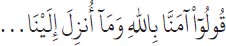
Qūlū āmannā bi-llāhi wa mā unzila ilaynā . . .

Qul Yā ahla-l-Kitāb ta‘ālaw ilā kalimatin sawā’ . . .
In the two Sunnah rak‘ahs of Maghrib and the two rak‘ahs of ṭawāf and istikhārah, one should recite al-Kāfirūn in the first and al-Ikhlāṣ in the second.
In the Witr ṣalāh one should recite Sūrat al-A‘lā after al-Fātiḥah in the first rak‘ah, al-Kāfirūn in the second, and al-Ikhlāṣ in the third, together with the Mu‘awwidhatayn (Surahs 113–114). All of this that we have mentioned has been narrated in hadiths from the Ṣaḥīḥ collections and elsewhere which are well-known and because of their fame we have no need to mention them. And Allah knows best.
If a person leaves out Sūrat al-Jumu‘ah in the first rak‘ah of Jumu‘ah, he should recite it in the second with Sūrat al-Munāfiqūn. Likewise, in the ṣalāh of ‘Īd or the ṣalāh for rain, in Witr and the Sunnah of Fajr and others that we have mentioned, those things that are of the same sense, if one leaves out what is Sunnah in the first he should recite it with what is Sunnah in the second, so that his ṣalāh is not devoid of those two chapters. If a person recites al-Munāfiqūn in the first rak‘ah of Jumu‘ah he should recite al-Jumu‘ah in the second and not repeat al-Munāfiqūn. The proof of this has been discussed in the commentary on al-Muhadhdhab.
It has been established in authentic narrations that the Messenger of Allah used to make the first rak‘ah of Ṣubḥ and other ṣalāhs longer than the second. Most of our [Shāfi‘ī] colleagues prefer to interpret this, and they say that the first should not be longer than the second. The people of precise investigation take the position that lengthening the first is mustaḥabb because of this authentic hadith. They agree that the third and the fourth rak‘ahs should be shorter than the first and the second. The soundest position is that reciting a chapter of the Qur’ān in them is not mustaḥabb, but if we say that it is mustaḥabb then the soundest position is that the third should be like the fourth, but some have said that it should be made longer than it.
used to make the first rak‘ah of Ṣubḥ and other ṣalāhs longer than the second. Most of our [Shāfi‘ī] colleagues prefer to interpret this, and they say that the first should not be longer than the second. The people of precise investigation take the position that lengthening the first is mustaḥabb because of this authentic hadith. They agree that the third and the fourth rak‘ahs should be shorter than the first and the second. The soundest position is that reciting a chapter of the Qur’ān in them is not mustaḥabb, but if we say that it is mustaḥabb then the soundest position is that the third should be like the fourth, but some have said that it should be made longer than it.The ‘ulamā’ agree unanimously that recitation should be audible in the ṣalāh of Ṣubḥ and in the first two rak‘ahs of Maghrib and ‘Ishā’ ; and that recitation should be silent in Ẓuhr and ‘Aṣr, in the third rak‘ah of Maghrib and in the third and fourth rak‘ahs of ‘Ishā’. They agree that recitation should be audible in Jumu‘ah, the two ‘Īds, Tarāwīḥ, and the Witr after it. This is mustaḥabb for the Imam and for anyone performing ṣalāh alone. There is consensus that when following the Imam one should not recite any of this aloud. It is Sunnah to recite audibly in the ṣalāh for lunar eclipse and silently in the ṣalāh for solar eclipse, and to recite audibly in the ṣalāh for rain and in the funeral ṣalāh, whether it be performed in the day or the night. The daytime Nawāfil prayers should not be recited out loud, except those for the ‘Īd and for rain.
Our colleagues disagree about Nawāfil prayers at night: some say that they should not be recited out loud, while others say that they should. The third view—which is the view of al-Qāḍī Ḥusayn and al-Baghāwī—is that they should be recited somewhere between loud and silent. If a person misses a prayer at night he should make it up during the day, or [if he misses a prayer] during the day he should make it up at night. Does one take into consideration the loud or silent recitation of the time he missed the ṣalāh or the time he fulfils it? There are two opinions. The more obvious is that one should take into consideration the time of fulfilling it. Another version is that one should recite it silently under all circumstances. Reciting out loud or silently according to circumstances is Sunnah and not wājib. So if a person recites out loud when he should have recited silently, or vice versa, his ṣalāh is still valid, and although this is makrūh he will not have to prostrate for forgetfulness. We have stated previously that in the silent recitation during Fajr, the Qur’ān and the adhkār that are prescribed in ṣalāh have to be loud enough so that the reciter can hear himself. If he cannot hear himself and there is no impediment, his recitation and his dhikr are not valid.
According to our [Shāfi‘ī] colleagues: “It is mustaḥabb for the Imam in ṣalāh performed out loud to make four silent pauses. The first is after the takbīrat al-iḥrām, so that one may recite the opening du‘ā’. The second is a slight pause between the completion of al-Fātiḥah and the Āmīn so that it may be known that the Āmīn is not part of al-Fātiḥah. The third pause is after the Āmīn so that the follower may recite al-Fātiḥah. The fourth is after the recitation of the chapter so that he may separate the recitation from the takbīr of going into rukū‘.
When one has finished al-Fātiḥah it is mustaḥabb to say Āmīn. There are many authentic and well-known hadiths about its virtue and great reward. This Āmīn is mustaḥabb for everyone who recites, whether in ṣalāh or outside it. There are four variants, the most eloquent and the best known of which is Āmīn with an elongation and without doubling of the letter [mīm]. The second is Amīn without elongation and without doubling of the letter [mīm]. The third is Āmīn with imālah [4].. The fourth is Āmmīn with an elongation and with doubling of the letter [mīm]. The first two are well-known. Al-Wāḥidī cited the third and the fourth at the beginning of al-Basīṭ. The first is the most preferable one.
The Āmīn is mustaḥabb for the Imam, those following him, and those performing ṣalāh alone in any ṣalāh in which recitation is done out loud. The correct view is that the follower should say the Āmīn whether the congregation be large or small. It is mustaḥabb that the Āmīn of those following should coincide with the Āmīn of the Imam, and not come before him or after him. There is no place in the ṣalāh where the utterance of a follower may coincide with that of the Imam except when saying Āmīn; the rest should come after the Imam.
It is Sunnah for anyone reciting [Qur’ān], whether in ṣalāh or outside it, when he hears or recites a verse about mercy, to ask of Allah  from His bounty; and when he hears or recites a verse about punishment to ask His protection from Hell-Fire or from punishment, or from evil and iniquity, or to say: O Allah, I ask You for well-being or something like that.
from His bounty; and when he hears or recites a verse about punishment to ask His protection from Hell-Fire or from punishment, or from evil and iniquity, or to say: O Allah, I ask You for well-being or something like that.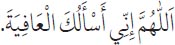
Allāhumma innī as’aluka-l-‘āfiyah.
If one hears or recites a verse that glorifies Allah , he should glorify Him and say: Peerless and Exalted is He.
, he should glorify Him and say: Peerless and Exalted is He.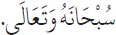
Subḥānahu wa ta‘ālā.
He may also say: Blessed is Allah, Lord of the Worlds.
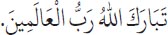
Tabāraka-llāhu Rabbu-l-‘ālamīn.
He may also say: Glorious is the Vastness of our Lord.

Jallat ‘aẓamatu Rabbinā.
Ḥudhayfah ibn al-Yamān  said: “I performed ṣalāh with the Messenger one night and he started al-Baqarah. I said to myself: ‘He will perform rukū‘ after one hundred verses.’ Then he continued and I said: ‘He will pray the rak‘ah with it.’ He continued. I said to myself: ‘He will perform rukū‘ with it.’ Then he started an-Nisā’ and recited it all. Then he started Āl ‘Imrān and recited it all. He recited slowly, when he came to a verse in which there was glorification he glorified Allah, when he came to a request he made a supplication, and when he came to a verse of seeking protection he sought protection.” [5].Muslim narrated it in his Ṣaḥīḥ.
said: “I performed ṣalāh with the Messenger one night and he started al-Baqarah. I said to myself: ‘He will perform rukū‘ after one hundred verses.’ Then he continued and I said: ‘He will pray the rak‘ah with it.’ He continued. I said to myself: ‘He will perform rukū‘ with it.’ Then he started an-Nisā’ and recited it all. Then he started Āl ‘Imrān and recited it all. He recited slowly, when he came to a verse in which there was glorification he glorified Allah, when he came to a request he made a supplication, and when he came to a verse of seeking protection he sought protection.” [5].Muslim narrated it in his Ṣaḥīḥ.Our Shāfi‘ī colleagues say that this glorification, asking and seeking protection is mustaḥabb whether reciting in ṣalāh or outside it, and for the Imam, a follower and a person performing ṣalāh alone, because it is a du‘ā’ and they are equal in it as they are in saying Āmīn. [6].
It is mustaḥabb [for Shāfi‘īs], when one recites: “Is not Allah the wisest of judges?” [7].to say: Yes, and I am one who testifies to that.
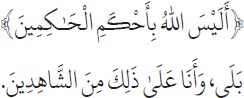
A-laysa-llāhu bi-aḥkami-l-ḥākimīn.
Balā, wa anā ‘alā dhālika mina-sh-shāhidīn.
It is mustaḥabb [for Shāfi‘īs], when one recites: “Has not that One the power to give life to the dead?” [8].to say: Yes indeed; I bear witness.
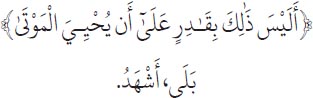
A-laysa dhālika bi-qādirin ‘alā an yuḥyiya-l-mawtā.
Balā, ashhadu.
It is mustaḥabb [for Shāfi‘īs], when one recites: “So in what message after this will they believe?” [9].to say: I believe in Allah.
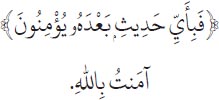
Fa-bi-ayyi ḥadīthin ba‘dahu yu’minūn.
Āmantu bi-llāh.
It is mustaḥabb [for Shāfi‘īs], when one recites: “Glorify the name of your Guardian-Lord, the Most High,” [10].to say: Glorious is your Lord, the Most High.

Sabbiḥi-sma Rabbika-l-A‘lā.
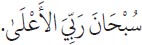
Subḥāna Rabbiya-l-A‘lā.
One should, if following the Shāfi‘ī madhhab, say all of the above, whether reciting in ṣalāh or not. I have explained the proof for this in the book at-Tibyān fī ādāb ḥamalat al-Qur’ān.
References
[1]  —The Ṭiwāl al-Mufaṣṣal are the chapters from al-Ḥujurāt to al-Burūj.
—The Ṭiwāl al-Mufaṣṣal are the chapters from al-Ḥujurāt to al-Burūj.[2]  —The Awsāṭ al-Mufaṣṣal are from aṭ-Ṭāriq to al-Bayyinah.
—The Awsāṭ al-Mufaṣṣal are from aṭ-Ṭāriq to al-Bayyinah.[3] —The Qiṣār al-Mufaṣṣal are from az-Zalzalah to an-Nās.
—The Qiṣār al-Mufaṣṣal are from az-Zalzalah to an-Nās.[4] Pronouncing the a inclining towards an i like Aymīn where the first vowel is like the sound of the English word ‘eh’. Saying Āmīn aloud is makrūh for Mālikīs following an Imam (Editors).
[5] Muslim (772), Abū Dāwūd (871), and an-Nasā’ī (2/176).
[6] In the Ḥanafī madhhab, however, to do so invalidates the ṣalāh.
[7] Qur’ān 95:8.
[8] Qur’ān 75:40.
[9] Qur’ān 7:186.
[10] Qur’ān 87:1.