
THERE ARE MANY hadiths which collectively require one to say: Allah is greater, abundant praise is due to Allah and glory be to Allah in the morning and in the evening. I turn my face towards the One Who created the heavens and the earth, following the true religion as a Muslim; I am not one of the idolaters. Verily my ṣalāh and my sacrifice and my life and my death are for Allah, Lord of the Worlds, Who has no partners. Thus I have been commanded to do, and I am one of the Muslims. O Allah, You are the King; there is no god but You. You are my Lord and I am Your slave. I have wronged myself and I admit my sin; so forgive me all my sins, for no one forgives sins but You. Guide me to the best of character, for no one guides to the best of it but You; and turn the evil of it away from me, for no one turns it away except You. I am present and at Your command, and all good is in Your hands and no evil is attributed to You. I am from You and [am returning] to You; Blessed are You and You are Most Exalted. I ask for Your forgiveness and repent to You.
Then one should say: O Allah, put a distance between me and my sins like the distance between the East and the West.
O Allah, purify me of sin as a white robe is purified of dirt.
O Allah, wash me of sin with snow, water and ice.
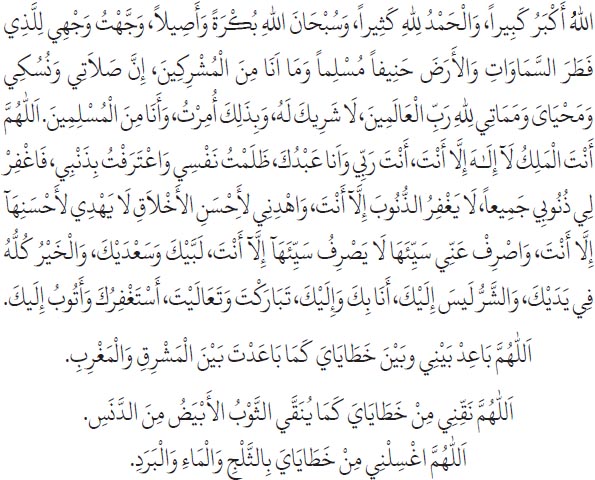
Allāhu akbaru kabīrā wa-l-ḥamdu li-llāhi kathīrā, wa subḥāna-llāhi bukratan wa aṣīlā, wajjahtu wajhī li-lladhī faṭara-s-samāwāti wa-l-arḍa ḥanīfan musliman wa mā anā mina-l-mushrikīn, inna ṣalātī wa nusukī wa maḥyāya wa mamātī li-llāhi Rabbī-l-‘ālamīn, lā sharīka lah, wa bi-dhālika umirt, wa anā mina-l-muslimīn, Allāhumma Anta-l-Maliku lā ilāha illā Ant, Anta Rabbī wa anā ‘abduk, ẓalamtu nafsī wa‘taraftu bi-dhanbī, fa-ghfir lī dhunūbī jamī‘ā, lā yaghfiru-dh-dhunūba illā Ant, wa-hdinī li-aḥsani-l-akhlāq lā yahdī li-aḥsanihā illā Ant, wa-ṣraf ‘annī sayyi’ahā, lā yāṣrifu sayyi’ahā illā Ant, labbayka wa sa‘dayk, wa-l-khayru kulluhu fī yadayk, wa-sh-sharru laysa ilayk, anā bika wa ilayk, tabārakta wa ta‘ālayt, astaghfiruka wa atūbu ilayk.
Allāhumma bā‘id baynī wa bayna khaṭāyāya kamā
bā‘adta bayna-l-mashriqi wa-l-maghrib.
bā‘adta bayna-l-mashriqi wa-l-maghrib.
Allāhumma naqqinī min khaṭāyāya kamā yunaqqi-
th-thawbu-l-abyaḍu mina-d-danas.
th-thawbu-l-abyaḍu mina-d-danas.
Allāhumma-ghsilnī min khaṭāyāya bi-th-thalji wa-l-mā’i wa-l-barad.
All that we have mentioned has been established from authentic narrations from the Messenger of Allah  . There are other hadiths on this subject, including the following.
. There are other hadiths on this subject, including the following.‘Ā’ishah  reported that when the Messenger of Allah started the ṣalāh he said: “Glory be to You, Allah, and with Your praise, and blessed is Your Name and exalted Your Majesty; there is no god other than You.” [1].This is narrated by at-Tirmidhī, Abū Dāwūd and Ibn Mājah with weak isnāds. Abū Dāwūd, at-Tirmidhī and al-Bayhaqī and others consider it weak.
reported that when the Messenger of Allah started the ṣalāh he said: “Glory be to You, Allah, and with Your praise, and blessed is Your Name and exalted Your Majesty; there is no god other than You.” [1].This is narrated by at-Tirmidhī, Abū Dāwūd and Ibn Mājah with weak isnāds. Abū Dāwūd, at-Tirmidhī and al-Bayhaqī and others consider it weak.
Subḥānaka-llāhumma wa bi-ḥamdik, wa tabāraka-smuk, wa ta‘ālā jadduk, wa lā ilāha ghayruk.
Abū Dāwūd, at-Tirmidhī, an-Nasā’ī, Ibn Mājah and al-Bayhaqī quote from the narration of Abū Sa‘īd al-Khudrī but they consider it weak. Al-Bayhaqī said: “Commencing with ‘Glory be to You, Allah, and blessed be Your Name!’ is narrated from Ibn Mas‘ūd and Anas in marfū‘ form and all of the narrations are weak. The most authentic is that narrated by ‘Umar ibn al-Khaṭṭāb  .”
.”
.”Al-Bayhaqī narrates, with his isnād from ‘Umar, that [the Prophet ]performed the takbīr and then said: “Glory be to You, O Allah, and with Your praise, and blessed is Your name, and lofty is Your majesty, and there is no god but You.” And Allah knows best.
]performed the takbīr and then said: “Glory be to You, O Allah, and with Your praise, and blessed is Your name, and lofty is Your majesty, and there is no god but You.” And Allah knows best.
Subḥānaka-llāhumma wa bi-ḥamdik, tabāraka-smuk, wa ta‘ālā jadduk, wa lā ilāha ghayruk.
We relate in the Sunan of al-Bayhaqī that ‘Alī reported that when the Messenger of Allah began the ṣalāh he would say: “There is no god but You. Glory be to You. I have wronged myself and I have done evil, so forgive me, for none forgives sins except You. I have turned my face” and so on. [2].This is a weak hadith, since the narrator, al-Ḥārith al-A‘war, is agreed by all to be weak. Ash-Sha‘bī calls al-Ḥārith a liar. Allah knows best.
reported that when the Messenger of Allah began the ṣalāh he would say: “There is no god but You. Glory be to You. I have wronged myself and I have done evil, so forgive me, for none forgives sins except You. I have turned my face” and so on. [2].This is a weak hadith, since the narrator, al-Ḥārith al-A‘war, is agreed by all to be weak. Ash-Sha‘bī calls al-Ḥārith a liar. Allah knows best.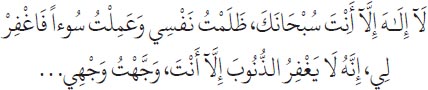
Lā ilāha illā Anta subḥānak, ẓalamtu nafsī wa ‘amiltu sū’an fa-ghfir lī, innahu lā yaghfiru-dh-dhunūba illā Ant, wajjahtu wajhī. . .
Concerning the Messenger of Allah saying “And no evil is attributable to You”, you should know that it is the opinion of the people of truth among hadith scholars, jurists from among the Companions of the Messenger of Allah , the generation that followed them, and the ‘ulamā’ of the Muslims, that all creation—good and bad, beneficial and harmful—comes from Allah  . It is by His Will and His Decree. Once this is established, then it is essential to interpret and understand this hadith. The ‘ulamā’ have mentioned some answers to this.
saying “And no evil is attributable to You”, you should know that it is the opinion of the people of truth among hadith scholars, jurists from among the Companions of the Messenger of Allah , the generation that followed them, and the ‘ulamā’ of the Muslims, that all creation—good and bad, beneficial and harmful—comes from Allah . It is by His Will and His Decree. Once this is established, then it is essential to interpret and understand this hadith. The ‘ulamā’ have mentioned some answers to this.Firstly, and this is the best-known, an-Nadhdhār ibn Shumayl and the Imams after him say it means: ‘One cannot come close to You with evil.’The second interpretation is ‘It cannot go up to You’ as only good words go up. Thirdly, ‘It is not associated with You.’ So one should not say: ‘O Creator of evil’, although He is its Creator, or: ‘O Creator of pigs’, although He is their Creator. Lastly, ‘It is not evil in relation to Your Wisdom, because You do not create anything in vain.’ And Allah knows best.
It is mustaḥabb for a person performing ṣalāh alone and for the Imam, if the followers allow him, to recite in the opening supplication all of the adhkār mentioned above. If the followers do not give the Imam permission, he should not make the ṣalāh long but should restrict himself to some of those adhkār. It is best for him to confine himself to saying: I turn my face . . . one of the Muslims. [3].Similarly, a person praying alone should also confine himself to this.
Know that these adhkār are mustaḥabb in both the compulsory and voluntary ṣalawāt. If a person leaves them out in the first rak‘ah, whether intentionally or unintentionally, he should not do them afterwards because he has omitted them from their proper place. If he does so, it will be makrūh but his ṣalāh will not be invalid. If he leaves them out after the takbīr until after starting the recitation and the seeking of protection, then he has missed their place and he should not recite them, although if he does recite it [then], his ṣalāh will not be invalid. If he comes in late to join the ṣalāh and he finds the Imam in one of the rak‘ahs, he should recite the adhkār, unless he fears that he will miss al-Fātiḥah (the opening chapter) by reciting them. He should instead engage in reciting al-Fātiḥah, as it is more important, being compulsory, while these adhkār are Sunnah. If a late comer joins the Imam in rukū‘, prostration or sitting, he should perform the takbīrat al-iḥrām and recite the dhikr that the Imam is occupied with. He should not recite the opening du‘ā’ at that point or after it.
Our [Shāfi‘ī] colleagues disagree as to whether or not the opening du‘ā’ is mustaḥabb in the funeral ṣalāh. The more correct view is that it is not mustaḥabb, because the prayer is based on brevity. The opening du‘ā’ is Sunnah and not compulsory, and if one leaves it out he does not have to prostrate for forgetfulness. It is Sunnah to say it softly. To say it aloud is makrūh but does not invalidate the ṣalāh.
The majority of [our colleagues] say that ash-Shāfi‘ī has two mas’alahs. The first is that he makes no difference between silent and loud recitations; and this is found in [Kitāb] al-Umm. The second is that he deems it Sunnah to recite aloud; this is found in [the book] al-Imlā’. Others hold that there are two opinions: the first is that it is better to recite out loud and the second that it is better to recite silently.
The correct view in general is that one should recite out loud. This was pronounced correct and authentic by Shaykh Abū Ḥāmid al-Isfarā’inī, the Imam of our colleagues from Iraq, and that is what Abū Hurayrah used to do. Ibn ‘Umar, however, used to recite softly, and this is the most correct view, according to the majority of our colleagues, and is to be preferred. Allah knows best.
References
[1] Abū Dāwūd (776), at-Tirmidhī (243), Ibn Mājah (806) from ‘Ā’ishah , Abū Dāwūd (775), at-Tirmidhī (243), and Ibn Mājah (804) from Abū Sa‘īd al-Khudrī . Ibn Ḥajar grades it as ḥasan. This hadith is also mentioned in the Mustadrak (1/235) of al-Ḥākim, who classes it as ṣaḥīḥ, and adh-Dhahabī agrees.
, Abū Dāwūd (775), at-Tirmidhī (243), and Ibn Mājah (804) from Abū Sa‘īd al-Khudrī . Ibn Ḥajar grades it as ḥasan. This hadith is also mentioned in the Mustadrak (1/235) of al-Ḥākim, who classes it as ṣaḥīḥ, and adh-Dhahabī agrees.[2] Al-Bayhaqī (2/33) and al-Futūḥāt (2/178–179). Ibn Ḥajar mentions that the narrator, al-Ḥārith al-A‘war, was declared trustworthy by some hadith scholars.
[3] “I turn my face towards the One Who created the heavens and the earth, following the true religion as a Muslim; I am not one of the idolaters. Verily my ṣalāh, my sacrifice, my life and my death are for Allah the Lord of the Worlds. He has no partners. Thus I have been commanded to do, and I am one of the Muslims.” For the Arabic see the beginning of the chapter.