
KNOW THAT ṢALĀH is not valid without the takbīrāt al-iḥrām, whether the ṣalāh be compulsory or supererogatory. According to the Shāfi‘īs and some others, the takbīr is part of the ṣalāh and is one of its essential elements. According to Abū Ḥanīfah, it is a precondition of ṣalāh but not a part of it.
Know that the words of the takbīr are Allah is greater. The two forms that are permissible are: Allah is greater or Allah is the Greatest.
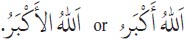
Allāhu akbar or Allāhu-l-akbar.
Both of these forms are permissible according to ash-Shāfi‘ī and Abū Ḥanīfah. According to Imam Mālik, only the first is permissible. As a precaution, one should use the first in order to avoid controversy. Takbīr is not permissible with any other words. If one said: ‘Allah is the Sublime,’ ‘Allah is the Most High,’ ‘Allah is the Most Magnificent,’ or anything like that, the ṣalāh would not be valid, according to ash-Shāfi‘ī and the majority [of scholars], although according to Abū Ḥanīfah it would be valid. If one said: ‘The Greatest is Allah’—reversing the order of the words—it would not be valid according to what is the correct position in our view. Some of our colleagues say that it would be valid, as it is valid, according to the correct position, to say: ‘Upon you be peace’ at the end of ṣalāh.
Know that the takbīr and all other adhkār [in ṣalāh] are not valid unless one utters them with the tongue so that he can hear himself, provided that there is no impediment. We have already explained this in the sections at the beginning of this book. If a person is mute or has some defect in his tongue, then he should move his tongue as much as he is able to and his ṣalāh will be valid.
Know that takbīr is not valid in any other language, if one is able to utter it in Arabic. If one is unable to do so, it will be valid but it will be compulsory to learn [the necessary] Arabic. If someone is negligent in learning it, his ṣalāh is not valid. It will be compulsory for him to repeat all the ṣalawāt that he performed while he was negligent.
Know that the correct and preferred view is that the takbīrat al-iḥrām should not be elongated, but should be kept short and said quickly. Some say that it should be elongated; but the first view is correct. It is mustaḥabb to extend the rest of the takbīrāt until one reaches the element or part of ṣalāh after them, according to the correct and preferred view. It is also said that it should not be elongated. If one elongates what should not be elongated and fails to lengthen what should be lengthened, one’s ṣalāh will not be invalid, but one will forfeit the merit [of correctness].
Note that the place to elongate the alif is after the lām in Allāh and nothing else should be lengthened.
It is Sunnah for the Imam to say the takbīrat al-iḥrām and the other takbīrāt aloud so that those following can hear him. Those following should say it softly in such a manner that they can hear themselves. If a follower says it loudly and the Imam says it softly the ṣalāh is not invalidated; but one should strive to make one’s takbīr correct. If one elongates the initial alif in Allāh or lengthens the bā’ in akbar so that it becomes akbār, one’s ṣalāh will be invalid.
Know that in a ṣalāh which comprises two rak‘ahs, eleven takbīrāt are prescribed. Those which comprise three rak‘ahs have seventeen takbīrāt, while those which comprise four rak‘ahs have twenty-two takbīrāt. Every rak‘ah has five takbīrāt: one for the rukū‘ and four for the prostration and coming up from it, besides which there are the takbīrāt al-iḥrām and the takbīr for the first tashahhud.
Know also that all of these takbīrāt are Sunnah. If a person omits one, whether intentionally or out of forgetfulness, his ṣalāh will not be invalid and it is not ḥarām for him. He does not have to perform the prostration of forgetfulness, unless he has omitted the takbīrat al-iḥrām, for the unanimous opinion is that the ṣalāh does not begin to take place without it. And Allah knows best.