
WE RELATE IN the Ṣaḥīḥs of al-Bukhārī and Muslim that Abū Hurayrah  related that the Messenger of Allah
  said: “The [evil] eye is a reality.” [1].
related that the Messenger of Allah said: “The [evil] eye is a reality.” [1].We relate in the same Ṣaḥīḥs that Umm Salamah  reported that the Prophet saw a young girl in her house whose eyes looked yellow and strange. He said: “Incant for her, for she has been affected by the evil eye.” [2].
reported that the Prophet saw a young girl in her house whose eyes looked yellow and strange. He said: “Incant for her, for she has been affected by the evil eye.” [2].I say that saf‘ah, with a fatḥah on the sīn and a sukūn on the fā’, mens ‘alteration and yellowness’. As for naẓrah [literally ‘look’], it mens ‘the [evil] eye’. One says ‘a child who has been looked at’, meaning that ‘the eye’ afflicted him.
We relate in the Ṣaḥīḥ of Muslim that Ibn ‘Abbās  related that the Messenger of Allah said: “The [evil] eye is a reality. If anything had preceded the [Divine] decree, the [evil] eye would have preceded it. So if you are asked to bathe, then bathe.” [3].
related that the Messenger of Allah said: “The [evil] eye is a reality. If anything had preceded the [Divine] decree, the [evil] eye would have preceded it. So if you are asked to bathe, then bathe.” [3].I say that the learned say that being asked to bathe means that someone says to the person who has the [evil] eye, i.e. the one who afflicts with his eye who looks at it with appreciation, “Bathe the inside of your lower garment, [worn] next to the skin, with water,” and then it is poured over the person afflicted with the eye, i.e. the one who has been looked at.
It is reliably transmitted that ‘Ā’ishah said, “The person who possessed ‘the eye’ used to be told to wash, and then the person afflicted would bathe with it[the same water they had used].” Abū Dāwūd narrates this hadith with a ṣaḥīḥ isnād.
said, “The person who possessed ‘the eye’ used to be told to wash, and then the person afflicted would bathe with it[the same water they had used].” Abū Dāwūd narrates this hadith with a ṣaḥīḥ isnād.We relate in the books of at-Tirmidhī, an-Nasā’ī and Ibn Mājah that Abū Sa‘īd al-Khudrī reported that the Messenger of Allah used to seek protection from the jinn and the evil eye of men until the two Chapters of Seeking Protection (al-Mu‘awwidhatān) were revealed. Once they were revealed he took them up and stopped using anything but them. [4].At-Tirmidhī states that this is a ḥasan hadith.
reported that the Messenger of Allah used to seek protection from the jinn and the evil eye of men until the two Chapters of Seeking Protection (al-Mu‘awwidhatān) were revealed. Once they were revealed he took them up and stopped using anything but them. [4].At-Tirmidhī states that this is a ḥasan hadith.We relate in the Ṣaḥīḥ of al-Bukhārī the hadith of Ibn ‘Abbās that the Messenger of Allah used to seek protection for Ḥasan and Ḥusayn, saying: “I seek protection for the two of you with the perfect Words of Allah from every shayṭān and poisonous thing, and from the evil eye.” He he said: “Truly your father [Ibrāhīm] used to seek protection with this prayer for Ismā‘īl and Isḥāq.” [5].
that the Messenger of Allah used to seek protection for Ḥasan and Ḥusayn, saying: “I seek protection for the two of you with the perfect Words of Allah from every shayṭān and poisonous thing, and from the evil eye.” He he said: “Truly your father [Ibrāhīm] used to seek protection with this prayer for Ismā‘īl and Isḥāq.” [5].
U‘īdhukumā bi-kalimāti-llāhi-t-tāmmah, min kulli shayṭānin wa hāmmah, wa min kulli ‘aynin lāmmah.
We relate in the book of Ibn as-Sunnī that Sa‘īd ibn Ḥakīm reported that when the Prophet was afraid of affecting anything with his eye he would say: “O Allah, bless it and do not harm it.” [6].
reported that when the Prophet was afraid of affecting anything with his eye he would say: “O Allah, bless it and do not harm it.” [6].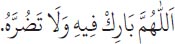
Allāhumma bārik fīhi wa lā taḍurrah.
We relate in [the same source] that Anas related that the Messenger of Allah said: “Whoever sees something that impresses him and says As Allah wills; there is no power except by Allah, will not harm it.” [7].
related that the Messenger of Allah said: “Whoever sees something that impresses him and says As Allah wills; there is no power except by Allah, will not harm it.” [7].
Mā shā’a-llāhu lā quwwata illā bi-llāh.
We relate in [the same source] that Sahl ibn Ḥunayf reported that the Messenger of Allah said: “If any of you sees anything that impresses him in himself or his wealth, he should pray for blessings on it, for the evil eye is a reality.” [8].
reported that the Messenger of Allah said: “If any of you sees anything that impresses him in himself or his wealth, he should pray for blessings on it, for the evil eye is a reality.” [8].We relate in [the same book] that ‘Āmir ibn Rabī‘ah reported that the Messenger of Allah said: “If any of you sees in himself and his wealth anything that impresses him, he should make du‘ā’ for blessings [upon it].” [9].
reported that the Messenger of Allah said: “If any of you sees in himself and his wealth anything that impresses him, he should make du‘ā’ for blessings [upon it].” [9].The Imam Abū Muḥammad al-Qāḍī Ḥusayn, one of our [Shāfi‘ī] colleagues, may Allah have mercy on him, stated in his book at-Ta‘līq fi-l-madhhab: “One of the Prophets, the blessings and peace of Allah be upon them all, looked at his people one day and thought them to be many. [The sight of them] pleased him, but seventy thousand of them died at that moment. So Allah  revealed to him, ‘You gave them “the eye”. If only when you eyed them you had safeguarded them, they would not have perished.’ He said, ‘What should I safeguard them with?’ Allah then revealed to him, ‘Say: I safeguard you by the Living, the Eternally Self-Subsistent Who never dies, and I repel evil from you by means of “There is no power nor strength but by Allah, the All-High, the Immense”.’”
revealed to him, ‘You gave them “the eye”. If only when you eyed them you had safeguarded them, they would not have perished.’ He said, ‘What should I safeguard them with?’ Allah then revealed to him, ‘Say: I safeguard you by the Living, the Eternally Self-Subsistent Who never dies, and I repel evil from you by means of “There is no power nor strength but by Allah, the All-High, the Immense”.’”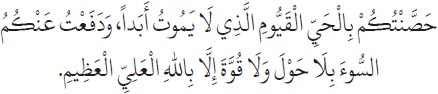
Ḥaṣṣantukum bi-l-Ḥayyi-l-Qayyūmi-lladhī lā yamūtu abadā, wa dafa‘tu ‘ankumu-s-sū’a bi-Lā ḥawla wa lā quwwata illā bi-llāhi-l-‘Aliyyi-l-‘Aẓīm.
The commentator on Qāḍī Ḥusayn said, “And the custom of Qāḍī Ḥusayn, may Allah have mercy on him, was that when he looked at his colleagues and their gravity and excellent condition pleased him, he would safeguard them with the aforementioned [prayer].” And Allah knows best.
References
[1] Al-Bukhārī (5944), Muslim (2187), and an-Nasā’ī (8/148).
[2] Al-Bukhārī (5739) and Muslim (2197).
[3] Muslim (2188) and at-Tirmidhī (2063).
[4] At-Tirmidhī (2059) and Ibn Mājah (3511).
[5] Al-Bukhārī (3371).
[6] Ibn as-Sunnī (207).
[7] Ibn as-Sunnī (206).
[8] Ibn as-Sunnī (204).
[9] Ibn as-Sunnī (250).