
IT IS MUSTAḤABB for anyone who hears the adhān and the iqāmah to repeat [each phrase], except when [the mu’adhdhin] says: Hasten to ṣalāh and Hasten to success, when he should say: There is no power or strength except by Allah.

Lā ḥawla wa lā quwwata illā bi-llāh.
And when he says: Prayer is better than sleep one should reply: You have spoken the truth and you have been honest.

Ṣadaqta wa barart.
It is also said that one should say: The Messenger of Allah  has spoken the truth: Prayer is better than sleep.
has spoken the truth: Prayer is better than sleep.
Ṣadaqa Rasūlu-llāhi ṣalla-llāhu ‘alayhi wa sallam, aṣ-ṣalātu khayru-m-mina-n-nawm.
After the two words of the iqāmah, one should respond: May Allah establish it and perpetuate it.

Aqāmaha-llāhu wa adāmahā.
After his words: I bear witness that there is no god but Allah one says: and I bear witness that there is no god but Allah. After his words: I bear witness that Muḥammad is the Messenger of Allah, one says: and I bear witness that Muḥammad is the Messenger of Allah. Then he should say: I am pleased with Allah as Lord, with Muḥammad as Messenger, and with Islam as religion.

Raḍītu bi-llāhi Rabbā, wa bi-Muḥammadin ṣalla-llāhu ‘alayhi wa sallama Rasūlā, wa bi-l-Islāmi dīnā.
When one has finished responding to the whole adhān one should say: May He bless and grant peace to the Prophet, may Allah bless him and grant him peace. And then one says: O Allah, Lord of this perfect call and established prayer, grant Muḥammad status and virtue and resurrect him to the praiseworthy station that You have promised him. Then one should supplicate for whatever one wishes by way of things of this world or the Hereafter.

Ṣallā wa sallama ‘ala-n-Nabiyyi ṣalla-llāhu ‘alayhi wa sallam. Allāhumma Rabba hādhihi-d-da‘wati-t-tāmmah, wa-ṣ-ṣalāti-l-qā‘imah, āti Muḥammadani-l-wasīlata wa-l-faḍīlah, wa-b‘athhu maqāma-m-maḥmūdani-lladhī wa‘adtah.
We relate from Abū Sa‘īd al-Khudrī  that the Messenger of Allah said: “When you hear the call then repeat what the mu’adhdhin says.” [1].Narrated by al-Bukhārī and Muslim in the ṣaḥīḥ.
that the Messenger of Allah said: “When you hear the call then repeat what the mu’adhdhin says.” [1].Narrated by al-Bukhārī and Muslim in the ṣaḥīḥ.‘Amr ibn al-‘Āṣ narrated that he heard the Prophet say: “When you hear the mu’adhdhin, say what he says, and then pray for blessings upon me. Whoever prays for blessings upon me, Allah will send ten blessings upon him. So ask Allah for intercession for me, for it is a rank in Paradise that only one servant of Allah is entitled to, and I hope that I will be that person. Whoever asks for intercession for me will enjoy my intercession.” [2].Muslim narrated this in his Ṣaḥīḥ.
narrated that he heard the Prophet say: “When you hear the mu’adhdhin, say what he says, and then pray for blessings upon me. Whoever prays for blessings upon me, Allah will send ten blessings upon him. So ask Allah for intercession for me, for it is a rank in Paradise that only one servant of Allah is entitled to, and I hope that I will be that person. Whoever asks for intercession for me will enjoy my intercession.” [2].Muslim narrated this in his Ṣaḥīḥ.‘Umar ibn al-Khaṭṭāb reported that the Messenger of Allah said: “If, when the mu’adhdhin says Allah is greater, Allah is greater, any of you says Allah is greater, Allah is greater; and when he says I bear witness that there is no god but Allah he says I bear witness that there is no god but Allah; and when he says I bear witness that Muḥammad is the Messenger of Allah he says I bear witness that Muḥammad is the Messenger of Allah; and when he says Come to ṣalāh he says There is no power and no strength but with Allah; and when he says Come to success he says There is no power and no strength but in Allah; and when he says Allah is greater, Allah is greater he says Allah is greater, Allah is greater; and when he says There is no god but Allah he says from his heart There is no god but Allah, he shall enter Paradise.” [3].Muslim narrated this in his Ṣaḥīḥ.
reported that the Messenger of Allah said: “If, when the mu’adhdhin says Allah is greater, Allah is greater, any of you says Allah is greater, Allah is greater; and when he says I bear witness that there is no god but Allah he says I bear witness that there is no god but Allah; and when he says I bear witness that Muḥammad is the Messenger of Allah he says I bear witness that Muḥammad is the Messenger of Allah; and when he says Come to ṣalāh he says There is no power and no strength but with Allah; and when he says Come to success he says There is no power and no strength but in Allah; and when he says Allah is greater, Allah is greater he says Allah is greater, Allah is greater; and when he says There is no god but Allah he says from his heart There is no god but Allah, he shall enter Paradise.” [3].Muslim narrated this in his Ṣaḥīḥ.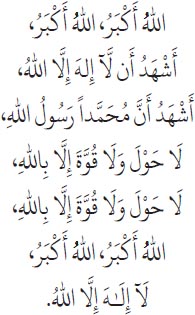
Allāhu akbar, Allāhu akbar,
Ashhadu a-l-lā ilāha illa-llāh,
Ashhadu anna Muḥammada-r-Rasūlu-llāh,
Lā ḥawla wa lā quwwata illā bi-llāh,
Lā ḥawla wa lā quwwata illā bi-llāh,
Allāhu akbar, Allāhu akbar,
Lā ilāha illa-llāh.
Ashhadu a-l-lā ilāha illa-llāh,
Ashhadu anna Muḥammada-r-Rasūlu-llāh,
Lā ḥawla wa lā quwwata illā bi-llāh,
Lā ḥawla wa lā quwwata illā bi-llāh,
Allāhu akbar, Allāhu akbar,
Lā ilāha illa-llāh.
Sa‘d ibn Abī Waqqāṣ reported that the Messenger of Allah said: “Whoever says, on hearing the mu’adhdhin: I bear witness that there is no god but Allah Who is One and has no partner, and I bear witness that Muḥammad is His slave and Messenger. I am pleased with Allah as Lord, with Muḥammad as Messenger and with Islam as religion, will have his sins forgiven.” [4].
reported that the Messenger of Allah said: “Whoever says, on hearing the mu’adhdhin: I bear witness that there is no god but Allah Who is One and has no partner, and I bear witness that Muḥammad is His slave and Messenger. I am pleased with Allah as Lord, with Muḥammad as Messenger and with Islam as religion, will have his sins forgiven.” [4].According to another account he said: “Whoever says when he hears the mu’adhdhin: And I bear witness.” Muslim narrated this in his Ṣaḥīḥ.

Ashhadu an lā ilāha illa-llāhu waḥdahu lā sharīka lah, wa ashhadu anna Muḥammadan ‘abduhu wa Rasūluh. Raḍītu bi-llāhi Rabbā, wa bi-Muḥammadin Rasūlan ṣalla-llāhu ‘alayhi wa sallam, wa bi-l-Islāmi dīnā.
And we relate from the Sunan of Abū Dāwūd that ‘Ā’ishah  reported that when the Messenger of Allah heard the mu’adhdhin make the declaration of faith he would say: “And I [also bear witness], and I [also bear witness].” [5].
reported that when the Messenger of Allah heard the mu’adhdhin make the declaration of faith he would say: “And I [also bear witness], and I [also bear witness].” [5].Jābir reported that the Messenger of Allah said: “Whoever, on hearing the call to ṣalāh, says O Allah, Lord of this perfect call and established prayer, grant Muḥammad status and virtue and resurrect him to the praiseworthy station that You have promised him, my intercession will be available to him on the Day of Judgment.” [6].Al-Bukhārī narrated this in his Ṣaḥīḥ.
reported that the Messenger of Allah said: “Whoever, on hearing the call to ṣalāh, says O Allah, Lord of this perfect call and established prayer, grant Muḥammad status and virtue and resurrect him to the praiseworthy station that You have promised him, my intercession will be available to him on the Day of Judgment.” [6].Al-Bukhārī narrated this in his Ṣaḥīḥ.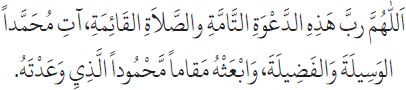
Allāhumma Rabba hādhihi-d-da‘wati-t-tāmmati wa-ṣ-ṣalāti-l-qā’imah, āti Muḥammadan-il-wasīlata wa-l-faḍīlah, wa-b‘athhu maqāma-m-maḥmūdan-illadhī wa‘adtah.
We relate in the book of Ibn as-Sunnī from Mu‘āwiyah that when the Messenger of Allah heard the mu’adhdhin say: Come to success, he would say: “O Allah, make us successful.” [7].
that when the Messenger of Allah heard the mu’adhdhin say: Come to success, he would say: “O Allah, make us successful.” [7].
Allāhumma-j‘alnā mufliḥīn.
And we relate from the Sunan of Abū Dāwūd from Abū Umāmah, or another of the Companions of the Prophet , that once when Bilāl began the iqāmah and said: “The ṣalāh has been established,” the Messenger of Allah said: “May Allah establish it and perpetuate it.” [8].And he said with respect to all the other expressions of the iqāmah just as is mentioned in the hadith of ‘Umar with respect to the adhān.
, that once when Bilāl began the iqāmah and said: “The ṣalāh has been established,” the Messenger of Allah said: “May Allah establish it and perpetuate it.” [8].And he said with respect to all the other expressions of the iqāmah just as is mentioned in the hadith of ‘Umar with respect to the adhān.
Aqāmahā Allāhu wa adāmahā.
And we relate from the book of Ibn as-Sunnī that when Abū Hurayrah heard the mu’adhdhin call the iqāmah he said: “O Allah, Lord of this perfect call and established prayer, bless Muḥammad and grant him his petitions on the Day of Resurrection.”
heard the mu’adhdhin call the iqāmah he said: “O Allah, Lord of this perfect call and established prayer, bless Muḥammad and grant him his petitions on the Day of Resurrection.”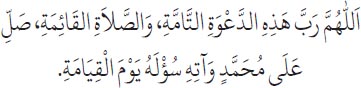
Allāhumma Rabba hādhihi-d-da‘wati-t-tāmmah, wa-ṣ-ṣalāti-l-qā‘imah, ṣalli ‘alā Muḥammadin wa ātihi su’lahu Yawma-l-Qiyāmah.
If one hears the mu’adhdhin or the iqāmah whilst engaged in ṣalāh one should not respond until one has finished ṣalāh. After one has said the salām to end the ṣalāh, he should respond as one who is not in ṣalāh responds. If one responds in ṣalāh, it is makrūh but the ṣalāh is not invalid. Likewise, if one hears him whilst in the lavatory, one should not respond immediately but when one comes out. If, however, one is reciting the Qur’ān, glorifying Allah, or reading hadith or some other [form of sacred] knowledge, he should interrupt all this and respond to the mu’adhdhin, and then return to what he was doing. This is because [the time for] the response would otherwise be lost, but what one is occupied with will usually not be lost. If one fails to follow the mu’adhdhin while he is calling the adhān it is mustaḥabb to make it up, unless a long time has elapsed.
References
[1] Al-Bukhārī (611), Muslim (383), al-Muwaṭṭa’ (1/67), Abū Dāwūd (522), at-Tirmidhī (208), and an-Nasā’ī—(2/23) in al-Mujtabā and (34) in ‘Amal al-yawm wa al-laylah.
[2] Muslim (384), Abū Dāwūd (523), at-Tirmidhī (3619), and an-Nasā’ī (2/25).
[3] Muslim (385), Abū Dāwūd (527), and an-Nasā’ī (40) in ‘Amal al-yawm wa al-laylah.
[4] Muslim (386), Abū Dāwūd (525), at-Tirmidhī (210), Ibn Mājah (721), and an-Nasā’ī (2/26) and (73) in ‘Amal al-yawm wa al-laylah.
[5] Abū Dāwūd (526) and al-Futūḥāt (2/128). Ibn Ḥajar states that an-Nawawī mentions that Abū Dāwūd reports it with a ṣaḥīḥ chain, and that is correct.
[6] Al-Bukhārī (614), Abū Dāwūd (529), at-Tirmidhī (211), and an-Nasā’ī (2/27).
[7] Ibn as-Sunnī (90) and al-Futūḥāt (2/130). Ibn Ḥajar states that this hadith is gharīb, as its chain contains a narrator whose transmissions are disregarded.
[8] Abū Dāwūd (528) and al-Futūḥāt (2/131). Ibn Ḥajar states that this hadith is gharīb. It was reported with this wording by Abū Dāwūd and he did not comment on it. Its chain contains an unknown (mubham) narrator, and there is some criticism of Shahr ibn Ḥawshab; but his hadiths are considered ḥasan as long as they do not conflict with other narrations.