
ACCORDING TO THE authoritative and acknowledged position, which is supported by authentic hadiths, the iqāmah is made up of eleven phrases: Allah is greater, Allah is greater. I bear witness that there is no god but Allah, I bear witness that Muḥammad is the Messenger of Allah. Come to ṣalāh, come to success. The ṣalāh has been established, the ṣalāh has been established. Allah is greater, Allah is greater. There is no god but Allah.
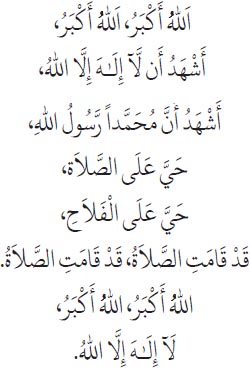
Allāhu akbar, Allāhu akbar,
Ashhadu a-l-lā ilāha illa-llāh,
Ashhadu anna Muḥammada-r-Rasūlu-llāh,
Ḥayya ‘alā-ṣ-ṣalāh,
Ḥayya ‘alā-l-falāḥ,
Qad qāmati-ṣ-ṣalāh, qad qāmati-ṣ-ṣalāh.
Allāhu akbar, Allāhu akbar,
Lā ilāha illa-llāh.
Ashhadu a-l-lā ilāha illa-llāh,
Ashhadu anna Muḥammada-r-Rasūlu-llāh,
Ḥayya ‘alā-ṣ-ṣalāh,
Ḥayya ‘alā-l-falāḥ,
Qad qāmati-ṣ-ṣalāh, qad qāmati-ṣ-ṣalāh.
Allāhu akbar, Allāhu akbar,
Lā ilāha illa-llāh.
Know that the adhān and iqāmah are both Sunnahs, in our view, according to the authoritative and acknowledged position, whether the adhān be for Jumu‘ah or for something else. Some of our colleagues are of the view that they are a communal obligation. [1].Some of them say they are only a communal obligation for Jumu‘ah and not for other ṣalāh. If we say that they are a communal obligation and the people of a town omit them, then they should be fought for refusing to perform them. If we say that it is Sunnah, then they should not be fought, according to the authoritative and acknowledged view, just as they will not be fought for abandoning the Sunnah ṣalāh of Ẓuhr etc. Some of our colleagues say that they should be confronted, because it is one of the manifest symbols of Islam.
It is mustaḥabb to chant the adhān and to raise the voice. It is mustaḥabb to utter the iqāmah rapidly and to make the voice quieter than for the adhān. It is mustaḥabb for the mu’adhdhin to have a beautiful voice and that he be reliable, trustworthy, competent and knowledgeable about the times of ṣalāh and that he do it voluntarily without thought of compensation. It is mustaḥabb that the adhān and the iqāmah be made while standing in a state of purity and in a high place, facing the qiblah. If a person calls the adhān and the iqāmah with his back to the qiblah, sitting, lying down or in a state of minor or major impurity, his adhān will be valid, but will be makrūh. The sinfulness of a person in major impurity will be greater than that of the one in minor impurity. The sinfulness of an iqāmah called by a person in a state of major impurity will be more severe.
The adhān is only required for the five ṣalawāt: Ṣubḥ, Ẓuhr, ‘Aṣr, Maghrib, and ‘Ishā’ and it is the same for the ṣalāh performed in its proper time, and for a missed ṣalāh which is being made up. It is the same whether at home or on a journey, and it is the same if one prays alone or in congregation. If one person calls the adhān, it will suffice for the rest. If a person performs a number of missed ṣalawāt at one time, he should call the adhān for the first and the iqāmah for each ṣalāh. If he combines two ṣalāhs, then he should call the adhān for the first and the iqāmah for both. For ṣalawāt other than the five [main] ṣalawāt there is no adhān; this opinion is unanimous. In the same category there are ṣalawāt before which, when one wants to do them in congregation, it is mustaḥabb to say The ṣalāh has assembled, such as the ‘Īd ṣalāh, the eclipse ṣalāh, and the ṣalāh of asking for rain. For some prayers it is not mustaḥabb, such as the sunan prayers and all the optional prayers. There are some over which there is disagreement, like the Tarāwīḥ and the funeral prayer. The correct view is that [the iqāmah] should be called before Tarāwīḥ but not before the funeral prayer.
The iqāmah is not valid except in its proper time and when one intends to proceed to the ṣalāh; and the adhān is not valid until the time of the ṣalāh has arrived, except for Ṣubḥ for which it is permissible to call the adhān before the time comes in. There are differences of opinion as to the time at which it is permissible. The most correct view is that it is permissible after half the night has passed. Other opinions are that it is permissible in the pre-dawn (saḥar); that it is permissible all night, but this [view] is of no consequence; and that it is permissible after two-thirds of the night have passed. The preferred view is the first-mentioned.
A woman or ambivalent hermaphrodite may call the iqāmah [for themselves]. They may not call the adhān because it is prohibited for them to raise their voices.
References
[1]  — Farḍ kifāyah— communal obligation. This means that it is the responsibility of the entire community, but if just one of them fulfils it, the whole community is absolved of the responsibility. If no one does it, it is a sin which applies to the whole community.
— Farḍ kifāyah— communal obligation. This means that it is the responsibility of the entire community, but if just one of them fulfils it, the whole community is absolved of the responsibility. If no one does it, it is a sin which applies to the whole community.