
IT IS MUSTAḤABB to deliver a sermon before the contract. The sermon should contain what we mentioned in the previous chapter, but this sermon should be longer. The same applies whether the sermon is delivered by the one who makes the contract or by someone else.
The best [sermon] is the following.
We relate in the Sunans of Abū Dāwūd, at-Tirmidhī, an-Nasā’ī and Ibn Mājah, as well as others, with ṣaḥīḥ isnāds, that ‘Abdullāh ibn Mas‘ūd  reported that the Messenger of Allah
  taught [his Companions] the sermon of need: “All praise be to Allah. We ask for His help and His forgiveness and we seek His protection from the evil of our souls. Whomever Allah has guided none can lead astray, and whomever He has led astray none can guide. I bear witness that there is no god but Allah and I bear witness that Muḥammad is His slave and Messenger. ‘O mankind, revere your Guardian Lord, Who created you from a single soul and created from it its mate, and from those two scattered countless men and women. Fear Allah, through Whom you demand your mutual rights; and revere the wombs which bore you, for Allah ever watches over you’”. [1].
reported that the Messenger of Allah taught [his Companions] the sermon of need: “All praise be to Allah. We ask for His help and His forgiveness and we seek His protection from the evil of our souls. Whomever Allah has guided none can lead astray, and whomever He has led astray none can guide. I bear witness that there is no god but Allah and I bear witness that Muḥammad is His slave and Messenger. ‘O mankind, revere your Guardian Lord, Who created you from a single soul and created from it its mate, and from those two scattered countless men and women. Fear Allah, through Whom you demand your mutual rights; and revere the wombs which bore you, for Allah ever watches over you’”. [1].“O you who believe, fear Allah as He should be feared, and die not except in a state of Islam.” [2].
“O you who believe, fear Allah, and say a word directed to the right, that He may make your actions sound and forgive you your sins. He that obeys Allah and His Messenger has attained a mighty triumph.” [3].
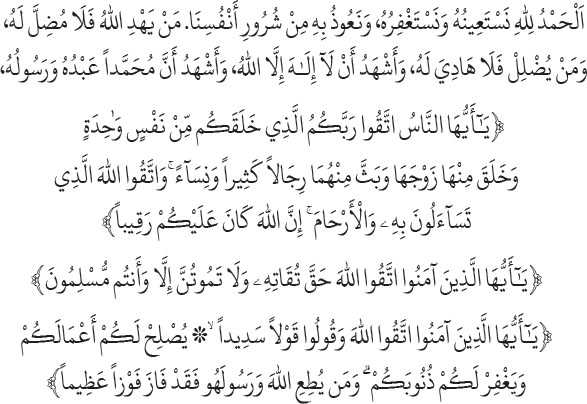
Al-ḥamdu li-llāhi nasta‘īnuhu wa nastaghfiruh, wa na‘ūdhu bihi min shurūri anfusinā. Man yahdi-llāhu fa-lā muḍilla lah, wa man yuḍlil fa-lā hādiya lah. Wa ashhadu an lā ilāha illa-llāh, wa ashhadu anna Muḥammadan ‘abduhu wa Rasūluh. Yā ayyuhā-n-nāsu-ttaqū Rabbakumu-lladhī khalaqakum min nafsin wāḥidatin wa khalaqa minhā zawjahā wa baththa minhumā rijālan kathīran wa nisā’ā, wa-ttaqu-llāha-lladhī tasā’ulūna bihi wa-l-arḥām. Inna-llāha kāna ‘alaykum Raqībā.
Yā ayyuha-lladhīna āmanu-ttaqu-llāha ḥaqqa tuqātihī wa lā tamūtunna illā wa antum Muslimūn.
Yā ayyuha-lladhīna āmanu-ttaqu-llāha wa qūlū qawlan sadīdan yuṣliḥ lakum a‘mālakum wa yaghfir lakum dhunūbakum. Wa man yuṭi‘i-llāha wa Rasūlahu fa-qad fāza fawzan ‘aẓīmā.
That is the wording of one of Abū Dāwūd’s narrations. According to another report [4]., after saying “And His Messenger” he also said: “Allah sent him with the truth as a bearer of glad tidings and a warner before the Hour. Whoever obeys Allah and His Prophet has been guided; whoever disobeys them harms none but himself, nor does he harm Allah at all.” [5]. At-Tirmidhī says that this is a ḥasan hadith.

Arsalahu bi-l-ḥaqqi bashīran wa nadhīran bayna yadayyi-s-sā‘ah. Man yuṭi‘i-llāha wa Rasūlahu fa-qad rashad, wa man ya‘ṣihimā fa-innahu lā yaḍurru illā nafsah, wa lā yaḍurru-llāha shay’ā.
According to our [Shāfi‘ī] colleagues, it is mustaḥabb to say also: ‘I marry you with what Allah has commanded to do: to hold together on equitable terms, or separate with kindness.’

Uzawwijuka ‘alā mā amara-llāhu bihi min imsākin bi-ma‘rūfin aw tasrīḥin bi-iḥsān.
The shortest [possible form] of these sermons is: ‘Praise be to Allah and blessings be upon the Messenger of Allah. I advise [people] to [have] fear of Allah.’ And Allah knows best.

Al-ḥamdu li-llāhi wa-ṣ-ṣalātu ‘alā Rasūli-llāh. Ūṣī bi-taqwa-llāh.
Know that this sermon is Sunnah. The chosen position is that if one does not deliver any of it the marriage is still valid, according to the consensus of the ‘ulamā’. It is cited of Dāwūd aẓ-Ẓāhir, may Allah be merciful to him, that he said that it is not valid, but the ‘ulamā’ who make careful investigation do not consider Dāwūd’s difference of opinion one to be reckoned with, and he does not break the consensus by his opposition. And Allah knows best.
The bridegroom does not deliver any sermon. If the legal guardian says to him ‘I marry you to So-and-so’ he should say at once, ‘I accept her in marriage’ [6].
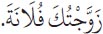
Zawwajtuka (name).
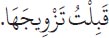
Qabiltu tazwījahā.
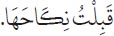
Qabiltu nikāḥahā.
If [the bridegroom] says: ‘Praise be to Allah and blessings be upon the Messenger of Allah. I accept,’ the marriage is valid and these [extra] words between the offer and acceptance will not affect it because it is but little, and it is associated with the contract. However, some of our [Shāfi‘ī] colleagues have said that it invalidates the contract, while others have said that it does not invalidate it and that on the contrary it is mustaḥabb for [the bridegroom] to say it. The correct position, as stated above, is that he should not say that but that if he goes against [that], the marriage contract is not invalidated. And Allah knows best.

Al-ḥamdu li-llāh, wa-ṣ-ṣalātu ‘alā Rasūli-llāh ṣalla-llāhu ‘alayhi wa sallam.
References
[1] Qur’ān 4:1.
[2] Qur’ān 3:102.
[3] Qur’ān 33:70–71.
[4] Abū Dāwūd (2118), at-Tirmidhī (1105), an-Nasā’ī (6/89), and Ibn Mājah (1892).
[5] Abū Dāwūd (2119).
[6] There are two sentences in Arabic here that both mean exactly the same in English.