
WE RELATE FROM the Ṣaḥīḥ of al-Bukhārī that Jābir  narrated: “When we ascended we would say: ‘Allah is greater,’ and when we descended we would say: ‘Glory be to Allah.’” [1].
narrated: “When we ascended we would say: ‘Allah is greater,’ and when we descended we would say: ‘Glory be to Allah.’” [1].
Allāhu akbar.
Subḥāna-llāh.
Subḥāna-llāh.
We narrated a hadith from Abū Dāwūd in the chapter on what to say when mounting an animal. According to Ibn ‘Umar  , the Prophet
  and his armies used to say takbīr when they ascended and tasbīḥ when they descended. [2].
, the Prophet and his armies used to say takbīr when they ascended and tasbīḥ when they descended. [2].We relate in the Ṣaḥīḥs of al-Bukhārī and Muslim that Ibn ‘Umar reported that when the Prophet returned from Ḥajj or ‘Umrah—the narrator said, “I only know that he said ‘a military expedition’”—whenever he climbed a hill or hillock he said takbīr thrice, and then said: “There is no god but Allah, the One Who has no partner. His is the kingdom and His is the praise, and He has power over all things. Returning, repenting, worshipping, prostrating before our Lord, praising. Allah has fulfilled His promise, and given victory to His servant, and routed the confederates by Himself.” [3].This is the wording of al-Bukhārī’s variant. Muslim’s variant is the same except that “I only know that he said a military expedition” is not in it. Instead of that it reads: “when he returned from armies, raiding parties, Ḥajj or ‘Umrah.”
reported that when the Prophet returned from Ḥajj or ‘Umrah—the narrator said, “I only know that he said ‘a military expedition’”—whenever he climbed a hill or hillock he said takbīr thrice, and then said: “There is no god but Allah, the One Who has no partner. His is the kingdom and His is the praise, and He has power over all things. Returning, repenting, worshipping, prostrating before our Lord, praising. Allah has fulfilled His promise, and given victory to His servant, and routed the confederates by Himself.” [3].This is the wording of al-Bukhārī’s variant. Muslim’s variant is the same except that “I only know that he said a military expedition” is not in it. Instead of that it reads: “when he returned from armies, raiding parties, Ḥajj or ‘Umrah.”I say that awfā, ‘climbed’, means irtafa‘a, ‘he ascended over’, and fadfad, with a fatḥah on both fā’s and in between them a dāl with a sukūn and at the end another dāl, means ‘elevated rugged land’; but some say ‘waterless desert in which there is nothing’, and others say ‘elevated rugged land with pebbles’ and yet others say ‘rugged high ground’.
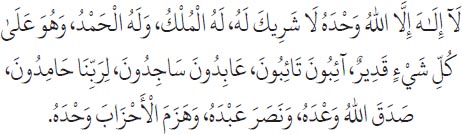
Lā ilāha illa-llāhu waḥdahu lā sharīka lah, lahu-l-mulk, wa lahu-l-ḥamd, wa Huwa ‘alā kulli shay’in qadīr. Ā’ibūnā tā’ibūn, ‘ābidūna sājidūn, li-Rabbinā ḥāmidūn. Ṣadaqa-llāhu wa‘dah, wa naṣara ‘abdah, wa hazama-l-aḥzāba waḥdah.
We relate in the two Ṣaḥīḥs that Abū Mūsā al-Ash‘arī narrated: “We were with the Prophet and when we looked down upon a valley we would say ‘There is no god but Allah’ and takbīr, raising our voices.” Then the Prophet said: “People, be kind to yourselves, for you are not calling on one who is deaf or who is absent. He is with you, He hears and is near.” [4].
narrated: “We were with the Prophet and when we looked down upon a valley we would say ‘There is no god but Allah’ and takbīr, raising our voices.” Then the Prophet said: “People, be kind to yourselves, for you are not calling on one who is deaf or who is absent. He is with you, He hears and is near.” [4].I say that irba‘ū with a bā’ means “be gentle to yourselves”.
We narrated a hadith from at-Tirmidhī in the chapter on the recommendation to seek advice, in which the Messenger of Allah said: “You must have fear of Allah and say takbīr on every ascent.”
said: “You must have fear of Allah and say takbīr on every ascent.”We relate in the book of Ibn as-Sunnī that Anas narrated that when the Prophet ascended to a high place in the land he would say: “O Allah, to You belongs exaltation over every high place and to You belongs praise in every situation.” [5].
narrated that when the Prophet ascended to a high place in the land he would say: “O Allah, to You belongs exaltation over every high place and to You belongs praise in every situation.” [5].
Allāhumma laka-sh-sharafu ‘alā kulli sharaf, wa laka-l-ḥamdu ‘alā kulli ḥāl.
References
[1] Al-Bukhārī (2993), an-Nasā’ī (541), and Ibn as-Sunnī (517).
[2] Abū Dāwūd (2599).
[3] Al-Bukhārī (6385), Muslim (1344), al-Muwaṭṭa’ (1/421), Abū Dāwūd (2770), at-Tirmidhī (950), and an-Nasā’ī (540).
[4] Al-Bukhārī (6384), Muslim (2704), Abū Dāwūd (1527), at-Tirmidhī (3371), and Ibn Mājah (3824).
[5] Ibn as-Sunnī (523).