
WE MENTIONED AT the beginning of this book what one should say on leaving the house. This is mustaḥabb for the traveller and he should say it as many times as possible. It is mustaḥabb for him to bid his family, relatives, companions and neighbours farewell. One should request their du‘ā’ and also make du‘ā’ for them.
We relate in the Musnad of Imam Aḥmad ibn Ḥanbal and elsewhere that Ibn ‘Umar  narrated that the Messenger of Allah
  said: “If Allah is asked to protect anything, He will protect it.” [1].
narrated that the Messenger of Allah said: “If Allah is asked to protect anything, He will protect it.” [1].We relate in the book of Ibn as-Sunnī from Abū Hurayrah  who reported that the Messenger of Allah said: “Anyone who is about to travel should say to those whom he leaves behind: I leave you in the care of Allah, Who does not allow anything entrusted to Him to be lost.” [2].
who reported that the Messenger of Allah said: “Anyone who is about to travel should say to those whom he leaves behind: I leave you in the care of Allah, Who does not allow anything entrusted to Him to be lost.” [2].
Astawdi‘ukumu-llāha-lladhī lā taḍī‘u wadā‘i‘uh.
And we relate that Abū Hurayrah also reported that the Messenger of Allah said: “When any of you is about to travel he should bid his brothers farewell, for Allah  puts benefit [for him] in their du‘ā’.” The Sunnah is that the one whom you are bidding farewell should say to you the following words, which we relate from the Sunan of Abū Dāwūd that Qaz‘ah reported that Ibn ‘Umar said to him: “Come, let me bid you farewell the way the Messenger of Allah bade me farewell: ‘I entrust your religion, your trusts and the last of your deeds to Allah.’” [3].
also reported that the Messenger of Allah said: “When any of you is about to travel he should bid his brothers farewell, for Allah puts benefit [for him] in their du‘ā’.” The Sunnah is that the one whom you are bidding farewell should say to you the following words, which we relate from the Sunan of Abū Dāwūd that Qaz‘ah reported that Ibn ‘Umar said to him: “Come, let me bid you farewell the way the Messenger of Allah bade me farewell: ‘I entrust your religion, your trusts and the last of your deeds to Allah.’” [3].
Astawdi‘u-llāha dīnaka wa amānataka wa khawātīma ‘amalik.
According to Imam al-Khaṭṭābī, ‘trusts’ refer to one’s family and those that he leaves behind, and the wealth that is with one’s custodian. He said that religion is mentioned here because difficulties are most likely to arise whilst travelling. Sometimes it could cause one to neglect certain religious matters.
We relate in the book of at-Tirmidhī that Nāfi‘ reported that Ibn ‘Umar said: “When the Prophet bade a man farewell he would take his hand and not release his hand until the man removed it. He said: ‘I entrust your religion, your trusts and the last of your deeds to Allah.’” [4].
said: “When the Prophet bade a man farewell he would take his hand and not release his hand until the man removed it. He said: ‘I entrust your religion, your trusts and the last of your deeds to Allah.’” [4].We relate in the book of at-Tirmidhī also that Salīm reported that Ibn ‘Umar used to say to people who were about to travel: “Come close to me so that I may bid you farewell as the Messenger of Allah used to bid us farewell. He said: ‘I entrust your religion, your trust, and the conclusions of your deeds to Allah.’” [5].According to at-Tirmidhī, this hadith is ḥasan ṣaḥīḥ.
reported that Ibn ‘Umar used to say to people who were about to travel: “Come close to me so that I may bid you farewell as the Messenger of Allah used to bid us farewell. He said: ‘I entrust your religion, your trust, and the conclusions of your deeds to Allah.’” [5].According to at-Tirmidhī, this hadith is ḥasan ṣaḥīḥ.
Astawdi‘u-llāha dīnaka wa amānataka wa ākhira ‘amalik.
We relate in the Sunan of Abū Dāwūd and others, with a ṣaḥīḥ isnād, that ‘Abdullāh ibn Yazīd al-Khatmī, a Companion, reported that when the Prophet bade an army farewell he would say: “I entrust your religion, your trusts and the conclusions of your deeds to Allah.” [6].
reported that when the Prophet bade an army farewell he would say: “I entrust your religion, your trusts and the conclusions of your deeds to Allah.” [6].
Astawdi‘u-llāha dīnaka wa amānataka wa khawātīma ‘amalik.
We relate in the book of at-Tirmidhī that Anas narrated that a man came to the Messenger of Allah and said: “I am about to go on a journey, so give me provisions.” He said: “May Allah equip you with fear of Allah.”
narrated that a man came to the Messenger of Allah and said: “I am about to go on a journey, so give me provisions.” He said: “May Allah equip you with fear of Allah.”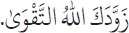
Zawwadaka-llāhu-t-taqwā.
He said: “Give me more.” He added: “And may He forgive your sins.”

Wa ghafara dhanbak.
He said: “Give me more.” He added: “May Allah make goodness easy for you wherever you are.” [7].According to at-Tirmidhī, this hadith is ḥasan.

Wa yassara laka-l-khayra ḥaythu mā kunt.
References
[1] Aḥmad (2/82), an-Nasā’ī (509), and al-Futūḥāt (5/113). Ibn Ḥajar grades this hadith as ṣaḥīḥ.
[2] Ibn as-Sunnī (506), an-Nasā’ī (508), and al-Futūḥāt (5/114). Ibn Ḥājar states that this is a ḥasan hadith.
[3] Abū Dāwūd (2600) and al-Futūḥāt (5/116). Ibn Ḥajar grades it as ḥasan.
[4] At-Tirmidhī (3438). Ibn Ḥajar grades this hadith as ḥasan owing to the supporting narrations for it.
[5] At-Tirmidhī (3439), Ibn Mājah (2826), and al-Futūḥāt (5/118). This hadith is ḥasan due to its supporting narrations.
[6] Abū Dāwūd (2601), Ibn as-Sunnī (505), and an-Nasā’ī (507).
[7] At-Tirmidhī (3440). Ibn Ḥajar grades it as ḥasan.