
IT IS MUSTAḤABB, when intending to leave home, to perform two rak‘ahs of ṣalāh.
This is based upon the hadith of Muqaṭṭam ibn al-Miqdām, the Companion  , who reported that the Messenger of Allah
  said: “No-one has left his family with anything better than two rak‘ahs that he performs among them when he intends to travel.” [1].Aṭ-Ṭabarānī narrated it.
, who reported that the Messenger of Allah said: “No-one has left his family with anything better than two rak‘ahs that he performs among them when he intends to travel.” [1].Aṭ-Ṭabarānī narrated it.According to some of our [Shāfi‘ī] colleagues, it is mustaḥabb to recite Qul Yā Ayyuha-l-Kāfirūn in the first of these, after al-Fātiḥah, and Qul Huwa-llāhu Aḥad in the second. Others say that one should recite Qul A‘ūdhu bi-Rabbi-l-falaq in the first, after al-Fātiḥah, and Qul A‘ūdhu bi-Rabbi-n-nās in the second. After saying the salām, he should recite the Verse of the Throne. It has been reported that whoever recites the Verse of the Throne before he leaves his home will not be afflicted with anything that he dislikes until he returns. [2].It is mustaḥabb to recite the chapter Li-īlāfi Quraysh. [3].The Imam and eminent master Abū ’l-Ḥasan al-Qazwīnī, the Shāfi‘ī jurist who had self-evident miracles, and luminous states, and evident gnoses, said that it brings security from all evil. Abū Ṭāhir ibn Jaḥshawī said: “I was about to travel and I was fearful, so I went to al-Qazwīnī and asked him for a du‘ā’. He told me: ‘Whoever wants to travel and fears an enemy or loneliness should recite Li-īlāfi Quraysh, for it is security from all evil.’ I recited it and no incident has befallen me until now.” It is mustaḥabb, upon completing this recitation, to supplicate with sincerity and grace. The best thing to say is: O Allah, I seek Your help and in You I trust. O Allah, smooth away for me the difficulties of my affair and ease the obstacles in my journey. Grant me more good than I have asked for, and turn away from me all evil. O my Lord, expand my breast, illumine my heart, and make my affair easy. O Allah, I ask You for protection, and I entrust to You myself, my religion, my family and my relatives and all that You have favoured me and them with in this world and the Hereafter. So protect us all from every evil, Most Generous One.
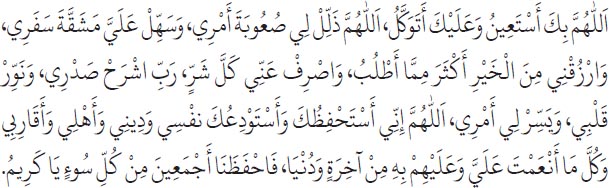
Allāhumma bika asta‘īnu wa ‘alayka atawakkal. Allāhumma dhallil lī ṣu‘ūbata amrī, wa sahhil ‘alayya mashaqqata safarī, wa-rzuqnī mina-l-khayri akthara mimmā aṭlub, wa-ṣrif ‘annī kulla sharr. Rabbi-shraḥ ṣadrī, wa nawwir qalbī, wa yassir lī amrī, Allāhumma innī astaḥfiẓuka wa astawdi‘uka nafsī wa dīnī wa ahlī wa aqāribī wa kulla mā an‘amta ‘alayya wa ‘alayhim bihi min ākhiratin wa dunyā, fa-ḥfaẓnā ajma‘īna min kulli sū’in yā Karīm.
One should begin and end his du‘ā’ with praise of Allah and invoking blessings and greetings on the Messenger of Allah . When one stands up after sitting he should say [the du‘ā’] we have related below from Anas .
. When one stands up after sitting he should say [the du‘ā’] we have related below from Anas .We relate that Anas reported that when the Messenger of Allah was about to go on a journey he said when standing up: “O Allah, to You I turn, and to You I hold fast. O Allah, be my sufficiency for that which preoccupies me and that which does not preoccupy me. O Allah, provide me with fear of You, forgive me my sins, and turn me towards good wherever I may turn.” [4].
reported that when the Messenger of Allah was about to go on a journey he said when standing up: “O Allah, to You I turn, and to You I hold fast. O Allah, be my sufficiency for that which preoccupies me and that which does not preoccupy me. O Allah, provide me with fear of You, forgive me my sins, and turn me towards good wherever I may turn.” [4].
Allāhumma ilayka tawajjaht, wa bika-‘taṣamt. Allāhumma-kfinī mā hammanī wa mā lā ahtammu lah. Allāhumma zawwidni-t-taqwā, wa-ghfir lī dhanbī, wa wajjihnī li-l-khayri aynamā tawajjaht.
References
[1] Al-Futūḥāt (5/105–107). Ibn Ḥajar mentioned that this hadith was reported in aṭ-Ṭabarānī’s work al-Manāsik. There is some weakness in its chain but it is raised to the level of ḥasan by other supporting narrations.
[2] Al-Futūḥāt (5/108). Ibn Ḥajar said he could not find a source for this hadith with this specific wording. However, the meaning of it is mentioned in a gharīb hadith whose chain contains some weakness, which was reported by Ibn as-Sunnī, al-Bayhaqī in ash-Shu‘ab and Abū ash-Shaykh in Thawāb al-‘amal.
[3] Qur’ān 106.
[4] Ibn as-Sunnī (496) and al-Futūḥāt (5/11). Ibn Ḥajar states that this hadith is gharīb, and goes on to mention certain weaknesses in its chain.