
ALLAH  SAYS: “O you who believe, when you encounter an army be firm and call on Allah in remembrance much (and often), that you may prosper. Obey Allah and His Messenger; and fall not into disputes, lest you lose heart and your power depart. Be patient and tenacious, for Allah is with those who patiently persevere. And be not like those who set out from their homes insolently, [only] to be seen by people and to hinder [people] from the Way of Allah.” [1].
SAYS: “O you who believe, when you encounter an army be firm and call on Allah in remembrance much (and often), that you may prosper. Obey Allah and His Messenger; and fall not into disputes, lest you lose heart and your power depart. Be patient and tenacious, for Allah is with those who patiently persevere. And be not like those who set out from their homes insolently, [only] to be seen by people and to hinder [people] from the Way of Allah.” [1].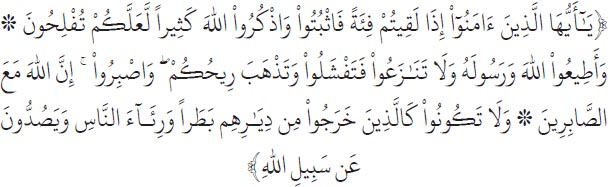
According to the learned, these verses form the most comprehensive statement on the rules of doing battle.
We relate in the Ṣaḥīḥs of al-Bukhārī and Muslim from Ibn ‘Abbās  , who narrated that while the Messenger of Allah
  was in his tent (at Badr) he said: “O Allah, I implore You by Your pact and promise. O Allah, if You so wish You will not be worshipped after today.”
, who narrated that while the Messenger of Allah was in his tent (at Badr) he said: “O Allah, I implore You by Your pact and promise. O Allah, if You so wish You will not be worshipped after today.”
Allāhumma innī anshuduka ‘ahdaka wa wa‘dak. Allāhumma in shi‘ta lam tu‘bad ba‘da-l-yawm.
Abū Bakr took him by the hand and said: “It is enough for you, Messenger of Allah. You have implored your Lord persistently.” He came out reciting: “‘Soon will their multitude be put to flight, and they will show their backs. No, the Hour (of Judgment) is the time promised them (for their full recompense): and that Hour will be most grievous and most bitter.’” [2].This is the wording of al-Bukhārī’s narration.
took him by the hand and said: “It is enough for you, Messenger of Allah. You have implored your Lord persistently.” He came out reciting: “‘Soon will their multitude be put to flight, and they will show their backs. No, the Hour (of Judgment) is the time promised them (for their full recompense): and that Hour will be most grievous and most bitter.’” [2].This is the wording of al-Bukhārī’s narration.
As for the wording of Muslim, he says: “The Prophet faced the qiblah, then stretched out his hand and raised his voice, supplicating to his Lord: ‘O Allah, fulfil Your promise to me. O Allah, grant what You have promised me. O Allah, if this small group of the people of Islam is destroyed You will not be worshipped on Earth’ and he continued to supplicate his Lord loudly, stretching out his hands so much so that his upper garment fell off.” [3].I say: yahtifu with fatḥah at the beginning and kasrah on the third [consonant] means ‘he raised his voice in supplication’.
faced the qiblah, then stretched out his hand and raised his voice, supplicating to his Lord: ‘O Allah, fulfil Your promise to me. O Allah, grant what You have promised me. O Allah, if this small group of the people of Islam is destroyed You will not be worshipped on Earth’ and he continued to supplicate his Lord loudly, stretching out his hands so much so that his upper garment fell off.” [3].I say: yahtifu with fatḥah at the beginning and kasrah on the third [consonant] means ‘he raised his voice in supplication’.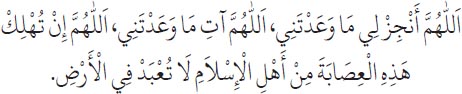
Allāhumma anjiz lī mā wa‘adtanī, Allāhumma āti mā wa‘adtanī, Allāhumma in tuhlik hādhihi-l-‘iṣābata min ahli-l-Islāmi lā tu‘bad fi-l-arḍ.
We relate in both Ṣaḥīḥs from ‘Abdullāh ibn Abī Awfā who reported that the Messenger of Allah , on one of the days that he met the enemy, waited until the sun rose, then stood among the people and said: “O people, do not look forward to meeting the enemy, but ask Allah for well-being. When you meet them, be steadfast. And know that Paradise is under the shadow of swords.” Then he said: “O Allah, Revealer of the Book, Mover of the clouds, Defeater of the tribes, rout them and convulse them.” [4].
who reported that the Messenger of Allah , on one of the days that he met the enemy, waited until the sun rose, then stood among the people and said: “O people, do not look forward to meeting the enemy, but ask Allah for well-being. When you meet them, be steadfast. And know that Paradise is under the shadow of swords.” Then he said: “O Allah, Revealer of the Book, Mover of the clouds, Defeater of the tribes, rout them and convulse them.” [4].
Allāhumma Munzila-l-Kitāb, wa Mujriya-s-saḥāb, wa Hāzima-l-aḥzāb, ahzimhum wa-nṣurnā ‘alayhim.
We relate in both Ṣaḥīḥs from Anas , who related that the Prophet came to Khaybar at daybreak. When the Jews of Khaybar saw him they said: “Muḥammad and the army!” They took refuge in the fort. The Prophet raised his hands and said: “Allah is greater! Khaybar is ruined. ‘When we descend in a people’s courtyard—how evil will be the morning of those who were warned!’ [5].” [6].
, who related that the Prophet came to Khaybar at daybreak. When the Jews of Khaybar saw him they said: “Muḥammad and the army!” They took refuge in the fort. The Prophet raised his hands and said: “Allah is greater! Khaybar is ruined. ‘When we descend in a people’s courtyard—how evil will be the morning of those who were warned!’ [5].” [6].
Allāhu akbar, kharibat Khaybar. Innā idhā nazalnā bi-sāḥati qawmin fa-sā’a ṣabāḥu-l-mundharīn.
We relate with ṣaḥīḥ isnāds from the Sunan of Abū Dāwūd from Sahl ibn Sa‘d who reported that the Messenger of Allah said: “Two supplications are not rejected (or else he said, ‘are seldom rejected’): at the time of the call to ṣalāh, and at the time of trepidation when some [people] attack others.” [7].I say that some acceptable texts read yulḥimu with the letter ḥā’ and others have it with the letter jīm. Both are well-known.
who reported that the Messenger of Allah said: “Two supplications are not rejected (or else he said, ‘are seldom rejected’): at the time of the call to ṣalāh, and at the time of trepidation when some [people] attack others.” [7].I say that some acceptable texts read yulḥimu with the letter ḥā’ and others have it with the letter jīm. Both are well-known.And we relate from the Sunans of Abū Dāwūd, at-Tirmidhī and an-Nasā’ī from Anas who related that when the Messenger of Allah went into battle he said: “O Allah, You are my Support and my Helper. Through You I defend, through You I attack, and through You I do battle.” [8].According to at-Tirmidhī, this is a ḥasan hadith.
who related that when the Messenger of Allah went into battle he said: “O Allah, You are my Support and my Helper. Through You I defend, through You I attack, and through You I do battle.” [8].According to at-Tirmidhī, this is a ḥasan hadith.
Allāhumma Anta ‘Aḍudī wa Naṣīrī. Bika aḥūl, wa bika aṣūl, wa bika uqātil.
I say that the meaning of ‘Aḍudī is ‘my Aid’. According to al-Khaṭṭābī the meaning of aḥūlu is aḥtālu, ‘I practise artifice or deception against the [enemy]’.
We relate with ṣaḥīḥ isnāds in the Sunans of Abū Dāwūd and an-Nasā’ī that Abū Mūsā al-Ash‘arī reported that when the Messenger of Allah feared [harm from any] people he would say: “O Allah, we make You responsible for their slaughter and we seek Your protection from their evil.” [9].
reported that when the Messenger of Allah feared [harm from any] people he would say: “O Allah, we make You responsible for their slaughter and we seek Your protection from their evil.” [9].
Allāhumma innā naj‘aluka fī nuḥūrihim, wa na‘ūdhuka min shūrūruhim.
We relate in the book of at-Tirmidhī from ‘Amārah ibn Za‘karah who narrated that he heard the Messenger of Allah say: “Allah says: ‘My slave—My true slave—is the one who remembers Me [even when] meeting his opponent,’” [10].meaning at the time of fighting. At-Tirmidhī says that the isnād of this hadith is not strong.
who narrated that he heard the Messenger of Allah say: “Allah says: ‘My slave—My true slave—is the one who remembers Me [even when] meeting his opponent,’” [10].meaning at the time of fighting. At-Tirmidhī says that the isnād of this hadith is not strong.I say that Za‘karah is written with a fatḥah on the zāy and on the kāf and a sukūn on the ‘ayn between them.
We relate in the book of Ibn as-Sunnī from Jābir ibn ‘Abdullāh who related that the Messenger of Allah said on the Day of Ḥunayn: “Do not wish to meet the enemy, for you do not know what you will be tried with on their account. When you meet them say: ‘O Allah, You are our Lord and their Lord; our hearts and their hearts are in Your hand. Only You can overcome them.’” [11].
who related that the Messenger of Allah said on the Day of Ḥunayn: “Do not wish to meet the enemy, for you do not know what you will be tried with on their account. When you meet them say: ‘O Allah, You are our Lord and their Lord; our hearts and their hearts are in Your hand. Only You can overcome them.’” [11].
Allāhumma Anta Rabbunā wa Rabbuhum, wa qulūbunā wa qulūbuhum bi-yadik, wa innamā yaghlibuhum Ant.
We relate in the hadith we mentioned earlier from the book of Ibn as-Sunnī from Anas who reported: “We were with the Prophet on an expedition and we met the enemy, and I heard him say: ‘O Owner of the Day of Judgment, You alone do we worship and You alone do we ask for help.’ I saw men falling to the ground with angels beating them from the front and behind.” [12].
who reported: “We were with the Prophet on an expedition and we met the enemy, and I heard him say: ‘O Owner of the Day of Judgment, You alone do we worship and You alone do we ask for help.’ I saw men falling to the ground with angels beating them from the front and behind.” [12].
Yā Mālika Yawmi-d-Dīni iyyāka na‘budu wa iyyāka nasta‘īn.
Imam ash-Shāfi‘ī related in al-Umm [13].a hadith with a mursal isnād according to which the Messenger of Allah said: “Look for acceptance of du‘ā’ when armies meet, after the iqāmah for ṣalāh, and when rain is falling.”
said: “Look for acceptance of du‘ā’ when armies meet, after the iqāmah for ṣalāh, and when rain is falling.”I say that it is mustaḥabb to recite what one finds easy from the Qur’ān and to say the du‘ā’ of difficulty which we have mentioned earlier. Ibn ‘Abbās reported that the Messenger of Allah used to say in moments of difficulty: “There is no god but Allah, the Great, the Clement. There is no god but Allah, Lord of the Mighty Throne. There is no god but Allah, Lord of the heavens and Earth and Lord of the Noble Throne.”
reported that the Messenger of Allah used to say in moments of difficulty: “There is no god but Allah, the Great, the Clement. There is no god but Allah, Lord of the Mighty Throne. There is no god but Allah, Lord of the heavens and Earth and Lord of the Noble Throne.”
Lā ilāha illa-llāhu-l-‘Aẓīmu-l-Ḥalīm, lā ilāha illa-llāhu Rabbu-l-‘Arshi-l-‘Aẓīm, lā ilāha illa-llāhu Rabbu-s-samāwāti wa Rabbu-l-arḍi wa Rabbu–l-‘Arshi-l-Karīm.
One should say what we mentioned earlier in another hadith: There is no god but Allah, the Forbearing, the Noble. Glory be to Allah, Lord of the Seven Heavens and Lord of the Mighty Throne. There is no god but You. He whom You protect becomes mighty; and glorious is Your acclaim.

Lā ilāha illa-llāhu-l-Ḥalīmu-l-Karīm. Subḥāna-llāhi Rabbi-s-samāwāti-s-sab‘i wa Rabbi-l-‘Arshi-l-‘aẓīm. Lā ilāha illā Ant, ‘azza jāruk, wa jalla thanā‘uk.
One should also say that which we introduced before in another hadith: Allah is sufficient for us and most excellent is He as a Protector. [14].
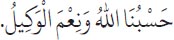
Ḥasbuna-llāhu wa ni‘ma-l-Wakīl.
One should also say: There is no power or strength except by Allah. As Allah wills; there is no power except with Allah. We have sought refuge with Allah and we have sought help from Allah. We trust in Allah.
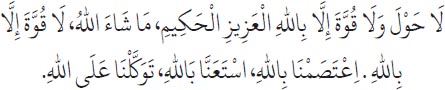
Lā ḥawla wa lā quwwata illā bi-llāhi-l-‘Azīzi-l-Ḥakīm, Mā shā’a-llāh, lā quwwata illā bi-llāh, i‘taṣamnā bi-llāh, ista‘annā bi-llāh, tawakkalnā ‘ala-llāh.
And one says: “I fortify us all by the Ever-Living, the Eternally Self-Sustaining, Who never dies; and I repel evil from us with ‘There is no might or power but through Allah the Mighty, the Immense.’”
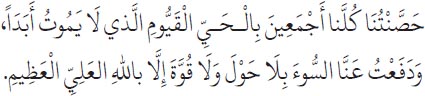
Ḥaṣṣantunā kullanā ajma‘īna bi-l-Ḥayyi-l-Qayyūmi-lladhī lā yamūtu abadā, wa dafa‘tu ‘anna-s-sū’a Bi-Lā ḥawla wa lā quwwata illā bi-llāhi-l-‘Aliyyi-l-‘Aẓīm.
And one says: “O You Whose Beneficence existed before time began, O You Whose goodness exceeds all other goodness, Owner of this world and the Hereafter, O Living, O Everlasting, O Master of Splendour and Grandeur, You for whom nothing is impossible or too great! Help us against these enemies of ours and others and make us swiftly triumph over them with well-being and general safety.”
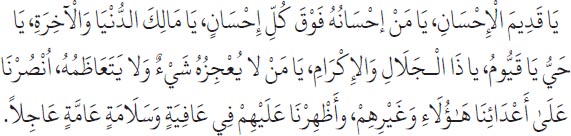
Yā Qadīma-l-iḥsān, yā man iḥsānuhu fawqa kulli iḥsān, yā Mālika-d-dunyā wa-l-ākhirah, yā Ḥayyu yā Qayyūm, yā Dha-l-Jalāli wa-l-Ikrām, yā man lā yu‘jizuhu shay’un wa lā yata‘āẓamuh, unṣurnā ‘alā a‘dā’inā hā’ulā’i wa ghayrihim, wa aẓhirnā ‘alayhim fī ‘āfiyatin wa salāmatin ‘āmmatin ‘ājilā.
All of the above are strongly enjoined, and have been tried and tested.
References
[1] Qur’ān 8:45–47.
[2] Qur’ān 54:46.
[3] Al-Bukhārī (3953), Muslim (1763), at-Tirmidhī (3081), and Abū Dāwūd (2690), in an abridged form.
[4] Al-Bukhārī (3025) and Muslim (1742).
[5] An allusion to Qur’ān 37:177 (“When it [punishment] descends in their courtyard—how evil will be the morning of those who were warned!”).
[6] Al-Bukhārī (371) and Muslim (1365).
[7] Abū Dāwūd (2540).
[8] Abū Dāwūd (2632) and at-Tirmidhī (3578).
[9] Abū Dāwūd (1537).
[10] At-Tirmidhī (3575) and al-Futūḥāt (5/62). Ibn Ḥajar grades it as ḥasan owing to a supporting narration.
[11] Ibn as-Sunnī (673).
[12] Ibn as-Sunnī (336).
[13] Al-Umm (1/223).
[14] Qur’ān 3:173.