
WE RELATE FROM the Ṣaḥīḥ of Muslim from ‘Ā’ishah  who related that every time it was her night with the Messenger of Allah
  he went out to al-Baqī‘ in the last part of the night. He would say: “Peace be upon you, home of believing people. What you were promised and you deferred until tomorrow has come to you. We shall, if Allah wills, be joining you. O Allah, forgive the inhabitants of Baqī‘ al-Gharqad.” [1].
who related that every time it was her night with the Messenger of Allah he went out to al-Baqī‘ in the last part of the night. He would say: “Peace be upon you, home of believing people. What you were promised and you deferred until tomorrow has come to you. We shall, if Allah wills, be joining you. O Allah, forgive the inhabitants of Baqī‘ al-Gharqad.” [1].
As-salāmu ‘alaykum dār qawmin mu’minīn, wa atākum mā tū‘adūn, ghadan mu‘ajjalūn, wa innā in shā’a-llāhu bikum lāḥiqūn. Allāhumma-ghfir li-ahli Baqī‘i-l-Gharqad.
We relate in the Ṣaḥīḥ of Muslim from ‘Ā’ishah who asked: “What should I say, Messenger of Allah?”—that is, when visiting a grave. He replied: “Say: Peace be upon you, dwellers in these homes of the believers and Muslims. May Allah have mercy on those who have gone before from you or us and those who come afterwards. We shall, if Allah wills, be joining you.” [2].
who asked: “What should I say, Messenger of Allah?”—that is, when visiting a grave. He replied: “Say: Peace be upon you, dwellers in these homes of the believers and Muslims. May Allah have mercy on those who have gone before from you or us and those who come afterwards. We shall, if Allah wills, be joining you.” [2].
As-salāmu ‘alā ahli-d-diyāri min al-mu’minīna wa-l-Muslimīn, yarḥamu-llāhu-l-mustaqdimīna minkum wa minnā wa-l-musta’khirīn, wa innā in shā’a-llāhu bikum la-lāḥiqūn.
We relate with ṣaḥīḥ isnāds from the Sunans of Abū Dāwūd, an-Nasā’ī and Ibn Mājah from Abū Hurayrah  who reported that the Messenger of Allah went out to a graveyard and said: “Peace be upon you, dwellers in the homes of the believers. We shall, if Allah wills, be joining you.” [3].
who reported that the Messenger of Allah went out to a graveyard and said: “Peace be upon you, dwellers in the homes of the believers. We shall, if Allah wills, be joining you.” [3].
As-salāmu ‘alaykum dāra qawmin mu’minīn, wa innā in shā’a-llāhu bikum lāḥiqūn.
We relate in the book of at-Tirmidhī from Ibn ‘Abbās who related that the Messenger of Allah once passed by the graves of the people of Madīnah. He turned his face towards them and said: “Peace be upon you, dwellers in these graves. May Allah forgive us and you. You are our predecessors and we are [following] in your footsteps.” [4].
who related that the Messenger of Allah once passed by the graves of the people of Madīnah. He turned his face towards them and said: “Peace be upon you, dwellers in these graves. May Allah forgive us and you. You are our predecessors and we are [following] in your footsteps.” [4].
As-salāmu ‘alaykum yā ahla-l-qubūr, yaghfiru-llāhu lanā wa lakum, antum salafunā wa naḥnu bi-l-athar.
We relate in the Ṣaḥīḥ of Muslim from Buraydah , who reported that the Messenger of Allah taught his Companions that when they visited graves they should say: “Peace be upon you, believing inhabitants of these dwellings. We shall, if Allah wills, be joining you. I ask Allah for well-being for us and for you.” [5].We relate also from an-Nasā’ī and Ibn Mājah, adding after his statement ‘shall be joining’ (al-lāḥiqūn) ‘and you are our predecessors while we are your followers’.
, who reported that the Messenger of Allah taught his Companions that when they visited graves they should say: “Peace be upon you, believing inhabitants of these dwellings. We shall, if Allah wills, be joining you. I ask Allah for well-being for us and for you.” [5].We relate also from an-Nasā’ī and Ibn Mājah, adding after his statement ‘shall be joining’ (al-lāḥiqūn) ‘and you are our predecessors while we are your followers’.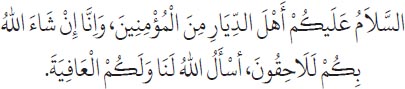
As-salāmu ‘alaykum ahla-d-diyāri mina-l-mu’minīn, wa innā in shā’a-llāhu bikum la-lāḥiqūn, as’alu-llāha lanā wa lakum al-‘āfiyah.
We relate in the book of Ibn as-Sunnī that ‘Ā’ishah reported that the Prophet came to al-Baqī‘ and said: “Peace be upon you, home of believing people. You have gone before us and we will join you. O Allah, do not deprive us of their reward, and do not lead us astray after them.” [6].
reported that the Prophet came to al-Baqī‘ and said: “Peace be upon you, home of believing people. You have gone before us and we will join you. O Allah, do not deprive us of their reward, and do not lead us astray after them.” [6].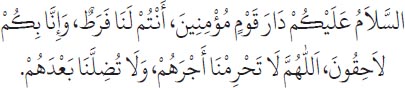
As-salāmu ‘alaykum dāra qawmin mu’minīn, antum lanā faraṭ, wa innā bikum lāḥiqūn. Allāhumma lā taḥrimnā ajrahum, wa lā tuḍillanā ba‘dahum.
It is mustaḥabb for visitors to recite Qur’ān, do dhikr, and make du‘ā’—all in abundance—for the dwellers of those graves and for all of the Muslim dead.
It is mustaḥabb to make a practice of visiting graves frequently and standing at the graves of good and pious people.
References
[1] Muslim (974) and an-Nasā’ī (3/94) in ‘Amal al-yawm wa al-laylah. Baqī‘ al-Gharqad is the old graveyard of al-Madīnat al-Munawwarah.
[2] Muslim (974), with a slight change in its wording.
[3] Abū Dāwūd (3237), an-Nasā’ī (4/91), and Ibn Mājah (4306).
[4] At-Tirmidhī (1053).
[5] Muslim (975), an-Nasā’ī (4/94), and Ibn Mājah (1547).
[6] Ibn as-Sunnī (596) and al-Futūḥāt (4/221). Ibn Ḥajar grades this hadith as ḥasan.