
Remembrance 2 from Chapter 120
The adhkār of the funeral ṣalāh
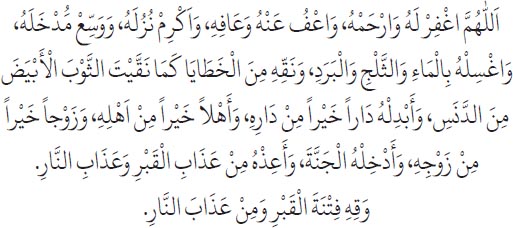
Allāhumma-ghfir lahu wa-rḥamh, wa‘fu ‘anhu wa ‘āfih, wa-krim nuzulah, wa wassi‘ madkhalah, wa-ghsilhu bi-l-mā’i wa-th-thalji wa-l-barad, wa naqqihi mina-l-khaṭāyā kamā tunaqqī-th-thawba-l-abyaḍa mina-d-danas, wa abdilhu dāran khayran min dārih, wa ahlan khayran min ahlih, wa zawjan khayran min zawjih, wa adkhilhu-l-Jannah, wa a‘idhhu min ‘adhābi-l-qabri wa min ‘adhābi-n-Nār. Wa-qihi fitnata-l-qabri wa ‘adhāba-l-qabr.
As for what is mustaḥabb, many hadiths and traditions have been narrated about it. As regards hadiths, the most authentic is that which we relate from the Ṣaḥīḥ of Muslim from ‘Awf ibn Mālik  , who reported: “The Messenger of Allah
  performed the funeral ṣalāh, and I memorised the du‘ā’ which he said: ‘Allah, forgive him and have mercy on him. Protect him and pardon him. Ennoble his dwelling and widen his entrance. Wash him with water, snow and ice, and purify him from sin as a white garment is purified of dirt. Give him in exchange a house better than his house, a family better than his [earthly] family, and a wife better than his [earthly] wife. Enter him into Paradise and protect him from the punishment in the grave and the punishment of Hell-Fire’, [2].until I wished that it were I who had died.” According to another hadith in Muslim, he also said: “And protect him from the trials of the grave and the punishment of Hell-Fire.”