
Remembrance 15 from Chapter 1
What has been narrated about the virtue of dhikr and is not restricted to a specific time
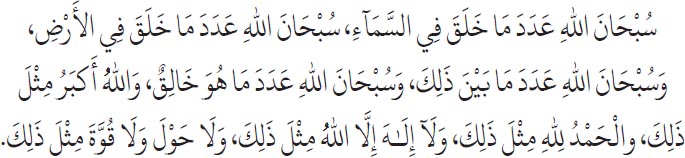
Subḥāna-llāhi ‘adada mā khalaqa fi-s-samā’, subḥāna-llāhi ‘adada mā khalaqa fi-l-arḍ, wa subḥāna-llāhi ‘adada mā bayna dhālik, wa subḥāna-llāhi ‘adada mā Huwa khāliq, wa-llāhu akbaru mithla dhālik, wa-l-ḥamdu li-llāhi mithla dhālik, wa lā ilāha illa-llāhu mithla dhālik, wa lā ḥawla wa lā quwwata mithla dhālik.
We relate in the Sunans of Abū Dāwūd and at-Tirmidhī that Sa‘d ibn Abī Waqqāṣ  narrated that he went with the Messenger of Allah
  to a woman, and in front of her were date stones or pebbles which she was using to make tasbīḥ. He said: “Should I not show you something that is easier and better than this? Glory be to Allah, equal to what He has created in the heavens; Glory be to Allah, equal to what He has created on Earth; Glory be to Allah, equal to the amount of what is between them; Glory be to Allah, equal to what He will create. And Allah is greater, equal to that, and All praise is due to Allah, equal to that; and There is no god but Allah, equal to that; and There is no power and no strength [except by Allah], equal to that.” [20].At-Tirmidhī described this hadith as ḥasan.