
WE RELATE FROM the Ṣaḥīḥ of Muslim that Abū Hurayrah  reported that the Messenger of Allah
  said: “A strong believer is better and dearer to Allah
  than a weak believer, although there is good in both. Be eager for that which will benefit you and seek the help of Allah, and do not be weak. If something befalls you, do not say: ‘If only I had done such-and-such it would have been like this or like that.’ Instead, say: ‘Allah has decreed, and what Allah wishes He does.’ Indeed, ‘If only’ opens the works of Shayṭān.” [1].
reported that the Messenger of Allah said: “A strong believer is better and dearer to Allah than a weak believer, although there is good in both. Be eager for that which will benefit you and seek the help of Allah, and do not be weak. If something befalls you, do not say: ‘If only I had done such-and-such it would have been like this or like that.’ Instead, say: ‘Allah has decreed, and what Allah wishes He does.’ Indeed, ‘If only’ opens the works of Shayṭān.” [1].We relate in the Sunan of Abū Dāwūd that ‘Awf ibn Mālik said that the Messenger of Allah gave judgment between two men, and the one against whom the judgment was given said when he turned away: “Allah is Sufficient for me and how excellent a Guardian is He!” [2].The Messenger said: “Allah rebukes people for weakness. You must be strong. If something overwhelms you, say: Allah is Sufficient for me and how excellent a Guardian is He.”316 I say al-kays with fatḥah on the letter kāf and sukūn on the letter yā’ can have two meanings. One of them is ar-rifq (gentleness), which means—and Allah knows best—acting with kindness whenever possible.
said that the Messenger of Allah gave judgment between two men, and the one against whom the judgment was given said when he turned away: “Allah is Sufficient for me and how excellent a Guardian is He!” [2].The Messenger said: “Allah rebukes people for weakness. You must be strong. If something overwhelms you, say: Allah is Sufficient for me and how excellent a Guardian is He.”316 I say al-kays with fatḥah on the letter kāf and sukūn on the letter yā’ can have two meanings. One of them is ar-rifq (gentleness), which means—and Allah knows best—acting with kindness whenever possible.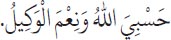
Ḥasbiya-llāhu wa ni‘ma-l-Wakīl.
References
[1] Muslim (2664) and an-Nasā’ī (621) in ‘Amal al-yawm wa al-laylah.
[2] Abū Dāwūd (3627) and al-Futūḥāt (4/24–25). Ibn Ḥajar states that this hadith is ḥasan. It was reported by Abū Dāwūd and an-Nasā’ī, and its chain contains Sayf ash-Shāmī, who was declared to be trustworthy by al-Ijlī. I do not know the name of his father. The rest of the narrators are of Muslim; it also contains the ‘anānah of Bāqiyyah, but from his narrating from ash-Shāmī.