
WE RELATE FROM Ibn as-Sunnī from Abī Mūsā al-Ash‘arī  who reported that the Messenger of Allah
  said: “Anyone afflicted with worry or grief should supplicate with these words: O Allah, I am Your slave and the son of Your male slave and the son of Your female slave, in Your grasp. My forelock is in Your hand, I am subject to Your decree, and Your decision on me is justice itself. I ask You by every name that is Yours, by which You have named Yourself, or which You have revealed in Your Book, or which You have taught any one of Your Creation, or which You have kept to Yourself in the knowledge of the Unseen with You, that You make the Qur’ān the light of my breast, the springtime of my heart, the removal of my sorrow, and the departure of my worries.” A man said: “O Messenger of Allah, anyone who is deprived of these words has been wronged.” He replied: “Yes! So say them and teach them, for Allah will remove the grief of anyone who says them seeking what is in them, and will prolong his happiness.” [1].
who reported that the Messenger of Allah said: “Anyone afflicted with worry or grief should supplicate with these words: O Allah, I am Your slave and the son of Your male slave and the son of Your female slave, in Your grasp. My forelock is in Your hand, I am subject to Your decree, and Your decision on me is justice itself. I ask You by every name that is Yours, by which You have named Yourself, or which You have revealed in Your Book, or which You have taught any one of Your Creation, or which You have kept to Yourself in the knowledge of the Unseen with You, that You make the Qur’ān the light of my breast, the springtime of my heart, the removal of my sorrow, and the departure of my worries.” A man said: “O Messenger of Allah, anyone who is deprived of these words has been wronged.” He replied: “Yes! So say them and teach them, for Allah will remove the grief of anyone who says them seeking what is in them, and will prolong his happiness.” [1].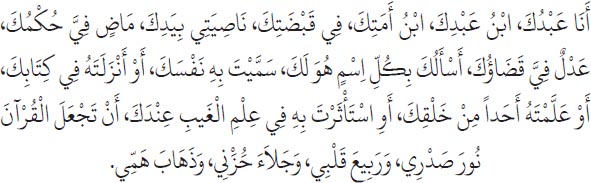
Ana ‘abduk, ibnu ‘abdik, ibnu amatik, fī qabḍatik, nāṣiyatī bi-yadik, māḍin fiyya ḥukmuk, ‘adlun fiyya qaḍā’uk, as’aluka bi-kulli-smin Huwa lak, sammayta bihi nafsak, aw anzalatahu fī Kitābik, aw ‘allamtahu aḥadan min khalqik, awi-sta’tharta bihi fī ‘ilmi-l-ghaybi ‘indak, an taj‘ala-l-Qur’āna nūra ṣadrī, wa rabī‘a qalbī, wa jalā’a ḥuznī, wa dhahāba hammī.
References
[1] Ibn as-Sunnī (334) and al-Futūḥāt (4/13). Ibn Ḥajar states that this hadith is gharīb, and goes on to mention that Ibn as-Sunnī also narrates another, similar hadith from Ibn Mas‘ūd, which is ḥasan and was graded as ṣaḥīḥ by some of the Imams of hadith.