
ALLAH  SAYS: “Say: Praise belongs to Allah, and peace be upon His servants whom He has chosen.” [1].
SAYS: “Say: Praise belongs to Allah, and peace be upon His servants whom He has chosen.” [1].
Allah says: “And say: Praise belongs to Allah; He will surely show you His signs.” [2].
says: “And say: Praise belongs to Allah; He will surely show you His signs.” [2].
Allah says: “Say: Praise belongs to Allah, Who has had no son.” [3].
says: “Say: Praise belongs to Allah, Who has had no son.” [3].
Allah says: “If you are grateful, I will assuredly increase you (in favours).” [4].
says: “If you are grateful, I will assuredly increase you (in favours).” [4].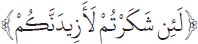
Allah says: “Then remember Me, and I will remember you. Be grateful to Me, and not thankless.” [5].
says: “Then remember Me, and I will remember you. Be grateful to Me, and not thankless.” [5].
The verses that explicitly tell us to praise and show gratitude to Allah, and that mention the merits of doing so, are many and well-known.
We relate in the Sunans of Abū Dāwūd and Ibn Mājah, and from the Musnad of Abū ‘Awānah al-Isfarā’inī extracted (mukharraj) from the Ṣaḥīḥ of Muslim, may Allah have mercy on him, from Abū Hurayrah  who reported that the Messenger of Allah
  said: “Every action of importance that is not started with the praise of Allah is defective and devoid of blessings.” [6].According to another hadith he said: “Every speech that is not started with the praise of Allah is mutilated.” According to another hadith he said: “Every important undertaking that is not started with In the name of Allah, the Beneficent, the Merciful is defective.”
who reported that the Messenger of Allah said: “Every action of importance that is not started with the praise of Allah is defective and devoid of blessings.” [6].According to another hadith he said: “Every speech that is not started with the praise of Allah is mutilated.” According to another hadith he said: “Every important undertaking that is not started with In the name of Allah, the Beneficent, the Merciful is defective.”And we relate all these wordings in the Kitāb al-Arba‘īn of al-Ḥāfiẓ ‘Abd al-Qādir ar-Ruhāwī. It is a ḥasan hadith which has been narrated in mawṣūl form, as we mentioned, and in mursal form; and the mawṣūl form has an excellent isnād. When a hadith is narrated in both mawṣūl and mursal form then according to the majority of the ‘ulamā’ the ruling on it is that it is mawṣūl, because it is an additional trustworthy narrator which is acceptable according to the masses [of the people of knowledge].
The meaning of ‘of importance’ (dhū bāl) is that its circumstances are of some concern. The meaning of ‘defective and devoid of blessings’ (aqṭa‘) is that it has a shortcoming and little blessing in it. ‘Mutilated’ (ajdham) has the same sense, and it is spelt with jīm and dhāl.
CLARIFYING THE CIRCUMSTANCES IN WHICH PRAISE OF ALLAH IS RECOMMENDED
According to the ‘ulamā’, it is mustaḥabb for every author, student, teacher, preacher and suitor to begin speaking with the praise of Allah and to mention it in all important matters. Ash-Shāfi‘ī said: “I like a man to praise Allah, extol Him and invoke blessings on the Messenger of Allah before proposing [marriage] and before anything else that he may wish.”
and invoke blessings on the Messenger of Allah before proposing [marriage] and before anything else that he may wish.”Know that saying ‘al-ḥamdu li-llāh’ is mustaḥabb in every important matter, as was already mentioned. It is also mustaḥabb after eating, drinking and sneezing and when proposing to a woman. Furthermore, it is mustaḥabb on making a marriage contract and on coming out of the lavatory. The explanation of these [cases] will come in the relevant chapters, together with the proof and a discussion of the rulings, if Allah desires. We have already mentioned what to say on coming out of the lavatory. It is mustaḥabb in written books, for teachers giving lessons, and for students when reading, whether they read hadith, jurisprudence or any other subject, to begin with the praise of Allah. The best wording for this is Praise be to Allah, Lord of the Worlds.
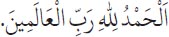
Al-ḥamdu li-llāhi Rabbi-l-‘ālamīn.
EXPLANATION OF WHAT IS A FUNDAMENTAL MATTER AND WHAT IS A PRECONDITION OF THE KHUṬBAH OF THE JUMU‘AH ETC.
The praise of Allah is a basic element of the sermon on Friday and at other times, without which it is not valid. The mandatory minimum is Praise be to Allah. It is best to augment the exaltation. The details of this are commonly found in books of jurisprudence. It is essential that it be in Arabic.
IT IS RECOMMENDED TO BEGIN AND CONCLUDE A DU‘Ā’ WITH PRAISE OF ALLAH
It is mustaḥabb to conclude supplications (da‘awāt) with the praise of Allah, Lord of the Worlds. They should likewise commence with the praise of Allah. Allah says: “And the end of their prayer will be: ‘Praise be to Allah, the Lord and Sustainer of the Universe.’” [7].
says: “And the end of their prayer will be: ‘Praise be to Allah, the Lord and Sustainer of the Universe.’” [7].
The proof that it is essential to start da‘awāt with praise and glorification of Allah will be cited in the chapter on salutations upon the Messenger of Allah , if Allah wishes.
, if Allah wishes.IT IS RECOMMENDED TO PRAISE ALLAH ON RECEIVING A BLESSING OR AVOIDING SOMETHING UNPLEASANT
Praising Allah is mustaḥabb when one is shown kindness or is diverted from something abhorrent, whether from oneself, a friend, or the Muslims in general.
And we relate from the Ṣaḥīḥ of Muslim from Abū Hurayrah who reported that the Messenger of Allah was brought two goblets on the night that he was taken to heaven. One contained wine and the other contained milk. He looked at them and chose the milk. Jibrīl  said: “Praise be to Allah, Who guided you to the natural religion. If you had taken the wine your Ummah would have gone astray.” [8].
who reported that the Messenger of Allah was brought two goblets on the night that he was taken to heaven. One contained wine and the other contained milk. He looked at them and chose the milk. Jibrīl said: “Praise be to Allah, Who guided you to the natural religion. If you had taken the wine your Ummah would have gone astray.” [8].EXPLANATION OF WHAT A SLAVE OF ALLAH SHOULD SAY IF ONE OF HIS CHILDREN DIES
We relate in the book of at-Tirmidhī and others, from Abū Mūsā al-Ash‘arī who narrated that the Messenger of Allah said: “When the son of one of Allah’s servants passes away, Allah asks His angels: ‘Have you taken the son of My servant?’ They reply: ‘Yes.’ He asks: ‘Did you take away the fruit of his heart?’ They say: ‘Yes.’ He says: ‘What did My servant say?’ They say: ‘He praised You and said “Verily we are from Allah and verily to Him do we return.”’ Allah says: ‘Build a house for My servant and name it The House of Praise.’” [9].According to at-Tirmidhī, this hadith is ḥasan.
who narrated that the Messenger of Allah said: “When the son of one of Allah’s servants passes away, Allah asks His angels: ‘Have you taken the son of My servant?’ They reply: ‘Yes.’ He asks: ‘Did you take away the fruit of his heart?’ They say: ‘Yes.’ He says: ‘What did My servant say?’ They say: ‘He praised You and said “Verily we are from Allah and verily to Him do we return.”’ Allah says: ‘Build a house for My servant and name it The House of Praise.’” [9].According to at-Tirmidhī, this hadith is ḥasan.The hadiths regarding the virtues of ḥamd are many and well-known. We have already mentioned in the first part of this book the ṣaḥīḥ narrations on the excellence of saying ‘Subhāna-llāh, al-ḥamdu li-llāh’ and the like.
According to the latter-day scholars among our [Shāfi‘ī] colleagues in Khurāsān, if a man makes a vow to praise Allah with the most comprehensive praise—or, as one of them said, ‘with the most magnificent of praise’—then he may fulfil that vow by saying: Praise be to Allah, such praise as fully befits His favours and suffices for increase from Him.”
with the most comprehensive praise—or, as one of them said, ‘with the most magnificent of praise’—then he may fulfil that vow by saying: Praise be to Allah, such praise as fully befits His favours and suffices for increase from Him.”
Al-ḥamdu li-llāh ḥamdan yuwāfī ni‘amahu wa yukāfī’u mazīdah.
The meaning of ‘befits His favours’ (yuwāfī ni‘amahu) i.e. corresponding to them so that they are produced along with it. ‘Suffices’ (yukāfi’u) with a hamzah on the end: that is, it matches the increase in His blessings, means that one undertakes to show gratitude for the blessings and good treatment He has granted by way of increase.
It has been said that if one makes a vow to extol Allah with the best exaltation, the way to fulfil that vow is to say: I am unable to exalt You sufficiently; You are as You have praised Yourself.
with the best exaltation, the way to fulfil that vow is to say: I am unable to exalt You sufficiently; You are as You have praised Yourself.
Lā uḥṣī thanā’an ‘alayk, Anta kamā athnayta ‘alā nafsik.
Some say that one should add at the end of the du‘ā’: And so to You be praise enough to please You.
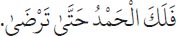
Fa-laka-l-ḥamdu ḥattā tarḍā.
Abū Sa‘d al-Mutawallī pictured the case of someone who swears an oath to praise Allah with most magnificent praises and the greatest of them and adds at the beginning of the dhikr: Glory be to You.

Subḥānak.
There is also a tradition from Abū Naṣr at-Tammār from Muḥammad ibn an-Naḍr, who stated that Adam said: “O Lord, You have kept me occupied with earning by my hands, so teach me something that contains complete praise and exaltation.” So Allah revealed to him: “O Adam, say thrice when you get up in the morning and thrice in the evening: Praise be to Allah, Lord of the Worlds—such praise as fully befits His favours and suffices for increase from Him. That will be complete praise and glorification.” And Allah knows best.
said: “O Lord, You have kept me occupied with earning by my hands, so teach me something that contains complete praise and exaltation.” So Allah revealed to him: “O Adam, say thrice when you get up in the morning and thrice in the evening: Praise be to Allah, Lord of the Worlds—such praise as fully befits His favours and suffices for increase from Him. That will be complete praise and glorification.” And Allah knows best.
Al-ḥamdu li-llāh ḥamdan yuwāfī ni‘amahu wa yukāfī’u mazīdah.
References
[1] Qur’ān 27:59.
[2] Qur’ān 27:93.
[3] Qur’ān 17:111.
[4] Qur’ān 14:7.
[5] Qur’ān 2:152.
[6] Abū Dāwūd (4840) and Ibn Mājah (1894). Al-Mundhirī said it was reported by an-Nasā’ī in a musnad and mursal form.
[7] Qur’ān 10:10.
[8] Muslim (168).
[9] At-Tirmidhī (1021), who states that this hadith is ḥasan gharīb, and al-Futūḥāt (3/296). Ibn Ḥajar grades it as ḥasan.