
KNOW THAT THERE are two types of people who wake up at night: one who does not sleep after waking up (we have already mentioned the adhkār appropriate for him); and one who wants to sleep afterwards. It is mustaḥabb for the latter to remember Allah until he falls asleep. Many adhkār have been conveyed in this regard. Some in the first category have already been quoted, such as [the following]:
We relate in the Ṣaḥīḥ of al-Bukhārī that ‘Ubādah ibn aṣ-Ṣāmit  reported that the Prophet
  said: “Whoever wakes up from his sleep and says: There is no god but Allah, One without partner. To Him belongs sovereignty and to Him belongs all praise, and He has power over all things. Praise be to Allah and glory be to Allah. There is no god but Allah. Allah is greater and there is no power and no strength except in Allah, and then says: O Allah, forgive me or supplicates, his prayer will be answered. If he makes ablution and performs ṣalāh, his ṣalāh will be accepted.” [1].The most approved text of al-Bukhārī states that one should say ‘Lā ilāha illa-llāh’ before ‘wa-llāhu akbar’. This is not mentioned by al-Ḥumaydī in al-Jam‘ bayn aṣ-Ṣaḥīḥayn. The wording is recorded in at-Tirmidhī’s narration and some others, but is omitted in Abū Dāwūd’s narration.
reported that the Prophet said: “Whoever wakes up from his sleep and says: There is no god but Allah, One without partner. To Him belongs sovereignty and to Him belongs all praise, and He has power over all things. Praise be to Allah and glory be to Allah. There is no god but Allah. Allah is greater and there is no power and no strength except in Allah, and then says: O Allah, forgive me or supplicates, his prayer will be answered. If he makes ablution and performs ṣalāh, his ṣalāh will be accepted.” [1].The most approved text of al-Bukhārī states that one should say ‘Lā ilāha illa-llāh’ before ‘wa-llāhu akbar’. This is not mentioned by al-Ḥumaydī in al-Jam‘ bayn aṣ-Ṣaḥīḥayn. The wording is recorded in at-Tirmidhī’s narration and some others, but is omitted in Abū Dāwūd’s narration.Al-Walīd ibn Muslim is in doubt as to the authenticity of the part of this hadith which reads, “Forgive me, or one supplicates”. He was one of the transmitters of this hadith and one of the teachers of the teachers of al-Bukhārī, Abū Dāwūd, at-Tirmidhī and others.
The word ta‘arr, with doubled letter rā’, means ‘he got up, awoke’.
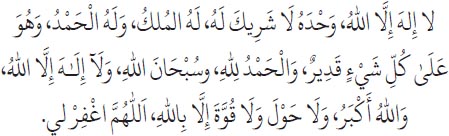
Lā ilāha illa-llāh, waḥdahu lā sharīka lah, lahu-l-mulk, wa lahu-l-ḥamd, wa Huwa ‘alā kulli shay’in qadīr, wa-l-ḥamdu li-llāh, wa subḥāna-llāh, wa lā ilāha illa-llāh, wa-llāhu akbar, wa lā ḥawla wa lā quwwati illā bi-llāh, Allāhumma-ghfir lī.
We relate in the Sunan of Abū Dāwūd, with an isnād he did not consider weak, from ‘Ā’ishah  , that when the Messenger of Allah woke up at night he used to say: “There is no god but You, glory be to You. O Allah, I ask Your forgiveness for my sins and I ask You for Your Mercy. O Allah, increase me in knowledge and do not turn my heart away after You have guided me. Grant me mercy from You. Verily You are the Ever-Bestowing.” [2].
, that when the Messenger of Allah woke up at night he used to say: “There is no god but You, glory be to You. O Allah, I ask Your forgiveness for my sins and I ask You for Your Mercy. O Allah, increase me in knowledge and do not turn my heart away after You have guided me. Grant me mercy from You. Verily You are the Ever-Bestowing.” [2].
Lā ilāha illā Ant, subḥānaka-llāhumma, astaghfiruka li-dhanbī, wa as’aluka raḥmatak, Allāhumma zidnī ‘ilmā, wa lā tuzigh qalbī ba‘da idh hadaytanī, wa hab lī min ladunka raḥmah, innaka Anta-l-Wahhāb.
We relate in the book of Ibn as-Sunnī from ‘Ā’ishah who reported that when the Messenger of Allah woke up at night (ta‘ārra) he would say: “There is no god but You: Allah, the One, the All-Conquering, Lord of the heavens and the earth and all that is between them, the Mighty, the All-Forgiving.” [3].
who reported that when the Messenger of Allah woke up at night (ta‘ārra) he would say: “There is no god but You: Allah, the One, the All-Conquering, Lord of the heavens and the earth and all that is between them, the Mighty, the All-Forgiving.” [3].
Lā ilāha illā Anta-llāhu-l-Wāḥidu-l-Qahhār, Rabbu-s-samāwāti wa-l-arḍi wa mā baynahuma-l-‘Azīzu-l-Ghaffār.
And we relate in the same source with a weak isnād from Abū Hurayrah , who narrated that he heard the Messenger of Allah say: “When Allah returns the soul of a Muslim servant to him at night, and he glorifies Him, asks Him for forgiveness and supplicates to Him, He will accept it from him.” [4].
, who narrated that he heard the Messenger of Allah say: “When Allah returns the soul of a Muslim servant to him at night, and he glorifies Him, asks Him for forgiveness and supplicates to Him, He will accept it from him.” [4].We relate in the books of at-Tirmidhī, Ibn Mājah and Ibn as-Sunnī with an excellent isnād from Abū Hurayrah who reported that the Messenger of Allah said: “When any one of you retires to his bed, he should dust his bed with the corner of his waist-wrapper (izār), because he does not know what came [to it] after him. Then he should say: In Your name, my Lord, I lay down my side and by You I raise it up. If You take my soul then have mercy on it, and if You release it then protect it by that with which You protect Your righteous servants.” [5].According to at-Tirmidhī, this hadith is ḥasan. The linguists say that ṣanifat al-izār with kasrah on the letter nūn means the side of it on which there are no fringes. It also said that it means either side.
who reported that the Messenger of Allah said: “When any one of you retires to his bed, he should dust his bed with the corner of his waist-wrapper (izār), because he does not know what came [to it] after him. Then he should say: In Your name, my Lord, I lay down my side and by You I raise it up. If You take my soul then have mercy on it, and if You release it then protect it by that with which You protect Your righteous servants.” [5].According to at-Tirmidhī, this hadith is ḥasan. The linguists say that ṣanifat al-izār with kasrah on the letter nūn means the side of it on which there are no fringes. It also said that it means either side.
Bismika-llāhumma Rabbī waḍa‘tu janbī, wa bika arfa‘uh, in amsakta nafsī fa-rḥamhā, wa in radadtahā fā-ḥfaẓhā bimā taḥfaẓu bihi ‘ibādika-ṣ-ṣāliḥīn.
And we relate from the Muwaṭṭa’ of Imam Mālik, may Allah be merciful to him, in the chapter on du‘ā’ at the end of the Book of Ṣalāt, from Mālik who said that it had reached him that when Abū ad-Dardā’ got up in the middle of the night he would say: “The eyes have gone to sleep and the stars have set, but You are the Ever-Living, the Self-Subsisting.” [6].The meaning of ghārat is ‘set’ (gharubat).

Nāmati-l-‘uyūn, wa ghārati-n-nujūm, wa Anta Ḥayyun Qayyūm.
References
[1] Al-Bukhārī (1154), at-Tirmidhī (3411), and Abū Dāwūd (5060).
[2] Abū Dāwūd (5061).
[3] Ibn as-Sunnī (762) and Natā ’ ij al-afkār (203). Ibn Ḥajar grades it as ḥasan.
[4] Ibn as-Sunnī (758).
[5] At-Tirmidhī (3392), Ibn Mājah (3874), and Ibn as-Sunnī (770).
[6] Al-Muwaṭṭa’ (3).