
WE HAVE ALREADY mentioned what should be said after every ṣalāh. It is mustaḥabb to add to this, and say the following after the Sunnah prayers of Maghrib.
We relate in the book of Ibn as-Sunnī from Umm Salamah  , who reported that when the Messenger of Allah
  prayed the ṣalāh of Maghrib he would enter her house, pray two rak‘ahs and say, among other words he supplicated with: “O Turner of hearts and eyesight, make our hearts firm in Your religion.” [1].
, who reported that when the Messenger of Allah prayed the ṣalāh of Maghrib he would enter her house, pray two rak‘ahs and say, among other words he supplicated with: “O Turner of hearts and eyesight, make our hearts firm in Your religion.” [1].
Yā Muqalliba-l-qulūbi thabbit qulūbanā ‘alā dīnik.
And we relate from the book of at-Tirmidhī, from ‘Ammār ibn Shabīb  who reported that the Messenger of Allah said: “If a person says ten times after the setting of the sun: There is no god but Allah. He is Alone and has no partner. To Him belongs sovereignty and to Him belongs all praise. He gives life and causes death and He has power over all things, Allah will appoint guards for him who will protect him from Shayṭān until he gets up in the morning. Allah will also record for him ten accepted good deeds and expiate ten mortal sins; and he will get the reward due for freeing ten believing slaves.” [2].At-Tirmidhī commented: We do not know of ‘Ammār ibn Shabīb having listened to the Prophet .
who reported that the Messenger of Allah said: “If a person says ten times after the setting of the sun: There is no god but Allah. He is Alone and has no partner. To Him belongs sovereignty and to Him belongs all praise. He gives life and causes death and He has power over all things, Allah will appoint guards for him who will protect him from Shayṭān until he gets up in the morning. Allah will also record for him ten accepted good deeds and expiate ten mortal sins; and he will get the reward due for freeing ten believing slaves.” [2].At-Tirmidhī commented: We do not know of ‘Ammār ibn Shabīb having listened to the Prophet .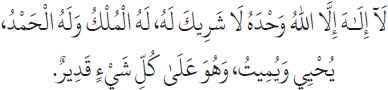
Lā ilāha illa-llāhu waḥdahu lā sharīka lah, lahu-l-mulku wa lahu-l-ḥamd, yuḥyī wa yumīt, wa Huwa ‘alā kulli shay’in qadīr.
I say: an-Nasā’ī has narrated in his book ‘Amal al-yawm wa al-laylah from two chains. One of them is the hadith as mentioned above and the second is from ‘Ammār from a man of the Anṣār. According to the Ḥāfiẓ [Ibn al-Ḥajar], the second of the narrations is the more correct.
I say: here the word ‘guards’ (maslaḥatan), with fatḥah on the letter mīm, sukūn on the letter sīn and fatḥah on the letters lām and hā’, means ‘guardians’ or ‘protectors’ (al-ḥarasa).
References
[1] Ibn as-Sunnī (663) and Natā’ij al-afkār (186). Ibn Ḥajar states that this hadith was reported by Ibn as-Sunnī via Sa‘d ibn as-Salṭ, who narrated it from ‘Aṭā ibn ‘Ajlān. ‘Aṭā has been declared to be a liar. However, I have found this hadith with a ḥasan chain which leads back to Umm Salamah, without a date.
[2] At-Tirmidhī (3528), who states that this hadith is ḥasan gharīb. We know only it from the hadith of al-Layth ibn Sa‘d, and we do not know of ‘Ammār ibn Shabīb having heard it from the Prophet . Ibn Ḥajar grades it as ḥasan.
. Ibn Ḥajar grades it as ḥasan.