
KNOW THAT DU‘Ā’IS prescribed after the last tashahhud, there being no disagreement about that.
We relate in the Ṣaḥīḥs of al-Bukhārī and Muslim from ‘Abdullāh ibn Mas‘ūd  that the Messenger of Allah
  taught his Companions the tashahhud and said afterwards: “Then one may make one’s choice of supplication.” According to a report by al-Bukhārī he said: “Whatever appeals to a person he may supplicate with.” According to a report in Muslim he said: “Then he may choose whichever he wishes by way of supplication.” [1].
that the Messenger of Allah taught his Companions the tashahhud and said afterwards: “Then one may make one’s choice of supplication.” According to a report by al-Bukhārī he said: “Whatever appeals to a person he may supplicate with.” According to a report in Muslim he said: “Then he may choose whichever he wishes by way of supplication.” [1].Know that this du‘ā’ is mustaḥabb and not wājib, and that it is mustaḥabb to prolong it, unless one is the Imam. A person may supplicate for what he wants by way of things of the Hereafter and this world. He may use the supplications that have been conveyed from the Messenger of Allah or he may use supplications that he has conceived and devised for himself. That which has been conveyed from the Messenger of Allah is best.
or he may use supplications that he has conceived and devised for himself. That which has been conveyed from the Messenger of Allah is best.On this topic many du‘ā’s have been established, among them:
We relate in the Ṣaḥīḥs of al-Bukhārī and Muslim that Abū Hurayrah related that the Messenger of Allah said: “When any of you has completed the last tashahhud, let him seek protection from four things: from the punishment of Hell, from punishment in the grave, from the trials of life and death, and from the evil of the anointed Dajjāl [Antichrist].” [2].
related that the Messenger of Allah said: “When any of you has completed the last tashahhud, let him seek protection from four things: from the punishment of Hell, from punishment in the grave, from the trials of life and death, and from the evil of the anointed Dajjāl [Antichrist].” [2].Muslim narrated this through many chains, and one of the related reports is that he said: “When any of you says the tashahhud then he should seek protection from four things. He should say: O Allah, I seek Your protection from the punishment of Hell, from punishment in the grave, from the trials of life and death, and from the evil trials of the anointed Dajjāl.”
said: “When any of you says the tashahhud then he should seek protection from four things. He should say: O Allah, I seek Your protection from the punishment of Hell, from punishment in the grave, from the trials of life and death, and from the evil trials of the anointed Dajjāl.”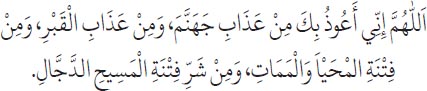
Allāhumma innī a‘ūdhu bika min ‘adhābi Jahannam, wa min ‘adhābi-l-qabr, wa min fitnati-l-maḥyā wa-l-mamāt, wa min sharri fitnati-l-masīḥi-d-Dajjāl.
We relate in the Ṣaḥīḥs of al-Bukhārī and Muslim, from ‘Ā’ishah  who reported that the Messenger of Allah used to make du‘ā’ in ṣalāh saying: “O Allah, I seek Your protection from the punishment in the grave, I seek Your protection from the trials of the anointed Dajjāl, and I seek Your protection from the trials of death and life. O Allah, I seek Your protection from misdeeds and debt.” [3].
who reported that the Messenger of Allah used to make du‘ā’ in ṣalāh saying: “O Allah, I seek Your protection from the punishment in the grave, I seek Your protection from the trials of the anointed Dajjāl, and I seek Your protection from the trials of death and life. O Allah, I seek Your protection from misdeeds and debt.” [3].
Allāhumma innī a‘ūdhu bika min ‘adhābi-l-qabr, wa a‘ūdhu bika min fitnati-l-masīḥi-d-Dajjāl, wa a‘ūdhu bika min fitnati-l-maḥyā wa-l-mamāt, Allāhumma innī a‘ūdhu bika min al-ma’thami wa-l-maghram.
We relate in the Ṣaḥīḥ of Muslim that ‘Alī narrated that when the Messenger of Allah performed ṣalāh, the last thing he would say between the tashahhud and the salutation was: “O Allah, forgive me for what I have done in the past and for what I have delayed, for what I have done in secret and for what I have done in public, for what I have squandered and for that which You know better than I. You are the One Who brings forward and the One Who puts behind, and there is no god but You.” [4].
narrated that when the Messenger of Allah performed ṣalāh, the last thing he would say between the tashahhud and the salutation was: “O Allah, forgive me for what I have done in the past and for what I have delayed, for what I have done in secret and for what I have done in public, for what I have squandered and for that which You know better than I. You are the One Who brings forward and the One Who puts behind, and there is no god but You.” [4].
Allāhumma-ghfir lī mā qaddamtu wa mā akhkhart, wa mā asrartu wa mā a‘lant, wa mā asraftu wa mā Anta a‘lamu bihi minnī, Anta-l-Muqaddimu wa Anta-l-Mu’akhkhiru lā ilāha illā Ant.
And we relate from the Ṣaḥīḥs of al-Bukhārī and Muslim that ‘Abdullāh ibn ‘Amr ibn al-‘Āṣ narrated that Abū Bakr aṣ-Ṣiddīq reported that he asked the Messenger of Allah : “Teach me a du‘ā’ that I may supplicate with in my ṣalāh.” He said: “Say: O Allah, I have wronged myself greatly and no-one forgives sins except You; so grant me forgiveness from You, and have mercy on me. You are the Most Forgiving and the Most Merciful.” [5].
reported that he asked the Messenger of Allah : “Teach me a du‘ā’ that I may supplicate with in my ṣalāh.” He said: “Say: O Allah, I have wronged myself greatly and no-one forgives sins except You; so grant me forgiveness from You, and have mercy on me. You are the Most Forgiving and the Most Merciful.” [5].
Allāhumma innī ẓalamtu nafsī ẓulman kathīran, wa lā yaghfiru-dh-dhunūba illā Ant, fa-ghfir lī maghfiratan min ‘indik, wa-rḥamnī, innaka Anta-l-Ghafūru-r-Raḥīm.
This is how we spell the term ‘much wrong’ (ẓulman kathīran) with the letter thā’ in most narrations, although some narrations of Muslim use the word ‘great’ (kabīr) with bā’. Both are good, so one ought to combine them to give ‘many great sins’ (ẓulman kathīran kabīran). Al-Bukhārī, in his Ṣaḥīḥ, and al-Bayhaqī as well as other Imams have used this hadith for the du‘ā’ at the end of the ṣalāh, and this is valid reasoning. His saying ‘in my ṣalāh’ generalises the whole and the appropriate time for du‘ā’ in ṣalāh is in this place.
We relate with a ṣaḥīḥ isnād in the Sunan of Abū Dāwūd from Abū Ṣāliḥ Dhakwān from one of the Companions of the Prophet who asked a man: “What do you say in the ṣalāh?” He replied: “I say the tashahhud and then I say: ‘O Allah, I ask you for Paradise and I seek refuge in You from Hell-Fire’, but I do not do the murmuring (dandanah) very well which you and Mu‘ādh do.” The Prophet replied: “About them we murmur (ḥawlahā nudandinu).”
who asked a man: “What do you say in the ṣalāh?” He replied: “I say the tashahhud and then I say: ‘O Allah, I ask you for Paradise and I seek refuge in You from Hell-Fire’, but I do not do the murmuring (dandanah) very well which you and Mu‘ādh do.” The Prophet replied: “About them we murmur (ḥawlahā nudandinu).”‘Murmuring’ (dandanah) means speech whose meaning is not understood. The phrase ‘hawlahā nudandinu’ means [murmuring] about Paradise and Hell-Fire, or about asking for them. The first is asking in the sense of seeking [Paradise] and the second is asking in the sense of seeking refuge [from Hell-Fire]. And Allah knows best.
It is mustaḥabb, under all circumstances, to make du‘ā’ by saying: ‘O Allah, I ask You for forgiveness and well-being. O Allah, I ask You for guidance, piety, modesty, and independence.’

Allāhumma innī as’aluka-l-‘afwa wa-l-‘āfiyah, Allāhumma innī as’aluka-l-hudā wa-t-tuqā wa-l-‘afāfa wa-l-ghinā.
And Allah knows best.
References
[1] Al-Bukhārī (831), Muslim (402).
[2] Al-Bukhārī (1377), Muslim (588), Abū Dāwūd (983), and an-Nasā’ī (3/58).
[3] Al-Bukhārī (832), Muslim (589), Abū Dāwūd (880), and an-Nasā’ī (3/56).
[4] Muslim (771) and at-Tirmidhī (3417).
[5] Al-Bukhārī (834), Muslim (2705), at-Tirmidhī (3521), and an-Nasā’ī (3/53).