
THIS CHAPTER IS the most important one to know about, and the one whose content it is most vital to apply. I have deliberately left it to last, in order to gain Allah’s blessing by completing [this book] with goodness. We ask Him for goodness for me, for those whom I love, and for all the Muslims.
Allah  says: “And ask forgiveness for your sin, and celebrate the praises of your Lord night and morning.” [1].
says: “And ask forgiveness for your sin, and celebrate the praises of your Lord night and morning.” [1].
Allah also says: “And ask forgiveness for your sin, and for the believers, men and women.” [2].
also says: “And ask forgiveness for your sin, and for the believers, men and women.” [2].
Allah has also said: “And seek the forgiveness of Allah; Allah is ever Most Forgiving, Most Merciful.” [3].
has also said: “And seek the forgiveness of Allah; Allah is ever Most Forgiving, Most Merciful.” [3].
Allah also says: “For the righteous are gardens near their Lord, beneath which rivers flow. Therein shall be their eternal home, with spouses purified and Allah’s good pleasure. Allah is All-Seeing of His servants: those who say ‘Lord, we have indeed believed, so forgive us our sins and save us from the agony of Hell-Fire’—those who show patience, who are truthful [and sincere], who worship devoutly, who spend [for the Cause of Allah], and who pray for forgiveness before dawn.” [4].
also says: “For the righteous are gardens near their Lord, beneath which rivers flow. Therein shall be their eternal home, with spouses purified and Allah’s good pleasure. Allah is All-Seeing of His servants: those who say ‘Lord, we have indeed believed, so forgive us our sins and save us from the agony of Hell-Fire’—those who show patience, who are truthful [and sincere], who worship devoutly, who spend [for the Cause of Allah], and who pray for forgiveness before dawn.” [4].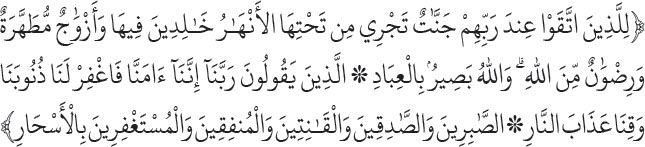
Allah says: “And Allah would not punish them while you are in their midst, nor would He punish them while they ask for forgiveness.” [5].
says: “And Allah would not punish them while you are in their midst, nor would He punish them while they ask for forgiveness.” [5].
Allah says: “And those who, having committed an act of indecency or wronged their own souls, remember Allah and ask for forgiveness for their sins—and who can forgive sins except Allah?—and do not persist knowingly in [the wrong] that they have done.” [6].
says: “And those who, having committed an act of indecency or wronged their own souls, remember Allah and ask for forgiveness for their sins—and who can forgive sins except Allah?—and do not persist knowingly in [the wrong] that they have done.” [6].
Allah says: “Whoever does evil or wrongs his own soul but afterwards seeks Allah’s forgiveness will find Allah Most Forgiving, Most Merciful.” [7].
says: “Whoever does evil or wrongs his own soul but afterwards seeks Allah’s forgiveness will find Allah Most Forgiving, Most Merciful.” [7].
Allah says: “And seek your Lord’s forgiveness, then turn to Him in repentance.” [8].
says: “And seek your Lord’s forgiveness, then turn to Him in repentance.” [8].
Allah says: “Then [I said], ‘Ask forgiveness from your Lord, for He is Oft-Forgiving.’” [9].
says: “Then [I said], ‘Ask forgiveness from your Lord, for He is Oft-Forgiving.’” [9].
Allah says: “And o my people, ask forgiveness of your Lord, and then turn to Him in repentance. . ..” [10].
says: “And o my people, ask forgiveness of your Lord, and then turn to Him in repentance. . ..” [10].
The verses about seeking forgiveness are many and well-known. [Enough] admonition has been imparted by some of what we have mentioned. As for the hadiths that exist concerning seeking forgiveness, it is impossible to study them in full, but I will allude to some examples.
We relate in the Ṣaḥīḥ of Muslim that al-Agharr al-Muzanī  , a Companion, reported that the Messenger of Allah
  said: “My heart becomes forgetful and I ask Allah for forgiveness one hundred times a day.” [11].
, a Companion, reported that the Messenger of Allah said: “My heart becomes forgetful and I ask Allah for forgiveness one hundred times a day.” [11].We relate in the Ṣaḥīḥ of al-Bukhārī that Abū Hurayrah reported that he heard the Messenger of Allah say, “By Allah, I ask Allah for forgiveness and repent to Him more than seventy times a day.” [12].
reported that he heard the Messenger of Allah say, “By Allah, I ask Allah for forgiveness and repent to Him more than seventy times a day.” [12].We relate, also from the Ṣaḥīḥ of al-Bukhārī, that Shaddād ibn Aws reported from the Prophet : “The foremost of all the formulae for seeking forgiveness is for the slave [of Allah] to say, ‘O Allah, You are my Lord, there is no god but You. You created me and I am Your slave, and I am bound to [fulfil] Your covenant and Your promise to the best of my ability. I seek Your protection from the evil that I have done, acknowledging Your favour upon me and admitting my sin. So forgive me, for none forgives sin except You.’ Whoever says this with conviction during the day and then passes away before the evening will be one of the people of Paradise; and whoever says it with conviction during the night and then passes away before the morning will be one of the people of Paradise.” [13].
reported from the Prophet : “The foremost of all the formulae for seeking forgiveness is for the slave [of Allah] to say, ‘O Allah, You are my Lord, there is no god but You. You created me and I am Your slave, and I am bound to [fulfil] Your covenant and Your promise to the best of my ability. I seek Your protection from the evil that I have done, acknowledging Your favour upon me and admitting my sin. So forgive me, for none forgives sin except You.’ Whoever says this with conviction during the day and then passes away before the evening will be one of the people of Paradise; and whoever says it with conviction during the night and then passes away before the morning will be one of the people of Paradise.” [13].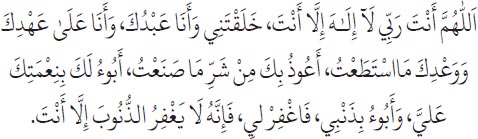
Allāhumma Anta Rabbī lā ilāha illā Ant, khalaqtanī wa anā ‘abduk, wa anā ‘alā ‘ahdika wa wa‘dika ma-staṭa‘t. A‘ūdhu bika min sharri mā ṣana‘t, abū’u laka bi-ni‘matika ‘alayya wa abū’u bi-dhanbī, fa-ghfir lī fa-innahu lā yaghfiru-dh-dhunūba illā Ant.
I say that abū’u ‘I acknowledge’—with a ḍammah on the bā’ and a hamzah after the extended [14].wāw—means ‘I confirm and acknowledge’.
We relate in the Sunans of Abū Dāwūd, at-Tirmidhī and Ibn Mājah that Ibn ‘Umar  reported: “We used to count the Messenger of Allah saying one hundred times in one sitting: ‘Lord, forgive me and relent towards me. You are the Oft-Relenting, the Most Merciful.’” [15].At-Tirmidhī says that this is a ṣaḥīḥ hadith.
reported: “We used to count the Messenger of Allah saying one hundred times in one sitting: ‘Lord, forgive me and relent towards me. You are the Oft-Relenting, the Most Merciful.’” [15].At-Tirmidhī says that this is a ṣaḥīḥ hadith.
Rabbi-ghfir lī wa tub ‘alayya. Innaka Anta-t-Tawwābu-r-Raḥīm.
We relate in the Sunans of Abū Dāwūd and Ibn Mājah that ‘Abdullāh ibn ‘Abbās narrated that the Messenger of Allah said: “Whoever adheres to seeking forgiveness, Allah will give him an escape from every constriction and relief from every worry, and will provide for him from where he does not expect.” [16].
narrated that the Messenger of Allah said: “Whoever adheres to seeking forgiveness, Allah will give him an escape from every constriction and relief from every worry, and will provide for him from where he does not expect.” [16].We relate in the Ṣaḥīḥ of Muslim that Abū Hurayrah reported that the Messenger of Allah said: “By Him in Whose hand is my soul, if you did not sin Allah would do away with you and bring a people who would sin and then ask for forgiveness from Allah ; and then He would forgive them.” [17].
reported that the Messenger of Allah said: “By Him in Whose hand is my soul, if you did not sin Allah would do away with you and bring a people who would sin and then ask for forgiveness from Allah ; and then He would forgive them.” [17].And we relate from the Sunan of Abū Dāwūd that ‘Abdullāh ibn Mas‘ūd reported that Allah’s Messenger liked to make du‘ā’ thrice and to ask for forgiveness thrice. [18].This hadith was cited not long ago, in the general chapter on da‘awāt.
reported that Allah’s Messenger liked to make du‘ā’ thrice and to ask for forgiveness thrice. [18].This hadith was cited not long ago, in the general chapter on da‘awāt.We relate in the books of Abū Dāwūd and at-Tirmidhī that one of Abū Bakr aṣ-Ṣiddīq’s freed slaves narrated that Abū Bakr reported that the Messenger of Allah said: “He is not persistent (in sin) who asks for forgiveness but then repeats it, even if he does so seventy times a day.” [19].According to at-Tirmidhī, the isnād is not strong.
freed slaves narrated that Abū Bakr reported that the Messenger of Allah said: “He is not persistent (in sin) who asks for forgiveness but then repeats it, even if he does so seventy times a day.” [19].According to at-Tirmidhī, the isnād is not strong.We relate in the book of at-Tirmidhī that Anas related that he heard the Messenger of Allah say: “Allah says, ‘Son of Adam, if you supplicate to Me and have hope in Me I will forgive you, whatever your [transgression may be]; and I do not care. Son of Adam, even if your sins reached up to the clouds in the sky, if you asked Me for forgiveness I would forgive you. Son of Adam, even if you came to Me with sins enough almost to fill the entire Earth, if you then came to Me without assigning partners to Me I would come to forgiveness enough almost to fill it.’” [20].At-Tirmidhī describes this hadith as ḥasan.
related that he heard the Messenger of Allah say: “Allah says, ‘Son of Adam, if you supplicate to Me and have hope in Me I will forgive you, whatever your [transgression may be]; and I do not care. Son of Adam, even if your sins reached up to the clouds in the sky, if you asked Me for forgiveness I would forgive you. Son of Adam, even if you came to Me with sins enough almost to fill the entire Earth, if you then came to Me without assigning partners to Me I would come to forgiveness enough almost to fill it.’” [20].At-Tirmidhī describes this hadith as ḥasan.I say that ‘anān as-samā’, with a fatḥah on the ‘ayn, means clouds, the singular being ‘anānah. Some say that ‘anān means those clouds that are visible to you, which face you and appear to you when you raise your head towards it. As for qurāb al-arḍ, ‘enough almost to fill the entire Earth’, it has been narrated with a ḍammah on the qāf and with a kasrah, but the ḍammah is what is well-known. It means [an amount] that would approximately fill it. Among those who state that it is spelt with a kasrah is the author of al-Maṭāli‘.
We relate in the Sunan of Ibn Mājah, with an excellent isnād, that ‘Abdullāh ibn Busr —with a ḍammah on the bā’ and with a sīn—reported that the Messenger of Allah said: “Excellent good fortune to him who finds in his book of deeds much seeking for forgiveness.” [21].
—with a ḍammah on the bā’ and with a sīn—reported that the Messenger of Allah said: “Excellent good fortune to him who finds in his book of deeds much seeking for forgiveness.” [21].We relate in the Sunans of Abū Dāwūd and at-Tirmidhī that ‘Abdullāh ibn ‘Abbās reported that the Messenger of Allah said: “Whoever says: I ask for the forgiveness of Allah, besides Whom there is no god, the Living, the Self-Subsisting, and I repent to Him will have his sins forgiven even if he has fled from the battlefield.” [22].According to al-Ḥākim this hadith is ṣaḥīḥ, according to the criteria of both al-Bukhārī and Muslim.
reported that the Messenger of Allah said: “Whoever says: I ask for the forgiveness of Allah, besides Whom there is no god, the Living, the Self-Subsisting, and I repent to Him will have his sins forgiven even if he has fled from the battlefield.” [22].According to al-Ḥākim this hadith is ṣaḥīḥ, according to the criteria of both al-Bukhārī and Muslim.
Astaghfiru-llāha-lladhī lā ilāha illā Huwa-l-Ḥayyu-l-Qayyūmu wa atūbu ilayh.
I say: “This subject is very extensive and abridging it is more appropriate than going into details, so we will confine ourselves to just this amount.”
ABOUT SAYING: ‘I SEEK FORGIVENESS OF ALLAH AND I TURN IN REPENTANCE TO HIM’
One of the things that are related to seeking forgiveness is that which is reported of ar-Rabī‘ ibn Khuthaym , who said: “Let none of you say ‘I ask forgiveness of Allah and I turn in repentance to Him,’ so that it is both a sin and a lie if he does do so. Instead one should say ‘O Allah forgive me and relent towards me.’”
, who said: “Let none of you say ‘I ask forgiveness of Allah and I turn in repentance to Him,’ so that it is both a sin and a lie if he does do so. Instead one should say ‘O Allah forgive me and relent towards me.’”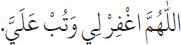
Allāhumma-ghfir lī wa tub ‘alayy.
What he says about ‘O Allah forgive me and relent towards me’ is sound; but as for disapproving of saying ‘I ask forgiveness of Allah’ and calling it a lie, no one will agree with him on that, because the meaning of ‘I ask forgiveness of Allah’ is ‘I seek His forgiveness’—and there is no lie in this. It is sufficient refutation of it to cite the aforementioned hadith from Ibn Mas‘ūd.
Al-Fuḍayl observed, “Asking for forgiveness without abandoning sin is the repentance of liars.” This is close to what Rābi‘ah al-‘Adawiyyah  said, “Our asking forgiveness needs much asking of forgiveness.”
observed, “Asking for forgiveness without abandoning sin is the repentance of liars.” This is close to what Rābi‘ah al-‘Adawiyyah said, “Our asking forgiveness needs much asking of forgiveness.”While clinging to the covering of the Ka‘bah, a desert Arab said: “O Allah, my asking for forgiveness in spite of persistence is iniquity, and to abandon asking for forgiveness in spite of my knowledge of the vastness of Your pardon would be feebleness. How much love You have shown me in spite of Your lack of need of me, and how much hatred I have shown You in spite of my need for You! O You Who fulfil when You promise, and forgive and pardon when You threaten, include my great transgression within Your immense pardon, o Most Merciful of those who show mercy.”
References
[1] Qur’ān 40:55.
[2] Qur’ān 47:19.
[3] Qur’ān 4:106.
[4] Qur’ān 3:15–17.
[5] Qur’ān 8:33.
[6] Qur’ān 3:135.
[7] Qur’ān 4:110.
[8] Qur’ān 11:3.
[9] Qur’ān 71:10.
[10] Qur’ān 11:52.
[11] Muslim (2702) and Abū Dāwūd (1515).
[12] Al-Bukhārī (6307) and at-Tirmidhī (3255).
[13] Al-Bukhārī (6306), at-Tirmidhī (3390), and an-Nasā’ī (8/279).
[14] The text has an ‘extended hamzah ’, which must be a mistake.
[15] Abū Dāwūd (1516), at-Tirmidhī (3430), Ibn Mājah (3814), and Ibn as-Sunnī (458).
[16] Abū Dāwūd (1518), Ibn Mājah (3819), and an-Nasā’ī (456).
[17] Muslim (2749).
[18] Abū Dāwūd (1524).
[19] At-Tirmidhī (3554) and Abū Dāwūd (1514).
[20] At-Tirmidhī (3534) and ad-Dārimī (2791). As-Sakhāwī grades this hadith as ḥasan in his referencing of an-Nawawī’s Arba‘īn.
[21] Ibn Mājah (3818) and an-Nasā’ī (455). The author of az-Zawā ’ id states that the chain for this hadith is ṣaḥīḥ and that its narrators are trustworthy.
[22] Abū Dāwūd (1517) and at-Tirmidhī (3572). Al-Mundhirī states that the chain for this hadith is good and continuous.