
ALLAH  SAYS: “Fulfill the covenant with Allah when you have entered into it.” [1].
SAYS: “Fulfill the covenant with Allah when you have entered into it.” [1].
Allah also says: “O you who believe, fulfil (all) obligations.” [2].
also says: “O you who believe, fulfil (all) obligations.” [2].
Allah also says: “And fulfil (every) pact, for (every) pact will be enquired into (on the Day of Reckoning).” [3].
also says: “And fulfil (every) pact, for (every) pact will be enquired into (on the Day of Reckoning).” [3].
There are many verses on this subject, the most severe of them being Allah’s saying: “You who believe, why do you say that which you do not do? It is most hateful in the sight of Allah that you say that which you do not do.” [4].
saying: “You who believe, why do you say that which you do not do? It is most hateful in the sight of Allah that you say that which you do not do.” [4].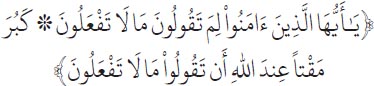
We relate in the Ṣaḥīḥs of al-Bukhārī and Muslim that Abū Hurayrah  reported that the Messenger of Allah
  said: “The signs of the hypocrite are three: when he speaks, he lies; when he makes a promise, he breaks it; and when he is trusted, he betrays.” According to a narration from Muslim he added: “even if he fasts and performs ṣalāh and claims to be a Muslim.” [5].The hadiths to this effect are numerous but there is enough in what I have mentioned.
reported that the Messenger of Allah said: “The signs of the hypocrite are three: when he speaks, he lies; when he makes a promise, he breaks it; and when he is trusted, he betrays.” According to a narration from Muslim he added: “even if he fasts and performs ṣalāh and claims to be a Muslim.” [5].The hadiths to this effect are numerous but there is enough in what I have mentioned.The ‘ulamā’ are unanimously agreed that anyone who promises a person something which is not prohibited ought to fulfil his promise. Is that wājib or mustaḥabb? There is some disagreement about that. Ash-Shāfi‘ī, Abū Ḥanīfah and the majority are of the opinion that it is mustaḥabb, so if anyone disregards it he will forfeit its merit and commit an extremely makrūh act, but will not be committing a sin. Another group are of the opinion that it is wājib.
According to Imam Abū Bakr ibn al-‘Arabī al-Mālikī, the most important of the people who took this position was ‘Umar ibn ‘Abd al-‘Azīz. Mālikīs have adopted a third position, which is that if the promise is bound to a cause—such as when someone says, ‘Marry and you will have such-and-such’, or ‘Swear an oath that you will not abuse me and you will have such-and-such’, or something of that kind—in that case it is wājib to fulfil the promise, but if the promise is an unqualified promise, it is not wājib. Those who do not regard it as wājib try to prove that it is a type of gift, and that a gift does not become binding except by taking possession, according to the majority; but according to Mālikīs it is binding even before taking possession.
References
[1] Qur’ān 16:91.
[2] Qur’ān 5:1.
[3] Qur’ān 17:34.
[4] Qur’ān 61:2–3.
[5] Al-Bukhārī (33), Muslim (59), at-Tirmidhī (2633), and an-Nasā’ī (8/117).