
WHAT IT IS MUSTAḤABB TO SAY TO SOMEONE WHO CALLS YOU
IT IS MUSTAḤABB to answer, when someone calls out to you, ‘At your service, and at your command’, or simply ‘At your service.’

Labbayka wa sa‘dayk.

Labbayka.
It is mustaḥabb to say ‘Welcome’ to a person who comes to one, or to say to anyone who treats one well or whom one sees doing a good deed: ‘May Allah protect you,’ or ‘May Allah reward you with goodness.’ The proof of this is contained in many authentic hadiths.

Marḥabā.

Ḥafiẓaka-llāh.

Jazāka-llāhu khayran.
There is no harm in saying to a man who is revered for his knowledge, piety and so on: ‘May Allah make me your ransom’ or ‘May my father and mother be your ransom’. The proof of this is contained in many authentic hadiths, which I have omitted for the sake of brevity.

Ja‘alani-llāhu fidāk.

Fidāka abī wa ummī.
ON A WOMAN MAKING HER EXPRESSION ROUGHER WHEN SPEAKING TO PEOPLE OTHER THAN CLOSE FAMILY
If a woman needs to talk to a man who is not precluded from marriage to her in order to buy or sell something, she must show diffidence and roughness in her speech and she should not speak gently, to avoid the danger that he may desire her.
Imam Abū al-Ḥasan al-Wāḥidī, one of our [Shāfi‘ī] colleagues, says in his book al-Basīṭ: “A woman is to be instructed, when addressing strangers, to speak in a severe tone, because that is less likely to create desire for the doubtful. She should do the same if she addresses someone who is unlawful to her because of being an in-law. Do you not see that Allah  gave this advice to the Mothers of the Believers, who are eternally unlawful [to anyone but the Prophet
  ]? Allah says: “Wives of the Prophet, you are not like any [other] women. If you fear Allah, be not too complaisant of speech, lest one in whose heart is disease should be moved by desire; but speak words (that are) respectable.” [1].
gave this advice to the Mothers of the Believers, who are eternally unlawful [to anyone but the Prophet ]? Allah says: “Wives of the Prophet, you are not like any [other] women. If you fear Allah, be not too complaisant of speech, lest one in whose heart is disease should be moved by desire; but speak words (that are) respectable.” [1].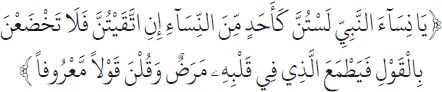
I say that what al-Wāḥidī says regarding roughness of voice is also mentioned by our companions. According to Shaykh Ibrāhīm al-Marwazī, one of our companions, [the best] way to roughen her voice is for her to put the back of her hand to her mouth and reply like that. And Allah knows best.
Al-Wāḥidī’s point about those unlawful to marry through their being in-laws being in the same case as non-relatives is weak and contradicts what is well-known among our colleagues, because they are like those who are unlawful by way of kinship as regards looking at them and being in seclusion with them. As for the Mothers of the Believers, they are only sacrosanct in virtue of marriage to them being unlawful as well as the obligation to respect them. Hence, marriage to their daughters is p
ermitted. And Allah knows best.
References
[1] Qur’ān 33:32.