
ANY MUSLIM MAN who is not known for sin or innovation may greet and be greeted. It is Sunnah to greet him and it is wājib for him to reply. Our [Shāfi‘ī] colleagues say that a woman with other women is like a man with other men. Imam Abū Sa‘d al-Mutawallī said about a woman [greeting] a man: “If she is his wife or female servant or a woman whom he is not allowed to marry, then the same ruling applies with her as with men greeting him. It is mustaḥabb for either of them to initiate the greeting and it is wājib for the other to reply. If she is a stranger, and she is beautiful and there is fear of temptation, a man should not greet her. If he does greet her, it is not permissible for her to answer him. She should not greet him, and if she does she is not entitled to a reply. If he answers her it will be makrūh. If she is an old woman whom he will not be tempted by, it is permissible for a man to greet her and for a man to answer her greeting.
I say that if the women are in a group and a man greets them, or there are many men and they greet one woman, it is permissible. This applies if there is no fear of temptation.
We relate in the Sunans of Abū Dāwūd, at-Tirmidhī and Ibn Mājah that Asmā’ bint Yazīd  narrated: “The Messenger of Allah
  passed by us, among some women, and he greeted us.” [1].At-Tirmidhī says that this is a ḥasan hadith. What I have just quoted is the narration of Abū Dāwūd. According to the report in at-Tirmidhī, [Asmā’] said: “One day the Messenger of Allah passed by in the mosque while a group of women were sitting there, and he gestured with his hand in greeting.”
narrated: “The Messenger of Allah passed by us, among some women, and he greeted us.” [1].At-Tirmidhī says that this is a ḥasan hadith. What I have just quoted is the narration of Abū Dāwūd. According to the report in at-Tirmidhī, [Asmā’] said: “One day the Messenger of Allah passed by in the mosque while a group of women were sitting there, and he gestured with his hand in greeting.”We relate in the Book of Ibn as-Sunnī that Jarīr ibn ‘Abdullāh  reported that the Messenger of Allah passed by some women and he greeted them. [2].
reported that the Messenger of Allah passed by some women and he greeted them. [2].We relate in the Ṣaḥīḥ of al-Bukhārī that Sahl ibn Sa‘d said: “There was a woman among us” (and in another report, “We had an old lady”) “who took chard roots and put them in a pot and ground grains of barley [with them]. When we had performed the ṣalāh of Jumu‘ah we went and greeted her and she offered it to us.” [3].
said: “There was a woman among us” (and in another report, “We had an old lady”) “who took chard roots and put them in a pot and ground grains of barley [with them]. When we had performed the ṣalāh of Jumu‘ah we went and greeted her and she offered it to us.” [3].We relate in the Ṣaḥīḥ of Muslim that Umm Hānī bint Abī Ṭālib reported: “I came to the Prophet on the day of the Conquest of Makkah while he was bathing and Fāṭimah was screening him. I greeted him.” She related the whole hadith. [4].
reported: “I came to the Prophet on the day of the Conquest of Makkah while he was bathing and Fāṭimah was screening him. I greeted him.” She related the whole hadith. [4].REPLYING TO NON-MUSLIM SUBJECTS OF A MUSLIM POLITY AND MENTION OF SOME RELATED ISSUES
Our [Shāfi‘ī] colleagues differ with regard to non-Muslim subjects of a Muslim polity. The majority are of the opinion that it is not permissible to initiate the greeting of peace with them. Others hold that it is not ḥarām but makrūh. If they greet a Muslim, then he should say in reply to them: ‘And upon you,’ without adding to this.

Wa ‘alaykum.
Al-Māwardī mentions another opinion of our colleagues: that it is permissible to initiate the greeting with them, but the one who greets should restrict himself to saying: ‘Peace be upon you’ using the singular and not the plural.

As-salāmu ‘alayk.
Al-Māwardī mentions another opinion: that one should say in reply to them ‘And on you be peace,’ but should not say: ‘And the mercy of Allah.’ I say: ‘These two opinions are uncommon and are to be rejected.’
We relate in the Ṣaḥīḥ of al-Bukhārī that Abū Hurayrah narrated that the Messenger of Allah said: “Do not start greeting the Jews and the Christians with peace, and if you meet any of them on the street then force them to the narrowest part of the street.” [5].
narrated that the Messenger of Allah said: “Do not start greeting the Jews and the Christians with peace, and if you meet any of them on the street then force them to the narrowest part of the street.” [5].We relate in the Ṣaḥīḥs of al-Bukhārī and Muslim that Anas related that the Messenger of Allah said: “If the People of the Book greet you then reply ‘And upon you.’” [6].
related that the Messenger of Allah said: “If the People of the Book greet you then reply ‘And upon you.’” [6].
Wa ‘alaykum.
We relate in the Ṣaḥīḥ of al-Bukhārī that Ibn ‘Umar  reported that the Messenger of Allah said: “When the Jews greet you they say: ‘May death be upon you’ [saying ‘death’ (sām) instead of ‘peace’ (salām)]; so say: ‘And upon you.’” [7].
reported that the Messenger of Allah said: “When the Jews greet you they say: ‘May death be upon you’ [saying ‘death’ (sām) instead of ‘peace’ (salām)]; so say: ‘And upon you.’” [7].
As-sāmu ‘alayk.
Wa ‘alayk.
Wa ‘alayk.
There are many hadiths like the ones we have mentioned regarding this question. And Allah knows best.
Imam Abū Sa‘d al-Mutawallī said: “If a man greets someone thinking that he is a Muslim and then it becomes clear that he is a disbeliever, it is mustaḥabb to ask him to disregard his greeting. The objective of this is to alienate him and to show him that there is no friendship between them. It is reported that Ibn ‘Umar greeted a man but then he was told that he was a Jew. He followed him and said to him: ‘Disregard my greeting.’” [8].
greeted a man but then he was told that he was a Jew. He followed him and said to him: ‘Disregard my greeting.’” [8].I say that it is reported in the Muwaṭṭā’ [9].of Imam Mālik that Mālik was asked whether a Muslim who has greeted a Jew or a Christian should ask him to consider the greeting unsaid, and he said: “No.” That is his school of thought, which Ibn al-‘Arabī chose. According to Imam Abū Sa‘d al-Mutawallī, if one wishes to greet a non-Muslim, he should do so without using the word ‘peace’. One should say: ‘May Allah guide you,’ or ‘May Allah favour your morning.’
I say that this there is no harm in using the greetings mentioned here by Abū Sa‘d al-Mutawallī when necessary, by saying “Good morning,” or “A blessed [morning]” or “A wholesome [morning]” or “May Allah give you a happy morning” or “happy and blessed” or “joyous”, and so on.
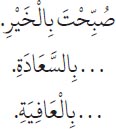
Ṣubbiḥta bi-l-khayr.
. . .bi-s-sa‘ādah.
. . .bi-l-‘āfiyah.
. . .bi-s-sa‘ādah.
. . .bi-l-‘āfiyah.
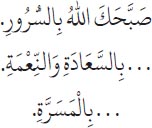
Ṣabbaḥaka-llāhu bi-s-surūr.
. . . bi-s-sa‘ādah wa-n-ni‘mah.
. . .bi-l-masarrah.
. . . bi-s-sa‘ādah wa-n-ni‘mah.
. . .bi-l-masarrah.
Otherwise, if one does not need to, the best position is not to say anything, because to do so would be to show them expansiveness and familiarity and to manifest a form of affection, whereas we are commanded to be tough on them and forbidden to love them, so one ought not to make a show of it; and Allah knows best.
GOING PAST DISBELIEVERS AMONG WHOM THERE ARE SOME MUSLIMS, IN WHICH CASE THE SUNNAH IS TO GREET THEM INTENDING THE MUSLIMS
If one person passes by a group in which there are Muslims, or one Muslim, together with disbelievers, it is Sunnah to greet them, directing it to the Muslims or Muslim.
We relate from the Ṣaḥīḥs of al-Bukhārī and Muslim that Usāmah ibn Zayd related that the Prophet passed by a gathering that was a mixture of Muslims, pagans, idol-worshippers and Jews, and the Prophet greeted them. [10].
related that the Prophet passed by a gathering that was a mixture of Muslims, pagans, idol-worshippers and Jews, and the Prophet greeted them. [10].WHAT A MUSLIM OUGHT TO WRITE IF HE ADDRESSES A LETTER TO AN IDOLATOR CONTAINING GREETINGS AND SUCHLIKE
If one writes a letter to an idolator with a greeting in it he should write along the following lines.
We relate in the Ṣaḥīḥs of al-Bukhārī and Muslim that in the hadith from Abū Sufyān about the story of Heraclius, he said that the Messenger of Allah wrote: “From Muḥammad, the slave and Messenger of Allah, to Heraclius, the Mighty [leader] of Rome. Peace be upon those who follow guidance.” [11].
about the story of Heraclius, he said that the Messenger of Allah wrote: “From Muḥammad, the slave and Messenger of Allah, to Heraclius, the Mighty [leader] of Rome. Peace be upon those who follow guidance.” [11].
Min Muḥammadin ‘Abdi-llāhi wa Rasūlih, ilā Hiraqla ‘aẓīmi-r-Rūm. Salāmun ‘alā mani-ttaba‘a-l-hudā. . ..
WHAT TO SAY WHEN VISITING A SICK NON-MUSLIM
Our colleagues disagree about visiting sick non-Muslims: some say that it is mustaḥabb, others that it is forbidden. Ash-Shāshī mentions the difference of opinion and then says: “The correct position in my view is that one should say that in general visiting a sick disbeliever is permissible. As an act of drawing near [to Allah] it is dependent on some kind of respect that is coupled with it, such as neighbourliness or their being a relative.”
We relate in the Ṣaḥīḥ of al-Bukhārī that Anas related that a Jewish boy who used to serve the Prophet became sick. The Prophet came to visit him. He sat by his head and said: “Embrace Islam.” He looked at his father, who was with him. He said: “Obey Abū al-Qāsim.” [The boy] embraced Islam. The Prophet went out saying: “All praise to Allah, Who has saved him from Hell-Fire.” [12].
related that a Jewish boy who used to serve the Prophet became sick. The Prophet came to visit him. He sat by his head and said: “Embrace Islam.” He looked at his father, who was with him. He said: “Obey Abū al-Qāsim.” [The boy] embraced Islam. The Prophet went out saying: “All praise to Allah, Who has saved him from Hell-Fire.” [12].We relate in the Ṣaḥīḥs of al-Bukhārī and Muslim that al-Muṣayyab, the father of Sa‘īd ibn al-Muṣayyab , related that when death came to Abū Ṭālib, the Messenger of Allah came to him and said: “O uncle, say: ‘There is no god but Allah.’” He then recounted the rest of the hadith. [13].
, related that when death came to Abū Ṭālib, the Messenger of Allah came to him and said: “O uncle, say: ‘There is no god but Allah.’” He then recounted the rest of the hadith. [13].I say that any Muslim visiting a sick non-Muslim ought to invite them to Islam and explain its benefits and advantages to them. He should urge them to embrace it before reaching a state in which repentance will not benefit them. If one prays for them, one should pray for their guidance and suchlike.
GREETING AN INNOVATOR OR SOMEONE WHO HAS COMMITTED A MAJOR WRONG ACTION BEFORE REPENTING OF IT
One ought not to greet or answer an innovator or a person who has committed a major sin but has not repented. That is the opinion of al-Bukhārī and others, for which he has adduced the following proof.
We relate in the two Ṣaḥīḥs that Ka‘b ibn Mālik , in his hadith about when he stayed behind from the expedition of Tabūk with his two companions, said: “The Messenger of Allah forbade people to talk to us.” He said: “I used to come to the Messenger of Allah and greet him, and ask myself: ‘Is he moving his lips in greeting or not?’” [14].
, in his hadith about when he stayed behind from the expedition of Tabūk with his two companions, said: “The Messenger of Allah forbade people to talk to us.” He said: “I used to come to the Messenger of Allah and greet him, and ask myself: ‘Is he moving his lips in greeting or not?’” [14].According to al-Bukhārī, ‘Abdullāh ibn ‘Amr said: “Do not greet anyone who drinks wine.” I say: “If one is forced to greet oppressors when going to see them, or because he fears for his worldly life, religion or some other thing if he does not greet them, then he should greet them.” According to the ‘ulamā’, he should intend ‘Peace’ as being one of the names of Allah  . His greeting would thus mean: ‘Allah is watching you.’
said: “Do not greet anyone who drinks wine.” I say: “If one is forced to greet oppressors when going to see them, or because he fears for his worldly life, religion or some other thing if he does not greet them, then he should greet them.” According to the ‘ulamā’, he should intend ‘Peace’ as being one of the names of Allah . His greeting would thus mean: ‘Allah is watching you.’IT IS SUNNAH TO GREET CHILDREN
As for children, it is Sunnah to greet them. We relate in the Ṣaḥīḥs of al-Bukhārī and Muslim that Anas passed by some children and greeted them, and said: “The Prophet used to do so.” According to a report in Muslim he said: “The Messenger of Allah passed by some children and greeted them.” [15].
passed by some children and greeted them, and said: “The Prophet used to do so.” According to a report in Muslim he said: “The Messenger of Allah passed by some children and greeted them.” [15].We relate in the Sunan of Abū Dāwūd and other sources as well, with isnāds of the two Ṣaḥīḥs, that Anas related that the Messenger of Allah passed by children who were playing and greeted them.”
related that the Messenger of Allah passed by children who were playing and greeted them.”And we relate in the book of Ibn as-Sunnī and elsewhere that [Anas] said: “He said, ‘Peace be upon you, children.’” [16].
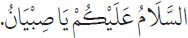
As-salāmu ‘alaykum yā ṣibyān.
References
[1] Abū Dāwūd (5204), at-Tirmidhī (2698), and Ibn Mājah (3701).
[2] Ibn as-Sunnī (224). According to Ibn Ḥajar this hadith is gharīb.
[3] Al-Bukhārī (6248).
[4] Muslim (336) and al-Bukhārī (280).
[5] Muslim (2167), Abū Dāwūd (5205), and at-Tirmidhī (2701).
[6] Al-Bukhārī (6258), Muslim (2163), Abū Dāwūd (5207), and at-Tirmidhī (3296).
[7] Al-Bukhārī (6258), Muslim (2164), al-Muwaṭṭa’ (2/960), Abū Dāwūd (5206), and at-Tirmidhī (1603).
[8] Al-Futūḥāt (5/344). Ibn Ḥajar mentions that this narration can be found in Shu‘ab al-īmān by al-Bayhaqī.
[9] Al-Muwaṭṭa’ (2/960).
[10] Al-Bukhārī (6254), Muslim (1798), and at-Tirmidhī (2701).
[11] Al-Bukhārī (7) and Muslim (1773).
[12] Al-Bukhārī (1356) and Abū Dāwūd (3095).
[13] Al-Bukhārī (3884), Muslim (24), and an-Nasā’ī (4/90–91).
[14] Al-Bukhārī (4418) and Muslim (2769).
[15] Al-Bukhārī (2647) and Muslim (2168).
[16] Abū Dāwūd (5202), an-Nasā’ī in ‘Amal al-yawm wa al-laylah (331), and Ibn as-Sunnī (226).