
KNOW THAT THE best greeting is to say: ‘Peace be upon you, and the mercy and blessings of Allah.’ One should use the plural even if the person greeted is alone. The one who replies should say: ‘And upon you be peace and the mercy and blessings of Allah.’ One should use the conjunction ‘and’.
One of those who stipulated that the best thing for the one initiating the greeting is to say ‘Peace be upon you, and the mercy and blessings of Allah’ was the Imam and most judicious of judges Abū al-Ḥasan al-Māwardī in his book al-Ḥāwī, in the Kitāb as-Siyar, as well as Imam Abū Sa‘d al-Mutawallī of our colleagues in Kitāb Ṣalāt al-Jumu‘ah as well as others. The evidence for it is that which we relate from the Musnad of ad-Dārimī and the Sunans of Abū Dāwūd and at-Tirmidhī, that ‘Imrān ibn al-Ḥuṣayn  said: “A man came to the Messenger of Allah
  and said: ‘Peace be upon you.’ He responded and then he sat down. The Prophet said: ‘Ten.’ Then another came and said: ‘Peace be upon you and the mercy of Allah.’ He responded to him and he sat down. The Prophet said: ‘Twenty.’ Then another came and said: ‘Peace be upon you and the mercy and blessings of Allah.’ He responded to him and he sat down. The Prophet said: ‘Thirty.’” At-Tirmidhī states that this is a ḥasan hadith.
said: “A man came to the Messenger of Allah and said: ‘Peace be upon you.’ He responded and then he sat down. The Prophet said: ‘Ten.’ Then another came and said: ‘Peace be upon you and the mercy of Allah.’ He responded to him and he sat down. The Prophet said: ‘Twenty.’ Then another came and said: ‘Peace be upon you and the mercy and blessings of Allah.’ He responded to him and he sat down. The Prophet said: ‘Thirty.’” At-Tirmidhī states that this is a ḥasan hadith.According to a report in Abū Dāwūd from Mu‘ādh ibn Anas  , another man came and said: “Peace be upon you, and the mercy, blessings and forgiveness of Allah.” He said: “Forty.” And he observed: “Such are the merits and rewards.” [1].
, another man came and said: “Peace be upon you, and the mercy, blessings and forgiveness of Allah.” He said: “Forty.” And he observed: “Such are the merits and rewards.” [1].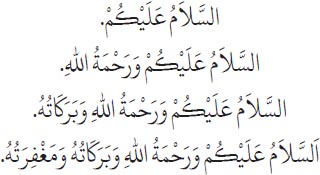
As-salāmu ‘alaykum.
As-salāmu ‘alaykum wa raḥmatu-llāh.
As-salāmu ‘alaykum wa raḥmatu-llāhi wa barakātuh.
As-salāmu ‘alaykum wa raḥmatu-llāhi wa barakātuhu wa maghfiratuh.
As-salāmu ‘alaykum wa raḥmatu-llāh.
As-salāmu ‘alaykum wa raḥmatu-llāhi wa barakātuh.
As-salāmu ‘alaykum wa raḥmatu-llāhi wa barakātuhu wa maghfiratuh.
We relate in the book of Ibn as-Sunnī, with a weak isnād, that Anas related that a man used to pass by the Prophet , herding the animals of his Companions, and say “Peace be upon you, Messenger of Allah,” and the Prophet would say to him: “And on you be peace and the mercy, blessings, forgiveness, and good pleasure of Allah.” Someone said: “You have greeted this person with a greeting with which you have not greeted any of your Companions.” He replied: “What is there to stop me from doing so, when he goes away with the reward of ten men or more?” [2].
related that a man used to pass by the Prophet , herding the animals of his Companions, and say “Peace be upon you, Messenger of Allah,” and the Prophet would say to him: “And on you be peace and the mercy, blessings, forgiveness, and good pleasure of Allah.” Someone said: “You have greeted this person with a greeting with which you have not greeted any of your Companions.” He replied: “What is there to stop me from doing so, when he goes away with the reward of ten men or more?” [2].
Wa raḥmatu-llāhi wa barakātuhu wa maghfiratuhu wa riḍwānuh.
I say: “According to our [Shāfi‘ī] colleagues, if the one who initiates the greeting says as-salāmu ‘alaykum, ‘Peace be upon you,’ the greeting is complete. If a person says as-salāmu ‘alayk or salāmu ‘alayk it will also be complete. The minimum reply is wa ‘alaykumu-s-salām or Wa ‘alayka-s-salām. If one leaves out the ‘and’ it will suffice as a reply. This is the correct position, as Imam ash-Shāfi‘ī has written in al-Umm. The majority of our colleagues have adopted this position. Abū Sa‘d al-Mutawallī of our colleagues was insistent in his book at-Tatimmah that it does not discharge his duty and it is not a reply; but this is weak or wrong, and it contradicts the Book and the Sunnah and the stated position of our Imam, ash-Shāfi‘ī.
As for the Scripture, Allah  says: “They said ‘Peace’; he said ‘Peace’.” That was the practice for those before us, and our religious text confirms this. This is the hadith from Abū Hurayrah which we cited earlier about the reply of the angels to Adam. The Prophet informed us that “It is your greeting and the greeting of your progeny”; and this Community (Ummah) is descended from his progeny. And Allah knows best.
says: “They said ‘Peace’; he said ‘Peace’.” That was the practice for those before us, and our religious text confirms this. This is the hadith from Abū Hurayrah which we cited earlier about the reply of the angels to Adam. The Prophet informed us that “It is your greeting and the greeting of your progeny”; and this Community (Ummah) is descended from his progeny. And Allah knows best.Our colleagues agree that if one says ‘alaykum it does not suffice as a reply. If one says wa ‘alaykum, with the ‘and’, does it suffice as a reply? Our colleagues have two opinions. If the one who initiates the greeting greets with the definite article or without it, then the one who replies may reply with either form. I say, however, that the definite article is more appropriate.
EXPLANATION OF THE MEANING OF THAT WHICH IS TRANSMITTED IN A ṢĀḤĪḤ FASHION FROM HIM , THAT HE USED TO REPEAT THE GREETING OF PEACE THREE TIMES
We relate in the Ṣaḥīḥ of al-Bukhārī that Anas reported that when the Prophet made a statement he repeated it thrice to ensure it was understood, and when he came to a group of people he greeted them thrice. [3].
reported that when the Prophet made a statement he repeated it thrice to ensure it was understood, and when he came to a group of people he greeted them thrice. [3].I say: “This hadith should be taken to mean that that was when the gathering was a large one. An explanation of this case will be presented, as will the words of al-Māwardī, the author of al-Ḥāwī, about it, if Allah wills.
EXPLANATION OF WHAT ARE THE MINIMAL GREETING AND ITS RESPONSE, AND WHAT IS MUSTAḤABB
The minimum greeting by which the Sunnah is fulfilled is that a person should raise his voice enough for those being greeted to hear him. If he does not make them hear, then he is not considered to have given the greeting, and it is not compulsory to reply to him. The minimum by which the obligation to reply is fulfilled is that a person should raise his voice enough for the one who greeted first to hear him. If he does not ensure that he hears it, he has not fulfilled the obligation to reply.
I say: “It is mustaḥabb to raise one’s voice so that it is certain that the person or people greeted have heard; if one doubts that they have heard, he should raise his voice more. When greeting people who are awake while there are others with them who are asleep, it is Sunnah to lower one’s voice so that those who are awake may hear him but he does not wake up those who are asleep.”
We relate in the Ṣaḥīḥ of Muslim that al-Miqdād narrated, in a long hadith: “We used to bring the Prophet his share of milk. He would come at night and greet us in such a way that he did not wake up those who were sleeping, but was heard by those who were awake. Sleep did not come to me but my two companions were asleep. The Prophet came and greeted us as he used to.” [4].
narrated, in a long hadith: “We used to bring the Prophet his share of milk. He would come at night and greet us in such a way that he did not wake up those who were sleeping, but was heard by those who were awake. Sleep did not come to me but my two companions were asleep. The Prophet came and greeted us as he used to.” [4].EXPLANATION THAT IT IS STIPULATED THAT ONE MUST RETURN THE GREETING IMMEDIATELY
According to Imam Abū Muḥammad, the Qāḍī Ḥusayn, Imam Abū al-Ḥasan al-Wāḥidī, and some other colleagues of ours, it is mandatory to answer immediately. If one delays in responding, it is not considered a reply, and one will be sinning for omitting the greeting.
References
[1] Ad-Dārimī (2/277), Abū Dāwūd (5195), and at-Tirmidhī (2690).
[2] Ibn as-Sunnī (234) and al-Futūḥāt (5/292–293). Ibn Ḥajar cites supporting narrations for this hadith which confirm its meaning.
[3] Al-Bukhārī (94) and at-Tirmidhī (2724).
[4] Muslim (2055) and at-Tirmidhī (2720).