
WE RELATE FROM the Ṣaḥīḥ of al-Bukhārī from Abū Umāmah  that when the Prophet
  removed his table [because people had finished eating] he would recite: [1].
that when the Prophet removed his table [because people had finished eating] he would recite: [1].
Al-ḥamdu li-llāhi kathīran ṭayyibā, mubārakan fīh, ghayra makfiyyin wa lā muwadda‘, wa lā mustaghnan ‘anh, Rabbanā.
Another version states that when he had finished his meal—and he once said it while removing his table, “Praise belongs to Allah Who has sufficed us and slaked our thirst unsufficed and unrejected.”

Al-ḥamdu li-llāhi-lladhī kafānā wa arwānā, ghayra makfiyyin wa lā makfūr.
I say: makfiyy, with fatḥah on the letter mīm and with a doubled yā’, is the correct and clear narration. Most narrators narrate it with the hamzah, but this is incorrect in the Arabic language, whether it is derived from [the words] kifāyah ‘sufficiency’ or kafa’tu-l-inā’, ‘I overturned the vessel’. In the same way, one cannot say maqrī’ for maqrū’ from qirā’ah, nor marmī’ for the word marmiyy, both with hamzah.
The author of Maṭāli‘ al-anwār, in his explanation of the hadith, says that all of this statement is concerned with food; and that is what the pronoun refers to.
According to al-Ḥarbī, makfiyy means a vessel that is upturned because there is no need for it, as he said ‘not free of need for it’, or because of the lack of it. And the words ‘not shown ingratitude’ means not denying the blessings of Allah  in it but showing gratitude, not withholding acknowledgement of them and praise for them.
in it but showing gratitude, not withholding acknowledgement of them and praise for them.Al-Khaṭṭābī holds the view that what is intended by all of this du‘ā’ is the Maker and so the pronoun refers back to Him; and that ghayr makfiyy means that He feeds but is not fed—an interpretation apparently based on the root meaning of kifāyah, ‘sufficiency’. Others have also held to this explanation of the hadith, i.e. that Allah has no need of any helper or assistant. According to al-Khaṭṭābī the meaning of lā muwadda‘ is ‘not discarding seeking from Him nor the desire for Him’; and this also has the meaning of [not] being free of Him.
and so the pronoun refers back to Him; and that ghayr makfiyy means that He feeds but is not fed—an interpretation apparently based on the root meaning of kifāyah, ‘sufficiency’. Others have also held to this explanation of the hadith, i.e. that Allah has no need of any helper or assistant. According to al-Khaṭṭābī the meaning of lā muwadda‘ is ‘not discarding seeking from Him nor the desire for Him’; and this also has the meaning of [not] being free of Him.Rabbanā is in the naṣb (accusative) case according to this, in the sense of singling out and praise, or in the vocative [O our Lord]: it is as if he was saying, ‘O our Lord, hear our praise and our du‘ā’.’ Those who put it in the raf‘ (nominative) case (Rabbunā) isolate it and make it a predicate, which is how al-Aṣīlī restricted it, as if one were saying, ‘That is our Lord’, or ‘You are our Lord’. It is also sound to use kasrah [Rabbinā] in apposition for the Name in the words, ‘Praise belongs to Allah . . . [our Lord]’.
Abū as-Sa‘ādāt Ibn al-Athīr mentions in Nihāyat al-gharīb something similar to this difference of opinion in summary form: “If one puts ‘our Lord’ in the nominative case (Rabbunā), then it is as a subject delayed to the end, meaning: ‘Our Lord is not sufficed and not taken leave of. . .’, making ghayru in the nominative case as well.” He also says: “The statement can also refer back to the word ‘praise’ (al-ḥamd) as if one were to say: ‘. . .much praise, that is not sufficient, or taken leave of, or free from any need of this praise’”.
[Ibn al-Athīr] adds: “‘And not taken leave of (muwadda‘)’ means ‘without leaving obedience’; it is said that this is from the word al-wadā‘ (farewell), to which it refers. And Allah knows best.”
And we relate from the Ṣaḥīḥ of Muslim that Anas reported that the Messenger of Allah said: “Allah loves it when His servant eats food and praises Him for it, and when he drinks and praises Him for it.” [2].
reported that the Messenger of Allah said: “Allah loves it when His servant eats food and praises Him for it, and when he drinks and praises Him for it.” [2].We relate in the Sunan of Abū Dāwūd and the books al-Jāmi‘ and ash-Shamā’il of at-Tirmidhī, that Abū Sa‘īd al-Khudrī narrated that when the Prophet finished eating he said: “Praise be to Allah, Who has fed us and given us to drink and made us Muslims.” [3].
narrated that when the Prophet finished eating he said: “Praise be to Allah, Who has fed us and given us to drink and made us Muslims.” [3].
Al-ḥamdu li-llāhi-lladhī aṭ‘amanā wa saqānā wa ja‘alanā Muslimīn.
We relate in the Sunans of Abū Dāwūd and an-Nasā’ī, with ṣaḥīḥ isnāds, that Abū Ayyūb Khālid ibn Zayd al-Anṣārī reported that when the Messenger of Allah ate and drank he said: “Praise be to Allah, Who has provided [food and drink], made it easy to swallow, and made a way out for it.” [4].
reported that when the Messenger of Allah ate and drank he said: “Praise be to Allah, Who has provided [food and drink], made it easy to swallow, and made a way out for it.” [4].
Al-ḥamdu li-llāhi-lladhī aṭ‘ama wa saqā, wa sawwaghahu wa ja‘ala lahu makhrajā.
We relate in the Sunans of Abū Dāwūd, at-Tirmidhī and Ibn Mājah that Mu‘ādh ibn Anas reported that the Messenger of Allah said: “Whoever eats food and says: Praise be to Allah, Who has fed me this and provided me with it without any power and might from me, his past sins will be forgiven.” [5].
reported that the Messenger of Allah said: “Whoever eats food and says: Praise be to Allah, Who has fed me this and provided me with it without any power and might from me, his past sins will be forgiven.” [5].
Al-ḥamdu li-llāhi-lladhī aṭ‘amanī hādhā wa razaqanīhi min ghayri ḥawlin minnī wa lā quwwah.
We relate in the Sunans of an-Nasā’ī and the book of Ibn as-Sunnī, with a ḥasan isnād, that ‘Abd ar-Raḥmān ibn Jubayr the Tābi‘ī stated that a man who served the Prophet for eight years told him that he heard the Prophet say, when food was brought to him: “In the name of Allah,” and when he had finished: “O Allah, You have fed and given to drink, You have freed from need, and You have relieved us, guided us, and revived us. So to You be all praise for what You have granted.” [6].
for eight years told him that he heard the Prophet say, when food was brought to him: “In the name of Allah,” and when he had finished: “O Allah, You have fed and given to drink, You have freed from need, and You have relieved us, guided us, and revived us. So to You be all praise for what You have granted.” [6].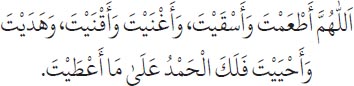
Allāhumma aṭ‘amta wa asqayt, wa aghnayta wa aqnayt, wa hadayta wa aḥyayt, fa-laka-l-ḥamdu ‘alā mā a‘ṭayt.
We relate in the book of Ibn as-Sunnī that ‘Abdullāh ibn ‘Amr ibn al-‘Āṣ  reported that the Prophet used to say when he finished his food: “Praise be to Allah, Who has favoured and guided us and satisfied our hunger and our thirst, and bestowed every kindness upon us.” [7].
reported that the Prophet used to say when he finished his food: “Praise be to Allah, Who has favoured and guided us and satisfied our hunger and our thirst, and bestowed every kindness upon us.” [7].
Al-ḥamdu li-llāhi-lladhī manna ‘alaynā wa hadānā, wa-lladhī ashba‘anā wa awrānā, wa kulla-l-iḥsāni ātānā.
We relate in the Sunans of Abū Dāwūd and at-Tirmidhī as well as the book of Ibn as-Sunnī that Ibn ‘Abbās reported that the Messenger of Allah said: “If any one of you eats food”—and in a narration by Ibn as-Sunnī “If Allah gives any one of you food”—“he should say: O Allah, bless us in it and give us better than it to eat. And anyone to whom Allah gives milk to drink should say: Allah, bless us in it and increase it for us; for there is nothing but milk that suffices both as a food and a drink in satiating hunger.” [8].At-Tirmidhī endorsed this hadith as ḥasan.
reported that the Messenger of Allah said: “If any one of you eats food”—and in a narration by Ibn as-Sunnī “If Allah gives any one of you food”—“he should say: O Allah, bless us in it and give us better than it to eat. And anyone to whom Allah gives milk to drink should say: Allah, bless us in it and increase it for us; for there is nothing but milk that suffices both as a food and a drink in satiating hunger.” [8].At-Tirmidhī endorsed this hadith as ḥasan.
Allāhumma bārik lanā fīhi wa aṭ‘imnā khayran minh.
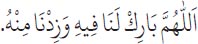
Allāhumma bārik lanā fīhi wa zidnā minh.
We relate in the book of Ibn as-Sunnī, with a weak isnād, that ‘Abdullāh ibn Mas‘ūd reported that when the Messenger of Allah drank from a vessel he would take three breaths [afterwards]; he praised Allah with every breath and thanked Him at the end. [9].
reported that when the Messenger of Allah drank from a vessel he would take three breaths [afterwards]; he praised Allah with every breath and thanked Him at the end. [9].References
[1] We omit the translation at this point since in the author’s explanation which follows there are several possible interpretations.
[2] Muslim (2734).
[3] Abū Dāwūd (3850), at-Tirmidhī (3453), and Ibn Mājah (3283). Ibn Ḥajar grades this hadith as ḥasan.
[4] Abū Dāwūd (3851) and An-Nasā’ī (285). Ibn Ḥajar grades this hadith as ṣaḥīḥ.
[5] Abū Dāwūd (4023), at-Tirmidhī (3454), and Ibn Mājah (3285).
[6] Ibn as-Sunnī (466). Ibn Ḥajar grades this hadith as ṣaḥīḥ.
[7] Ibn as-Sunnī (467). Ibn Ḥajar cites some other narrations which strengthen this hadith.
[8] Abū Dāwūd (3730), at-Tirmidhī (3451), Ibn as-Sunnī (475), and an-Nasā’ī (286).
[9] Ibn as-Sunnī (472).