
WE RELATE FROM the Ṣaḥīḥs of al-Bukhārī and Muslim that ‘Umar ibn Abī Salamah  related: “The Messenger of Allah
  told me: ‘Mention the name of Allah and eat with your right hand.’” [1].
related: “The Messenger of Allah told me: ‘Mention the name of Allah and eat with your right hand.’” [1].We relate in the Sunans of Abū Dāwūd and at-Tirmidhī that ‘Ā’ishah  reported that the Messenger of Allah said: “When any one of you eats, he should mention the name of Allah at the beginning; and if he forgets to mention Allah at the beginning, he should say: ‘In the name of Allah’ at the beginning and the end of it.” [2].At-Tirmidhī described this hadith as ḥasan ṣaḥīḥ.
reported that the Messenger of Allah said: “When any one of you eats, he should mention the name of Allah at the beginning; and if he forgets to mention Allah at the beginning, he should say: ‘In the name of Allah’ at the beginning and the end of it.” [2].At-Tirmidhī described this hadith as ḥasan ṣaḥīḥ.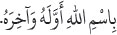
Bismi-llāhi awwalahu wa ākhirah.
We relate in the Ṣaḥīḥ of Muslim that Jābir related that he heard the Messenger of Allah say: “When a man enters his home and remembers Allah  on entering and on eating, Shayṭān says: ‘There is no lodging or supper for you.’ If he enters and does not remember Allah , Shayṭān says: ‘You have found lodging for the night.’ If he does not remember Allah on eating he says: ‘You have found lodging and supper.’” [3].
related that he heard the Messenger of Allah say: “When a man enters his home and remembers Allah on entering and on eating, Shayṭān says: ‘There is no lodging or supper for you.’ If he enters and does not remember Allah , Shayṭān says: ‘You have found lodging for the night.’ If he does not remember Allah on eating he says: ‘You have found lodging and supper.’” [3].We also relate from the Ṣaḥīḥ of Muslim that Anas narrated a hadith about one of the manifest miracles of the Messenger of Allah , [which occurred] when Abū Ṭalḥah and Umm Sulaym invited him [to eat]. The Prophet said: “Give permission for ten.” Permission was granted and they entered. The Prophet said: “Eat and mention the name of Allah .” They ate until he had done the same for eighty men. [4].
narrated a hadith about one of the manifest miracles of the Messenger of Allah , [which occurred] when Abū Ṭalḥah and Umm Sulaym invited him [to eat]. The Prophet said: “Give permission for ten.” Permission was granted and they entered. The Prophet said: “Eat and mention the name of Allah .” They ate until he had done the same for eighty men. [4].We also relate from the Ṣaḥīḥ of Muslim that Ḥudhayfah narrated: “When we partook of food with the Messenger of Allah we did not lay our hands on it until the Messenger of Allah had put his hand on it. Once, we partook of food with him and a young girl came as if pushed forward. She started to put her hand in the food, and the Messenger of Allah took her hand [away]. Then a Bedouin came as if pushed forward, and he [the Messenger of Allah ] took his hand [away]. Then the Messenger of Allah said: ‘Shayṭān makes food lawful for himself if the name of Allah is not mentioned on it. He brought this young girl to make the food lawful [for himself], but I took hold of her hand. Then he brought this Bedouin to make the food lawful [for himself], but I took his hand. I swear by the One Who holds my life in His hands that [Shayṭān’s] hand is in my hand with their hands.’ Then he mentioned the name of Allah and ate.” [5].
narrated: “When we partook of food with the Messenger of Allah we did not lay our hands on it until the Messenger of Allah had put his hand on it. Once, we partook of food with him and a young girl came as if pushed forward. She started to put her hand in the food, and the Messenger of Allah took her hand [away]. Then a Bedouin came as if pushed forward, and he [the Messenger of Allah ] took his hand [away]. Then the Messenger of Allah said: ‘Shayṭān makes food lawful for himself if the name of Allah is not mentioned on it. He brought this young girl to make the food lawful [for himself], but I took hold of her hand. Then he brought this Bedouin to make the food lawful [for himself], but I took his hand. I swear by the One Who holds my life in His hands that [Shayṭān’s] hand is in my hand with their hands.’ Then he mentioned the name of Allah and ate.” [5].We relate in the Sunans of Abū Dāwūd and an-Nasā’ī that Umayyah ibn Makhshī, a Companion, said: “The Messenger of Allah was sitting while a man was eating. He did not mention the name of Allah until just one morsel of his food remained. When he raised it to his mouth he said: ‘In the name of Allah at the beginning and the end of it.’ The Messenger of Allah smiled then said: ‘Shayṭān kept on eating with him, but when he mentioned the name of Allah, Shayṭān threw up what was in his belly.’”
said: “The Messenger of Allah was sitting while a man was eating. He did not mention the name of Allah until just one morsel of his food remained. When he raised it to his mouth he said: ‘In the name of Allah at the beginning and the end of it.’ The Messenger of Allah smiled then said: ‘Shayṭān kept on eating with him, but when he mentioned the name of Allah, Shayṭān threw up what was in his belly.’”I say: Makhshī has fatḥah on the letter mīm with no vowel on the khā’, kasrah on the letter shīn, and a doubled yā’. This hadith suggests that the Prophet did not know until the end that the man had not remembered the name of Allah, for if he had known he would not have refrained from telling him to mention Allah. [6].
did not know until the end that the man had not remembered the name of Allah, for if he had known he would not have refrained from telling him to mention Allah. [6].We relate in the book of at-Tirmidhī that ‘Ā’ishah related that the Messenger of Allah was once eating food with six of his Companions when a Bedouin came and ate it in two morsels. The Messenger of Allah said: “If he had mentioned [Allah], it would have been enough for you all.” [7].According to at-Tirmidhī, this hadith is ḥasan ṣaḥīḥ.
related that the Messenger of Allah was once eating food with six of his Companions when a Bedouin came and ate it in two morsels. The Messenger of Allah said: “If he had mentioned [Allah], it would have been enough for you all.” [7].According to at-Tirmidhī, this hadith is ḥasan ṣaḥīḥ.We relate from Jābir , from the Prophet who said: “Whoever forgets to make remembrance of Allah while eating, let him recite, ‘Say, He is Allah, One’ when he finishes’”.
, from the Prophet who said: “Whoever forgets to make remembrance of Allah while eating, let him recite, ‘Say, He is Allah, One’ when he finishes’”.I say that the ‘ulamā’ agree as to the desirability of mentioning the name of Allah when beginning to eat. If one leaves it out at the beginning, intentionally, unintentionally or because of coercion or some other impediment and then he is able to do it while eating, it is mustaḥabb for him to mention the name of Allah. This is because of the hadith mentioned earlier. One should say In the name of Allah at the beginning and the end of it as is narrated in the hadith. Invoking the name of Allah when drinking water, milk, honey, soup or other drinks is as desirable as when eating. The ‘ulamā’ say that it is mustaḥabb to mention the name of Allah aloud, so that it may be a reminder for others to say the name and in order that one may be imitated in doing so. And Allah knows best.
IN CONCLUSION: SOME RULINGS RELATING TO MENTIONING THE NAME OF ALLAH OVER FOOD
The most important thing to know about the tasmiyah, [8].and the amount that is adequate, is that the best thing is to say: In the name of Allah, the Beneficent, the Merciful. If one says In the name of Allah, that will suffice, and he will have fulfilled the Sunnah. This applies even if that person is in a state of major ritual impurity, menstruating, or suchlike. All those who eat should remember Allah. And I have mentioned that in my Kitāb aṭ-Ṭabaqāt, in the biographical notice of ash-Shāfi‘ī, may Allah have mercy on him. It resembles the greeting of salām and responding to a person who sneezes, in the sense that if one of a group remembers Allah it suffices for the rest.
References
[1] Al-Bukhārī (5376), Muslim (2022), Al-Muwaṭṭa’ (2/934) Abū Dāwūd (3777), at-Tirmidhī (1858), Ibn Mājah (3267) and an-Nasā’ī (278).
[2] Abū Dāwūd (3767) and at-Tirmidhī (1859). Ibn Ḥajar grades it as ḥasan.
[3] Muslim (2018) and Abū Dāwūd (3765).
[4] Muslim (2040).
[5] Muslim (2017), Abū Dāwūd (3766), an-Nasā’ī (273), and Ibn as-Sunnī (460).
[6] Abū Dāwūd (3768), an-Nasā’ī (282), Aḥmad (4/336), and al-Ḥākim (4/108), who grades it as ṣaḥīḥ ; adh-Dhahabī agrees.
[7] At-Tirmidhī (1859).
[8] Tasmiyah means saying the name of Allah.