
WE HAVE ALREADY mentioned what one should say when leaving the house to go anywhere. When a person leaves to go to the mosque it is mustaḥabb to add the following.
We relate in the Ṣaḥīḥ of Muslim the long hadith of Ibn ‘Abbās  about a night he spent in the house of his aunt Maymūnah
  . He mentions the hadith about the Tahajjud prayer of the Messenger
  and says: “The mu’adhdhin called the adhān for Ṣubḥ, and he went out to the mosque saying: ‘O Allah, put light in my heart, light in my tongue, light in my hearing, and light in my sight. Put light behind me and put light in front of me. Put light above me and put light beneath me. O Allah, grant me light.’” [1].
about a night he spent in the house of his aunt Maymūnah . He mentions the hadith about the Tahajjud prayer of the Messenger and says: “The mu’adhdhin called the adhān for Ṣubḥ, and he went out to the mosque saying: ‘O Allah, put light in my heart, light in my tongue, light in my hearing, and light in my sight. Put light behind me and put light in front of me. Put light above me and put light beneath me. O Allah, grant me light.’” [1].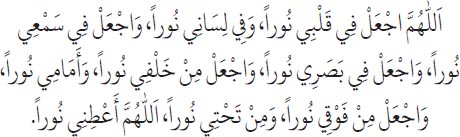
Allāhumma-j‘al fī qalbī nūrā, wa fī lisānī nūrā, wa-j‘al fī sam‘ī nūrā, wa-j‘al fī baṣarī nūrā, wa-j‘al min khalfī nūrā, wa amāmī nūrā, wa-j‘al min fawqī nūrā, wa min taḥtī nūrā, Allāhumma a‘ṭinī nūrā.
We relate in the book of Ibn as-Sunnī that Bilāl reported that when the Messenger of Allah went out to ṣalāh he would say: “In the name of Allah. I believe in Allah, I trust in Allah, there is no power and no strength except by Allah. O Allah, by the right that supplicants have over You and by the right of my going out now, I have not gone out in arrogance or pride, or for show and pomp. I have gone out seeking Your pleasure and to ward off Your wrath. I ask You to protect me from Hell-Fire and let me enter Paradise.” [2].This hadith is weak. One of the narrators, al-Wāzi‘ ibn Nāfi‘ al-‘Uqaylī, is agreed by all to be so weak as to be rejected in hadith transmissions.
reported that when the Messenger of Allah went out to ṣalāh he would say: “In the name of Allah. I believe in Allah, I trust in Allah, there is no power and no strength except by Allah. O Allah, by the right that supplicants have over You and by the right of my going out now, I have not gone out in arrogance or pride, or for show and pomp. I have gone out seeking Your pleasure and to ward off Your wrath. I ask You to protect me from Hell-Fire and let me enter Paradise.” [2].This hadith is weak. One of the narrators, al-Wāzi‘ ibn Nāfi‘ al-‘Uqaylī, is agreed by all to be so weak as to be rejected in hadith transmissions.We also relate the same meaning from the book of Ibn as-Sunnī in ‘Aṭiyyah al-‘Awfī’s narration from Abū Sa‘īd al-Khudrī from the Messenger of Allah . ‘Aṭiyyah, too, is regarded as weak.
from the Messenger of Allah . ‘Aṭiyyah, too, is regarded as weak.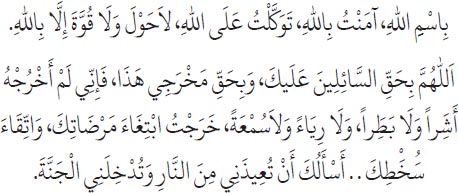
Bismi-llāh, āmantu bi-llāh, tawakkaltu ‘ala-llāh, lā ḥawla wa lā quwwata illā bi-llāh.
Allāhumma bi-ḥaqq-s-sā’ilīna ‘alayk, wa bi-ḥaqqi makhrajī hādhā, fa innī lam akhrujhu asharan wa lā baṭarā, wa lā riyā’an wa lā sum‘ah, kharajtu-btighā’a marḍātik, wa-ttiqā‘a sakhaṭik, as’aluka an tu‘īdhanī mina-n-Nāri wa tudkhilani-l-Jannah.
References
[1] Muslim (763), Abū Dāwūd (58), and an-Nasā’ī (2/218).
[2] Ibn as-Sunnī (83) and al-Futūḥāt (2/40–41). Ibn Ḥajar mentions a similar narration from Abū Sa‘īd al-Khudrī, reported by Ibn as-Sunnī (84), who states that it is a ḥasan hadith reported by Aḥmad, Ibn Mājah, Ibn Khuzaymah in Kitāb at-Tawḥīd, and Abū Nu‘aym al-Aṣbahānī.