
WE RELATE FROM the Ṣaḥīḥ of Muslim as well as the Muwaṭṭa’ of Mālik, and at-Tirmidhī and others that Khawlah bint Ḥākim  reported: “I heard the Messenger of Allah
  say: “Whoever dismounts at a place and then says I seek protection in the perfect words of Allah from the evil of what He has created, nothing will harm him until he sets off again from that place.” [1].
reported: “I heard the Messenger of Allah say: “Whoever dismounts at a place and then says I seek protection in the perfect words of Allah from the evil of what He has created, nothing will harm him until he sets off again from that place.” [1].
A‘ūdhu bi-kalimāti-llāhi-t-tāmmāti min sharri mā khalaq.
We relate in the Sunan of Abū Dāwūd and others that ‘Umar ibn al-Khaṭṭāb  reported: “When the Prophet of Allah was travelling he would say, when night was approaching: ‘O Earth, my Lord and yours is Allah. I seek protection in Allah from your evil and the evil that is in you, and the evil that has been created in you, and the evil of that which crawls on you. I seek protection in Allah from lions, black things, snakes, scorpions, and the inhabitants of the land, parents and offspring alike.’” [2].
reported: “When the Prophet of Allah was travelling he would say, when night was approaching: ‘O Earth, my Lord and yours is Allah. I seek protection in Allah from your evil and the evil that is in you, and the evil that has been created in you, and the evil of that which crawls on you. I seek protection in Allah from lions, black things, snakes, scorpions, and the inhabitants of the land, parents and offspring alike.’” [2].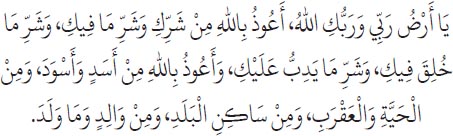
Yā arḍu Rabbī wa Rabbuki-llāh. A‘ūdhu bi-llāhi min sharriki wa sharri mā fīk, wa sharri mā khuliqa fīk, wa sharri mā yadibbu ‘alayk, wa a‘ūdhu bi-llāhi min asadin wa aswad, wa min al-ḥayyati wa-l-‘aqrab, wa min sākini-l-balad, wa min wālidin wa mā walad.
Al-Khaṭṭābī said that ‘the inhabitants of the land’ means the jinns that dwell on and inhabit the earth, as well as the regions of the earth. Creatures have dwellings, even those that have no building or house. He [also] said that ‘father’ can sometimes mean Iblīs and ‘son’ can sometimes mean Shayṭān. Those are al-Khaṭṭābī’s words.
The word aswad means an individual. Any individual can be called aswad [i.e. they need not be dark-skinned].
We relate in the book of Ibn as-Sunnī that Anas said: ‘Whenever we set out, we used to say tasbīḥ until we halted on our journey”.
said: ‘Whenever we set out, we used to say tasbīḥ until we halted on our journey”.References
[1] Muslim (2708), Malik (2/978), and at-Tirmidhī (3433).
[2] Abū Dāwūd (2603), an-Nasā’ī (563) in ‘Amal al-yawm wa al-laylah, and al-Futūḥāt (5/146). Ibn Ḥajar grades this hadith as ṣaḥīḥ.