
WE RELATE FROM the books of at-Tirmidhī and Ibn Mājah, from ‘Abdullāh ibn Abī ‘Awfā  , who reported that the Messenger of Allah
  said: “Whoever has need of anything from Allah
  or from any human being should do wuḍū’ as perfectly as possible. After that he should perform two rak‘ahs of ṣalāh. Next he should praise Allah and invoke blessings upon the Prophet . Then he should say: There is no god but Allah, the Forbearing, the Most Generous. Glory be to Allah, Lord of the Exalted Throne. Praise be to Allah, Lord of the Worlds. I ask You for that which evokes Your Mercy, for deeds which bring about Your forgiveness, for the benefit of complete piety, and for safety from all error. Do not leave me with any sin unforgiven, any worry not removed by You, or any need that is pleasing to You without fulfilling it, Most Merciful of those who show mercy.” [1].At-Tirmidhī stated that there is some controversy concerning the isnād.
, who reported that the Messenger of Allah said: “Whoever has need of anything from Allah or from any human being should do wuḍū’ as perfectly as possible. After that he should perform two rak‘ahs of ṣalāh. Next he should praise Allah and invoke blessings upon the Prophet . Then he should say: There is no god but Allah, the Forbearing, the Most Generous. Glory be to Allah, Lord of the Exalted Throne. Praise be to Allah, Lord of the Worlds. I ask You for that which evokes Your Mercy, for deeds which bring about Your forgiveness, for the benefit of complete piety, and for safety from all error. Do not leave me with any sin unforgiven, any worry not removed by You, or any need that is pleasing to You without fulfilling it, Most Merciful of those who show mercy.” [1].At-Tirmidhī stated that there is some controversy concerning the isnād.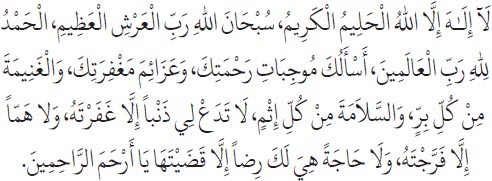
Lā ilāha illa-llāhu-l-Ḥalīmu-l-Karīm, Subḥāna-llāhi Rabbi-l-‘Arshi-l-‘aẓīm, al-ḥamdu li-llāhi Rabbi-l-‘ālamīn, as’aluka mūjibāti raḥmatik, wa ‘azā’ima maghfiratik, wa-l-ghanīmata min kulli birr, wa-s-salāmata min kulli ithm, lā tada‘ lī dhanban illā ghafartah, wa lā hamman illā farrajtah, wa lā ḥājatan hiya laka riḍan illā qaḍaytahā yā Arḥama-r-rāḥimīn.
I say: “It is mustaḥabb to supplicate with the du‘ā’ of distress and: O Allah, grant us good in this world and good in the Hereafter, and spare us the punishment of Hell-Fire” because of what we have previously narrated from the two Ṣaḥīḥ books about these two.

Allāhumma ātinā fi-d-dunyā ḥasanatan wa fi-l-ākhirati ḥasanatan wa qinā ‘adhāba-n-Nār.
We relate in the books of at-Tirmidhī and Ibn Mājah from ‘Uthmān ibn Ḥunayf , who narrated that a blind man came to the Prophet and said: “Supplicate to Allah to cure me.” He replied: “If you want, I will supplicate; or if you want, you can have patience and it will be better for you.” [The man] said: “Supplicate.” He [the Prophet ] told him to make wuḍū’ and to supplicate with this du‘ā’: “O Allah, I ask You and I turn to You through Your Prophet Muḥammad, the Prophet of Mercy. O Muḥammad, I have turned to my Lord through you in this need of mine, that it may be fulfilled for me. O Allah, let him intercede for me.” [2].At-Tirmidhī states that this hadith is ḥasan ṣaḥīḥ.
, who narrated that a blind man came to the Prophet and said: “Supplicate to Allah to cure me.” He replied: “If you want, I will supplicate; or if you want, you can have patience and it will be better for you.” [The man] said: “Supplicate.” He [the Prophet ] told him to make wuḍū’ and to supplicate with this du‘ā’: “O Allah, I ask You and I turn to You through Your Prophet Muḥammad, the Prophet of Mercy. O Muḥammad, I have turned to my Lord through you in this need of mine, that it may be fulfilled for me. O Allah, let him intercede for me.” [2].At-Tirmidhī states that this hadith is ḥasan ṣaḥīḥ.
Allāhumma innī as’aluka wa atawajjahu ilayka bi-Nabiyyika Muḥammad, Nabiyyi-r-raḥmah ṣalla-llāhu ‘alayhi wa sallam. Yā Muḥammadu innī tawajjahtu bika ilā Rabbī fī ḥājatī hādhihi li-tuqḍā lī, Allāhumma fa-shaffi‘hu fiyy.
References
[1] At-Tirmidhī (479), Ibn Mājah (1384), al-Ḥākim (1/320), and al-Futūḥāt (4/298–299). This hadith is weak.
[2] At-Tirmidhī (3573), Ibn Mājah (1385), and al-Ḥākim (1/313), who grades it as ṣaḥīḥ and adh-Dhahabī agrees.