
KNOW THAT IT is mustaḥabb to spend the nights preceding the ‘Īds in dhikr of Allah  , ṣalāh and other acts of obedience, because of the hadiths in this regard: “If a person spends the night of ‘Īd worshipping Allah, his heart will not die on the day when hearts die.” In another hadith [the Prophet
  ] said: “If a person has stayed up on the nights of the two ‘Īds to worship Allah, hoping for the reward thereof, his heart will not die on the day when hearts die.” Thus it is reported by ash-Shāfi‘ī and Ibn Mājah, [1].but it is a weak hadith which we have narrated in the version of Abū Umāmah in both marfū‘ and mawqūf form—both of which are weak. Nevertheless, it is permissible to practice on [the basis of] weak hadiths when they concern virtuous deeds, as we explained near the beginning of this book.
, ṣalāh and other acts of obedience, because of the hadiths in this regard: “If a person spends the night of ‘Īd worshipping Allah, his heart will not die on the day when hearts die.” In another hadith [the Prophet ] said: “If a person has stayed up on the nights of the two ‘Īds to worship Allah, hoping for the reward thereof, his heart will not die on the day when hearts die.” Thus it is reported by ash-Shāfi‘ī and Ibn Mājah, [1].but it is a weak hadith which we have narrated in the version of Abū Umāmah in both marfū‘ and mawqūf form—both of which are weak. Nevertheless, it is permissible to practice on [the basis of] weak hadiths when they concern virtuous deeds, as we explained near the beginning of this book.The ‘ulamā’ disagree about the amount by which spending the night in worship is accomplished. What is more apparently correct is that it has to be done for most of the night. Others say that is is accomplished by even one hour [of worship].
ON THE TIMES AND CIRCUMSTANCES IN WHICH TAKBĪR IS RECOMMENDED
It is mustaḥabb to say takbīr on the nights of the two ‘Īds. It is mustaḥabb on ‘Īd al-Fiṭr from sunset until the Imam starts the ṣalāh of ‘Īd. This is mustaḥabb after the ṣalāh and in all other situations. It should be increased when there is a crowd. One should say takbīr walking, sitting, lying down, in the street, in the mosque and in bed. On ‘Īd al-Aḍḥā the takbīr should be said after the Ṣubḥ ṣalāh on the Day of ‘Arafāt until praying the ṣalāh of ‘Aṣr on the last day of tashrīq. One says takbīr after ‘Aṣr, and then ceases.
This is the most correct [understanding] which is the basis of practice, although there is well-known disagreement amongst scholars both in our madhhab and others. But the correct opinion is what we have mentioned. There are hadiths about this that we have related from the Sunan of al-Bayhaqī, and I have explained all of that with regard to hadith and the transmission of the madhhab in Sharḥ al-Muhadhdhab, mentioning all the furū‘ discussions relating to them. Here my intention is only to allude to it in summary fashion.
According to our companions, the words of the takbīr are: Allah is greater, Allah is greater, Allah is greater. This should be said continually, and one may repeat it as much as he likes. Ash-Shāfi‘ī and his colleagues hold that if one adds anything to it he should say: Allah is greater, all praise is due to Allah, and glory be to Allah in the morning and in the evening. There is no god but Allah and we worship none but Him, fulfilling our religion sincerely for Him even though the disbelievers dislike it. There is no god but Allah, the One; He has fulfilled His promise and made His servant victorious and routed the tribes by Himself. There is no god but Allah and Allah is greater.
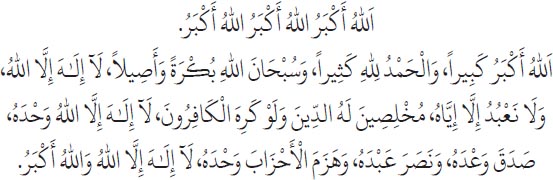
Allāhu akbaru Allāhu akbaru Allāhu akbar. Allāhu akbaru kabīrā, wa-l-ḥamdu li-llāhi kathīrā, wa Subḥāna-llāhi bukratan wa aṣīlā. Lā ilāha illa-llāh, wa lā na‘budu illā iyyāh, mukhliṣīna lahu-d-dīna wa law kariha-l-kāfirūn. Lā ilāha illa-llāhu waḥdah, ṣadaqa wa‘dah, wa naṣara ‘abdah, wa hazama-l-aḥzāba waḥdah. Lā ilāha illa-llāhu wa-llāhu akbar.
According to a group of our [Shāfi‘ī] colleagues there is no harm in saying what is customary among people, which is: Allah is greater, Allah is greater, Allah is greater. There is no god but Allah and Allah is greater. Allah is greater, and all praise is due to Allah.

Allāhu akbaru Allāhu akbaru Allāhu akbar. Lā ilāha illa-llāh, wa-llāhu akbar, Allāhu akbar, wa li-llāhi-l-ḥamd.
ONE MUST RECITE TAKBĪR AFTER EVERY PRAYER ON THE DAYS [ON WHICH IT IS CUTOMARY]
Know that the takbīrāt are prescribed after every ṣalāh that is performed on the days of the takbīr, whether it be wājib, nāfil or the funeral ṣalāh, and regardless of whether it be a compulsory ṣalāh performed in its proper time or a ṣalāh of which the due time has passed. This is not the proper place to mention the divergent views; the correct opinion is what I have mentioned, and the legal ruling is to act upon it.
If the Imam makes takbīr contrary to what the person following him believes [to be correct] because the Imam thought the takbīr should be done for the Day of ‘Arafāt or the ayyām at-tashrīq and the person following him did not think so, or vice versa, should one then follow the Imam or not? There are two views, according to our [Shāfi‘ī] colleagues. The more correct is to follow one’s conviction, because adherence to the Imam (qudwah) ends with the concluding salām of the ṣalāh, which does not apply if he does more takbīr in the ‘Īd prayer than the person following him thinks right—in which case he should be followed because of the qudwah.
ON THE TAKBĪRĀT AND KHUṬBAHS FOR THE TWO ‘ĪDS AND OF THE ADHKĀR FOR THOSE OCCASIONS
It is Sunnah to say additional takbīrāt in the ṣalāh of ‘Īd. In the first rak‘ah one should do seven takbīrāt besides the opening takbīr and five takbīrāt—besides the takbīr of rising from rukū‘—in the second. The takbīr in the first rak‘ah should be done after the opening du‘ā’ and before seeking protection. In the second it should be done before seeking protection. It is mustaḥabb to say between the takbīrāt: Glory be to Allah, all praise is due to Allah and there is no god but Allah and Allah is greater. That is the opinion of the majority of our [Shāfi‘ī] colleagues.

Subḥāna-llāh, wa-l-ḥamdu li-llāh, wa lā ilāha illa-llāh, wa-llāhu akbar.
Others of our colleagues hold that one should say: There is no god but Allah. He is Alone and has no partner. To Him belongs sovereignty and to Him belongs all praise. In His hands is all good and He has power over all things.
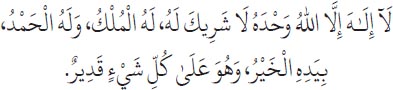
Lā ilāha illa-llāhu waḥdahu lā sharīka lah, lahu-l-mulk, wa lahu-l-ḥamd, bi-yadihi-l-khayr, wa Huwa ‘alā kulli shay’in qadīr.
Abū Naṣr aṣ-Ṣabbāgh and others stated that there is nothing wrong with what people are accustomed to say: Allah is greater, all praise is due to Allah, and glory be to Allah in the morning and in the evening.

Allāhu akbaru kabīrā, wa-l-ḥamdu li-llāhi kathīrā, wa Subḥāna-llāhi bukratan wa aṣīlā.
All of this [dhikr] is unlimited and unrestricted. If anyone leaves out all this dhikr and the seven or five takbīrāt, his ṣalāh will still be valid and he does not have to prostrate for forgetfulness, but he will have forfeited this immense merit. If one forgets the takbīrāt until after starting recitation, he does not have to return to the takbīrāt, according to the correct opinion. Ash-Shāfi‘ī has a weak opinion, which is that one should return to [the takbīrāt].
In the two sermons of the ṣalāh of ‘Īd it is mustaḥabb to say takbīr nine times in the first and seven times in the second [rak‘ah].
As for the recitation in the ṣalāh of ‘Īd, we have already explained what is mustaḥabb to recite in it in the chapter describing the adhkār of the ṣalāh. One should recite in the first rak‘ah, after al-Fātiḥah, Sūrah Qāf [2].and in the second Iqtarabati-s-sā‘ah, i.e. Sūrat al-Qamar. [3].If one wishes he may [instead] recite in the first Ṣabbihi-sma Rabbika-l-A‘lā; [4].and in the second Hal atāka ḥadīthu-l-Ghāshiyah. [5].
References
[1] Ibn Mājah (1782) and al-Futūḥāt (4/235). The author of az - Zawā ’ id states that this hadith’s chain is weak due to the tadlīs (concealing faults) of Baqiyyah. Ibn Ḥajar states that it is gharīb with a muḍṭarib (disturbed) chain.
[2] Qur’ān 50.
[3] Qur’ān 54.
[4] Qur’ān 87.
[5] Qur’ān 88.