
IT IS SUNNAH to scatter three handfuls of earth into the grave, all taken from the end where the head lies. A group of our colleagues say that it is mustaḥabb to say with the first handful “From it We have created you”, with the second “And into it We shall return you” and with the third “And from it We shall take you once more.” [1].

Minhā khalaqnākum, wa fīhā nu‘īdukum, wa minhā nukhrijukum tāratan ukhrā.
It is mustaḥabb, after completing the burial, to sit at the grave for the time it would take to slaughter a camel and distribute its meat. Those who sit should engage in the recitation of the Qur’ān, du‘ā’ for the deceased, admonition, stories of the virtuous people and the states of the righteous.
We relate in the Ṣaḥīḥs of al-Bukhārī and Muslim from ‘Alī  who reported: “We were with a funeral at Baqī‘ al-Gharqad. The Messenger of Allah
  came to us and sat and we sat down around him. He had a stick with him. He bent down and scratched the ground with the stick. Then he said: ‘There is none of you who does not have his place in Hell-Fire or his place in Paradise written.’ [Those present] said: ‘Messenger of Allah, should we not rely on what is written for us?’ He said: ‘Do good deeds, for everyone is given the ability to do what he has been created for’” [2].and he mentioned the full hadith.
who reported: “We were with a funeral at Baqī‘ al-Gharqad. The Messenger of Allah came to us and sat and we sat down around him. He had a stick with him. He bent down and scratched the ground with the stick. Then he said: ‘There is none of you who does not have his place in Hell-Fire or his place in Paradise written.’ [Those present] said: ‘Messenger of Allah, should we not rely on what is written for us?’ He said: ‘Do good deeds, for everyone is given the ability to do what he has been created for’” [2].and he mentioned the full hadith.We relate in the Ṣaḥīḥ of Muslim that ‘Amr ibn al-‘Āṣ said: “When you bury me, sit around my grave for as long as it takes to slaughter a camel and distribute its meat, so that I may listen to you and see how I should answer the Angels of my Lord.” [3].
said: “When you bury me, sit around my grave for as long as it takes to slaughter a camel and distribute its meat, so that I may listen to you and see how I should answer the Angels of my Lord.” [3].We relate with a ḥasan isnād from the Sunans of Abū Dāwūd and al-Bayhaqī from ‘Uthmān who recounted that when the Prophet had finished a burial he stood by the grave and said: “Ask for forgiveness for your brother and ask for steadfastness for him, for he is being questioned now.” [4].According to ash-Shāfi‘ī and his colleagues it is mustaḥabb to recite a portion of the Qur’ān by him. They said that if one recited all of the Qur’ān that would be good.
who recounted that when the Prophet had finished a burial he stood by the grave and said: “Ask for forgiveness for your brother and ask for steadfastness for him, for he is being questioned now.” [4].According to ash-Shāfi‘ī and his colleagues it is mustaḥabb to recite a portion of the Qur’ān by him. They said that if one recited all of the Qur’ān that would be good.We relate in the Sunan of al-Bayhaqī, with a ḥasan isnād, from Ibn ‘Umar  , that the Prophet used to like to recite the beginning and the end of Sūrat al-Baqarah. [5].
, that the Prophet used to like to recite the beginning and the end of Sūrat al-Baqarah. [5].THE RULING CONCERNING PROMPTING [THE DECEASED] AFTER BURIAL
Prompting (talqīn) the deceased is mustaḥabb according to many of our colleagues, such as al-Qādī al-Ḥusayn in his Ta‘līq, the companion of Abū Sa‘d al-Mutawallī in his book at-Tatmiyyah, the Shaykh and ascetic Imam Abū al-Fatḥ Naṣr ibn Ibrāhīm ibn Naṣr al-Maqdisī, Imam Abū al-Qāsim ar-Rāfi‘ī, and others. Qāḍi al-Ḥusayn has transmitted it from his colleagues. As for its wording, Shaykh Naṣr said that upon completion of the burial one should stand at the head [of the grave] and say: O So-and-so, remember the pact that you left the world with: the testimony that there is no god but Allah, One without partner, and that Muḥammad is His slave and Messenger; that the Hour is coming and there is no doubt of it; and that Allah will resurrect all who are in the grave. Say: ‘I am pleased with Allah as my Lord, with Islam as my religion, with Muḥammad as my Messenger, with the Ka‘bah as my qiblah, with the Qur’ān as my Imam and with the Muslims as my brothers. My Lord is Allah; there is no god but Him, and He is the Lord of the Mighty Throne.’ This is the wording of Shaykh Abū Naṣr al-Maqdisī in his book al-Tahdhīb, and the wording from the rest is similar. In the wording of others there are shortcomings (naqṣ). Some say: O slave of Allah, son [or daughter] of the female slave of Allah; some say: O slave of Allah, son [or daughter] of Ḥawwā’; some say: O So-and-so—using his name—son [or daughter] of the female slave of Allah; or O So-and-so son [or daughter] of Ḥawwā’—all of which have the same sense.
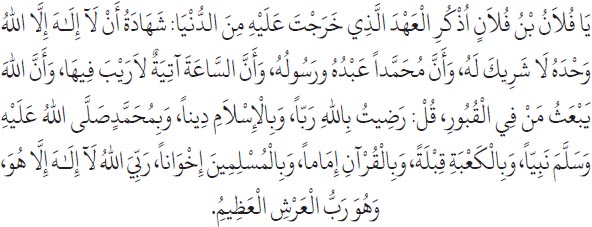
Yā (name) ibnu (father’s name) udhkuri-l-‘ahda-lladhī kharajta ‘alayhi mina-d-dunyā: shahādatu an lā ilāha illa-llāh waḥdahu lā sharīka lah, wa anna Muḥammadan ‘abduhu wa Rasūluh, wa anna-s-sā‘ata ātiyatun lā rayba fīhā, wa anna-llāha yab‘athu man fi-l-qubūr. Qul: Raḍītu bi-llāhi Rabbā, wa bi-l-Islāmi dīnā, wa bi-Muḥammadin ṣalla-llāhu ‘alayhi wa sallam Nabiyyā, wa bi-l-Ka‘bati qiblah, wa bi-l-Qur’āni imāmā, wa bi-l-Muslimīna ikhwānā, Rabbiya-llāhu lā ilāha illā Hū, wa Huwa Rabbu-l-‘Arshi-l-‘Aẓīm.
The Shaykh and Imam Abū ‘Amr ibn aṣ-Ṣalāḥ, may Allah have mercy on him, was asked regarding this type of talqīn, and he said in his fatāwā: “Talqīn is what we prefer and do. A group of our companions from Khurāsān say that there is a hadith from Abū Umāmah, although the isnād cannot be established. However, it is supported with evidences with the precedence of the early people of Shām. As for talqīn of a suckled child, there is no evidence that it can be taken for it and we do not support it.” But Allah knows best.
I say that no talqīn is to be done for a child, whether a breast-feeding baby or older, as long as he had not reached the age of puberty and become charged with responsibility. And Allah knows best.
References
[1] Qur’ān 20:55.
[2] Al-Bukhārī (1362), Muslim (2647), Abū Dāwūd (4694), and at-Tirmidhī (2137).
[3] Muslim (121).
[4] Abū Dāwūd (3221) and al-Bayhaqī (4/56). Ibn Ḥajar states that this hadith is ḥasan.
[5] Al-Bayhaqī (4/56). Ibn Ḥajar states that this hadith is mawqūf ḥasan.