
WE RELATE FROM the Ṣaḥīḥ of Muslim from Umm Salamah  who reported: “I heard the Messenger of Allah
  say: ‘There is no servant [of Allah] who has been afflicted with a calamity and then says: We are from Allah and to Him do we return (Qur’ān 2:156). O Allah, reward me for my affliction and give me something better in return for it without Allah rewarding him for his affliction and giving him something better than it.’” Umm Salamah also related: “When Abū Salamah passed away I said what the Messenger of Allah had instructed me to say, and Allah gave me someone better than Abū Salamah: the Messenger of Allah .” [1].
who reported: “I heard the Messenger of Allah say: ‘There is no servant [of Allah] who has been afflicted with a calamity and then says: We are from Allah and to Him do we return (Qur’ān 2:156). O Allah, reward me for my affliction and give me something better in return for it without Allah rewarding him for his affliction and giving him something better than it.’” Umm Salamah also related: “When Abū Salamah passed away I said what the Messenger of Allah had instructed me to say, and Allah gave me someone better than Abū Salamah: the Messenger of Allah .” [1].
Innā li-llāhi wa innā ilayhi rāji‘ūn. Allāhumma ajirnī fī muṣībatī wa akhlif lī khayran minhā.
We relate in the Sunan of Abū Dāwūd from Umm Salamah who related that the Messenger of Allah said: “If any of you is afflicted with a calamity let him say: We are from Allah and to Him do we return. O Allah, from You I hope for the reward for my calamity, so reward me for it and give me in exchange something better than it.” [2].
who related that the Messenger of Allah said: “If any of you is afflicted with a calamity let him say: We are from Allah and to Him do we return. O Allah, from You I hope for the reward for my calamity, so reward me for it and give me in exchange something better than it.” [2].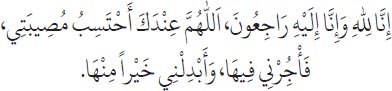
Innā li-llāhi wa innā ilayhi rāji‘ūn, Allāhumma ‘indaka aḥtasibu muṣībatī, fa-’jurnī fīhā, wa abdilnī khayran minhā.
We relate in the books of at-Tirmidhī and others from Abū Mūsā al-Ash‘arī  , who reported that the Messenger of Allah said: “When the son of a servant [of Allah] passes away, Allah
  asks His angels: ‘Have you taken the son of My servant?’ They reply: ‘Yes.’ He asks: ‘Did you take away the fruit of his heart?’ They reply: ‘Yes.’ He asks: ‘What did My servant say?’ They reply: ‘He praised You and said: “Verily we are from Allah and to Him do we return.”’ Allah says: ‘Build a house for My servant in Paradise and name it the House of Praise.’” [3].At-Tirmidhī describes this hadith as ḥasan. Its meaning is that which we relate from the Ṣaḥīḥ of al-Bukhārī.
, who reported that the Messenger of Allah said: “When the son of a servant [of Allah] passes away, Allah asks His angels: ‘Have you taken the son of My servant?’ They reply: ‘Yes.’ He asks: ‘Did you take away the fruit of his heart?’ They reply: ‘Yes.’ He asks: ‘What did My servant say?’ They reply: ‘He praised You and said: “Verily we are from Allah and to Him do we return.”’ Allah says: ‘Build a house for My servant in Paradise and name it the House of Praise.’” [3].At-Tirmidhī describes this hadith as ḥasan. Its meaning is that which we relate from the Ṣaḥīḥ of al-Bukhārī.Abū Hurayrah reported that the Messenger of Allah said: “Allah says: ‘There is no other reward for My servant, when I take away his bosom friend out of all the people of the world, than Paradise.” [4].
reported that the Messenger of Allah said: “Allah says: ‘There is no other reward for My servant, when I take away his bosom friend out of all the people of the world, than Paradise.” [4].References
[1] Muslim (918), Abū Dāwūd (3115), an-Nasā’ī (1069) in ‘Amal al-yawm wa al-laylah.
[2] Abū Dāwūd (3119).
[3] At-Tirmidhī (1021).
[4] Al-Bukhārī (6424).